A rural child specialist has to find the weight of five children of different ages. He knows from past experience that each of the children weighs less than 30 Kg, and all five weigh different amounts. Unfortunately, the scale available in the village can measure weight only over 30 Kg, so the doctor decides to weigh the children in pairs. His new assistant weighed the children without noting down the names. The ten weights recorded were: 35, 36, 37, 39, 40, 41, 42, 45, 46 and 47 Kg. The weight of the lightest child is:
Show Hint
- 15 Kg.
- 16 Kg.
- 17 Kg.
- 18 Kg.
The Correct Option is B
Solution and Explanation
There are $\binom{5}{2}=10$ pairs from 5 children, matching the 10 recorded weights, and each child's own weight shows up in exactly 4 of those pair sums, since each child is paired once with each of the other four. So adding all ten numbers counts every child's weight four times over.
Sum of the ten weights: $35+36+37+39+40+41+42+45+46+47 = 408$. Dividing by 4, the five children together weigh $408/4 = 102$ Kg.
Now test the answer choices directly. Suppose the lightest child weighs $w_1$. The smallest recorded pair-sum, 35, has to be $w_1$ plus the second-lightest child, so the second-lightest weighs $35 - w_1$. The next smallest sum, 36, has to be $w_1$ paired with the third child, since pairing the lightest with anyone beats any pair that leaves the lightest out, so the third child weighs $36 - w_1$.
Using the total of 102 Kg: the three heaviest children together weigh $102 - 35 = 67$ Kg (removing the two lightest), and the two lightest plus the third child together weigh $102 - 47 = 55$ Kg (removing the two heaviest, since 47 is the largest recorded sum).
Try $w_1 = 16$: the second child is $35 - 16 = 19$. From $w_1+w_2+w_3=55$, the third child is $55 - 16 - 19 = 20$. Check the pair $w_1+w_3 = 16+20=36$, exactly the second-smallest recorded sum, so this guess holds up so far.
The remaining two weights come from $w_3+w_4+w_5=67$, so $w_4+w_5=47$ (matching the largest recorded sum). Using the second-largest sum, $w_3+w_5=46$, gives $w_5=26$, then $w_4=21$.
The five weights, 16, 19, 20, 21 and 26, reproduce every one of the ten given sums (35, 36, 37, 39, 40, 41, 42, 45, 46, 47) with nothing left over, so this guess is fully consistent. Trying 15, 17 or 18 instead of 16 breaks this chain of checks at some step, since the derived numbers stop matching the full list of ten sums.
So the lightest child weighs 16 Kg.
Top Questions on Number System
- Find the number of integers \(n\) such that \(1 \leq n \leq 100\) and \(n^2 + 3n + 2\) is divisible by 5.
- BITSAT - 2025
- Mathematics
- Number System
- Find the smallest number between 2000 and 3000 that is exactly divisible by 21, 24 and 28.
- SNAP - 2024
- Quantitative Aptitude
- Number System
- Based on the given pattern find the next term of the given series: 5, 6, 16, 57, 244, 1245, ?
- SNAP - 2024
- Quantitative Aptitude
- Number System
- There are 3 different types of rice weighing \(435,\ 493,\) and \(551\) kg respectively. The rice is packed in bags so that no two types are mixed and all bags are of equal size. Find the least number of bags.
- SNAP - 2024
- Quantitative Aptitude
- Number System
- Want to practice more? Try solving extra ecology questions todayView All Questions
Questions Asked in XAT exam
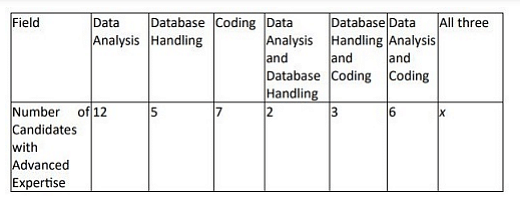
The number of applicants with advanced expertise in all three fields is given as x in the table, where x is a non-negative integer.
- XAT - 2024
- Data Interpretation