A family consists of the father, the mother, two sons and the youngest daughter. The father's age is four times the age of the second son. The first son's age is in the ratio \(3:1\) with that of his sister. The mother is \(3.5\) times as old as the second son. The second son's age is \(\frac{2}{3}\) of the first son's age. The youngest daughter is 5 years old. Find the sum of all their ages.
Show Hint
- 115 yrs
- 105 yrs
- 205 yrs
- 210 yrs
The Correct Option is B
Solution and Explanation
Let's solve this by taking the second son's age as the base variable and building every other age from it, instead of starting from the daughter as before.
We know the daughter's age directly: \(D = 5\) years.
The problem says the second son's age is two thirds of the first son's age, so if we call the second son's age \(x\), then:
\[ x = \frac{2}{3}S_1 \implies S_1 = \frac{3x}{2} \]We are also told the first son and his sister are in the ratio 3:1, meaning \(S_1 = 3D = 15\). Since \(S_1 = \frac{3x}{2}\), we get:
\[ \frac{3x}{2} = 15 \implies x = 10 \]So the second son's age is \(x = 10\) years, which fixes the first son at \(S_1 = 15\) years.
The father is four times the second son's age: \(F = 4x = 4 \times 10 = 40\) years.
The mother is 3.5 times the second son's age: \(M = 3.5x = 35\) years.
Adding every member's age, father (40) plus mother (35) plus first son (15) plus second son (10) plus daughter (5):
\[ 40+35+15+10+5 = 105 \]This matches only option (2). The other totals, 115, 205 and 210, do not correspond to any consistent set of ages built from the given ratios, so they can be ruled out.
\[ \boxed{105 \text{ years}} \]Top Questions on Ratio and Proportion
- There are 187 fruits in total. The ratio of apples to mangoes is \(2 : 3\), and the rest are oranges. After selling 67 apples, 26 mangoes, and half of the oranges, the ratio of the remaining apples to oranges becomes \(1 : 2\). Determine how many unsold fruits remain.
- CAT - 2024
- Quantitative Aptitude
- Ratio and Proportion
- A mixture P is formed by removing a certain amount of coffee from a coffee jar and replacing the same amount with cocoa powder and the same amount is again removed from P and replaced with the same amount of cocoa powder to form a mixture Q. If the ratio of coffee and cocoa in Q=16:9. Then the ratio of coca in with P:Q is?
- CAT - 2023
- Quantitative Aptitude
- Ratio and Proportion
- In a company, 20% of the employees work in the manufacturing department. If the total salary obtained by all the manufacturing employees is one-sixth of the total salary obtained by all the employees in the company, then the ratio of the average salary obtained by the manufacturing employees to the average salary obtained by the non-manufacturing employees is
- CAT - 2023
- Quantitative Aptitude
- Ratio and Proportion
- If a certain amount of money is divided equally among n persons, each one receives Rs 352 . However, if two persons receive Rs 506 each and the remaining amount is divided equally among the other persons, each of them receive less than or equal to Rs 330 . Then, the maximum possible value of n is
- CAT - 2023
- Quantitative Aptitude
- Ratio and Proportion
- Want to practice more? Try solving extra ecology questions todayView All Questions
Questions Asked in XAT exam
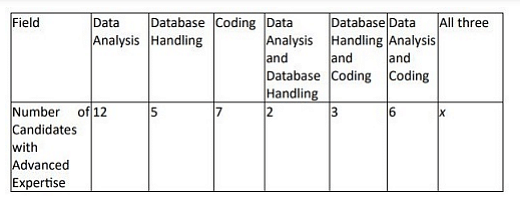
The number of applicants with advanced expertise in all three fields is given as x in the table, where x is a non-negative integer.
- XAT - 2024
- Data Interpretation