Question:medium
A double convex lens made of glass of refractive index \(1.5\) and radii of curvature \(20\,\text{cm}\) each is immersed in a liquid of refractive index \(n_L\). The correct plot showing the variation of the power, in the units of diopter \((D)\), as a function of \(n_L\), is:
A double convex lens made of glass of refractive index \(1.5\) and radii of curvature \(20\,\text{cm}\) each is immersed in a liquid of refractive index \(n_L\). The correct plot showing the variation of the power, in the units of diopter \((D)\), as a function of \(n_L\), is:
Show Hint
Power of a lens in a medium:
\[
P=
\left(\frac{n_g}{n_m}-1\right)
\left(\frac1{R_1}-\frac1{R_2}\right)
\]
If surrounding medium has larger refractive index than the lens, the lens may behave like a concave lens.
Updated On: Jun 4, 2026


Show Solution
The Correct Option is C
Solution and Explanation
Step 1: Understanding the Concept:
Power \( P \) is given by Lens Maker's Formula: \( P = \frac{1}{f} = \left(\frac{n_{lens}}{n_{medium}} - 1\right) \left(\frac{1}{R_1} - \frac{1}{R_2}\right) \).
Step 3: Detailed Explanation:
1) Substituting values:
\( R_1 = 20 \text{ cm} = 0.2 \text{ m} \), \( R_2 = -20 \text{ cm} = -0.2 \text{ m} \).
\( \frac{1}{R_1} - \frac{1}{R_2} = \frac{1}{0.2} + \frac{1}{0.2} = 10 \text{ m}^{-1} \).
\( P(n_L) = \left(\frac{1.5}{n_L} - 1\right) \times 10 = \frac{15}{n_L} - 10 \).
2) Analyzing the function:
- At \( n_L = 1 \) (air): \( P = 15 - 10 = 5 D \).
- At \( n_L = 1.5 \) (liquid same as lens): \( P = 0 \).
- As \( n_L \to \infty \), \( P \to -10 \).
- Derivative \( P' = -15/n_L^2<0 \) (decreasing).
- Second derivative \( P'' = 30/n_L^3>0 \) (concave upwards).
Step 4: Final Answer:
The graph in option (A) matches these characteristics.
Power \( P \) is given by Lens Maker's Formula: \( P = \frac{1}{f} = \left(\frac{n_{lens}}{n_{medium}} - 1\right) \left(\frac{1}{R_1} - \frac{1}{R_2}\right) \).
Step 3: Detailed Explanation:
1) Substituting values:
\( R_1 = 20 \text{ cm} = 0.2 \text{ m} \), \( R_2 = -20 \text{ cm} = -0.2 \text{ m} \).
\( \frac{1}{R_1} - \frac{1}{R_2} = \frac{1}{0.2} + \frac{1}{0.2} = 10 \text{ m}^{-1} \).
\( P(n_L) = \left(\frac{1.5}{n_L} - 1\right) \times 10 = \frac{15}{n_L} - 10 \).
2) Analyzing the function:
- At \( n_L = 1 \) (air): \( P = 15 - 10 = 5 D \).
- At \( n_L = 1.5 \) (liquid same as lens): \( P = 0 \).
- As \( n_L \to \infty \), \( P \to -10 \).
- Derivative \( P' = -15/n_L^2<0 \) (decreasing).
- Second derivative \( P'' = 30/n_L^3>0 \) (concave upwards).
Step 4: Final Answer:
The graph in option (A) matches these characteristics.
Was this answer helpful?
2
Top Questions on Ray optics and optical instruments
- A light ray passes from air (refractive index = 1) into water (refractive index = 1.33). If the angle of incidence is 30°, what is the angle of refraction in water?
- MHT CET - 2025
- Physics
- Ray optics and optical instruments
- A convex lens has a focal length of 20 cm. An object is placed 30 cm in front of the lens. What is the image distance from the lens?
- MHT CET - 2025
- Physics
- Ray optics and optical instruments
- A lens has focal length $ f = 20 \, \text{cm} $. What is the power of the lens?
- MHT CET - 2025
- Physics
- Ray optics and optical instruments
- An object is placed at a distance of 10 cm from a concave mirror of focal length 15 cm. What is the image distance?
- MHT CET - 2025
- Physics
- Ray optics and optical instruments
- Want to practice more? Try solving extra ecology questions todayView All Questions
Questions Asked in JEE Advanced exam
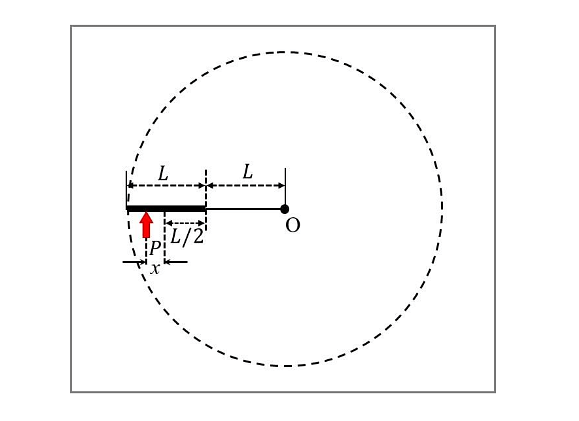
A thin uniform rod of length L and certain mass is kept on a frictionless horizontal table with a massless string of length L fixed to one end (top view is shown in the figure). The other end of the string is pivoted to a point O. If a horizontal impulse P is imparted to the rod at a distance x = L/n from the mid-point of the rod (see figure), then the rod and string revolve together around the point O, with the rod remaining aligned with the string. In such a case, the value of n is _____.
- JEE Advanced - 2024
- Friction