Question:medium
Two cylinders, both fitted with frictionless pistons, are filled with mixtures of He and Ar gases. In the first cylinder, the masses of He and Ar are \(m_1\) and \(m_2\), respectively. In the second cylinder, the masses of He and Ar are \(m_2\) and \(m_1\), respectively. The molar mass of Ar is \(10\) times the molar mass of He. The external pressure applied by the piston on the first cylinder needs to be \(5\) times that on the second cylinder so that the volume of the gas mixtures in both the cylinders are equal at the same temperature. Assuming He and Ar behave like ideal gases, the value of \(\left(\dfrac{m_1}{m_2}\right)\) is ____.
Two cylinders, both fitted with frictionless pistons, are filled with mixtures of He and Ar gases. In the first cylinder, the masses of He and Ar are \(m_1\) and \(m_2\), respectively. In the second cylinder, the masses of He and Ar are \(m_2\) and \(m_1\), respectively. The molar mass of Ar is \(10\) times the molar mass of He. The external pressure applied by the piston on the first cylinder needs to be \(5\) times that on the second cylinder so that the volume of the gas mixtures in both the cylinders are equal at the same temperature. Assuming He and Ar behave like ideal gases, the value of \(\left(\dfrac{m_1}{m_2}\right)\) is ____.
Show Hint
At equal V and T, n is proportional to P. So total moles in cylinder 1 are 5 times those in cylinder 2.
Updated On: Nov 19, 2026
Show Solution
Correct Answer: 9.8
Solution and Explanation
Step 1: Count the gas in units of m2/M:
Let $x = \dfrac{m_1}{m_2}$ and let $M$ be the molar mass of He, so Ar is $10M$.
Cylinder 1 holds $\dfrac{m_2}{M}\left(x + \dfrac{1}{10}\right)$ mol. Cylinder 2 holds $\dfrac{m_2}{M}\left(1 + \dfrac{x}{10}\right)$ mol.
Step 2: Link pressure with the amount of gas:
The volume and the temperature are the same in both. So the pressure that the piston must supply is in direct proportion to the moles inside.
The first cylinder needs 5 times the pressure, so it has 5 times the moles.
Step 3: Form the equation:
\[ x + 0.1 = 5\,(1 + 0.1x) \]
\[ x + 0.1 = 5 + 0.5x \ \Rightarrow\ 0.5x = 4.9 \ \Rightarrow\ x = 9.8 \]
Final Answer:
The ratio $m_1/m_2$ is 9.8. \[ \boxed{\dfrac{m_1}{m_2} = 9.8} \]
Was this answer helpful?
0
Top Questions on States of matter
- What is the oxidation state of Fe in \( \mathrm{Fe_3O_4} \)?
- MHT CET - 2024
- Physics
- States of matter
- Convert 72 degrees Celsius to Fahrenheit.
- MHT CET - 2024
- Physics
- States of matter
- How many lattice points are there in a Body-Centered Cubic (BCC) structure?
- MHT CET - 2024
- Chemistry
- States of matter
- What is the molar mass of a gas, if 2.5 g of the gas occupies 1.12 L at STP?
- MHT CET - 2025
- Chemistry
- States of matter
- Want to practice more? Try solving extra ecology questions todayView All Questions
Questions Asked in JEE Advanced exam
A thin uniform rod of length L and certain mass is kept on a frictionless horizontal table with a massless string of length L fixed to one end (top view is shown in the figure). The other end of the string is pivoted to a point O. If a horizontal impulse P is imparted to the rod at a distance x = L/n from the mid-point of the rod (see figure), then the rod and string revolve together around the point O, with the rod remaining aligned with the string. In such a case, the value of n is _____.
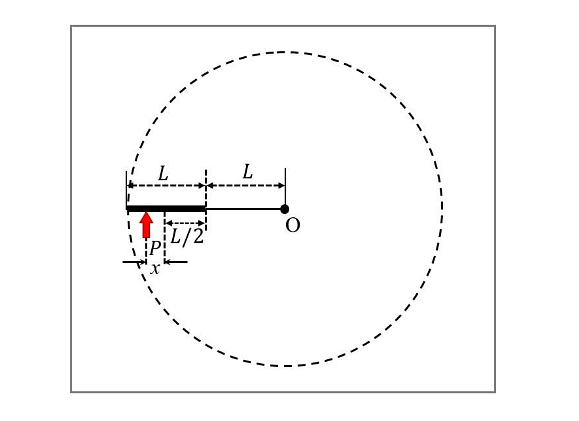
- JEE Advanced - 2024
- Friction