Question:medium
Two cylinders, both fitted with frictionless pistons, are filled with mixtures of He and Ar gases. In the first cylinder, the masses of He and Ar are \(m_1\) and \(m_2\), respectively. In the second cylinder, the masses of He and Ar are \(m_2\) and \(m_1\), respectively. The molar mass of Ar is \(10\) times the molar mass of He. The external pressure applied by the piston on the first cylinder needs to be \(5\) times that on the second cylinder so that the volume of the gas mixtures in both the cylinders are equal at the same temperature. Assuming He and Ar behave like ideal gases, the value of \(\left(\dfrac{m_1}{m_2}\right)\) is ____.
Two cylinders, both fitted with frictionless pistons, are filled with mixtures of He and Ar gases. In the first cylinder, the masses of He and Ar are \(m_1\) and \(m_2\), respectively. In the second cylinder, the masses of He and Ar are \(m_2\) and \(m_1\), respectively. The molar mass of Ar is \(10\) times the molar mass of He. The external pressure applied by the piston on the first cylinder needs to be \(5\) times that on the second cylinder so that the volume of the gas mixtures in both the cylinders are equal at the same temperature. Assuming He and Ar behave like ideal gases, the value of \(\left(\dfrac{m_1}{m_2}\right)\) is ____.
Show Hint
Since volume and temperature are the same for both cylinders, use PV=nRT to turn the given pressure ratio directly into a mole ratio, n1/n2 = P1/P2. Write the total moles in each cylinder as the sum of moles of He and Ar, using the given relation between their molar masses. To save algebra, introduce the required ratio m1/m2 as a single unknown from the start rather than solving for m1 and m2 separately.
Updated On: Aug 17, 2026
Show Solution
Solution and Explanation
Step 1: Understanding the Concept:
This problem centers on the Ideal Gas Equation and the behavior of gas mixtures.
According to the Ideal Gas Law, the volume of a gas or a mixture of gases is determined by the total number of moles, the temperature, and the pressure: \[ PV = n_{\text{total}}RT \] Since the gases (Helium and Argon) are both noble gases and are assumed to behave ideally, we can calculate the total moles in each cylinder by summing the moles of each individual component.
The core relationship given here is that the volume (\(V\)) and temperature (\(T\)) are identical for both systems.
This implies that the ratio of the total number of moles to the pressure must be the same for both cylinders.
Step 2: Key Formula or Approach:
Let \(M_{\text{He}}\) be the molar mass of Helium and \(M_{\text{Ar}}\) be the molar mass of Argon.
We are given: \(M_{\text{Ar}} = 10 \cdot M_{\text{He}}\).
For Cylinder 1: \[ n_1 = \frac{m_1}{M_{\text{He}}} + \frac{m_2}{M_{\text{Ar}}} = \frac{m_1}{M_{\text{He}}} + \frac{m_2}{10M_{\text{He}}} = \frac{10m_1 + m_2}{10M_{\text{He}}} \] For Cylinder 2: \[ n_2 = \frac{m_2}{M_{\text{He}}} + \frac{m_1}{M_{\text{Ar}}} = \frac{m_2}{M_{\text{He}}} + \frac{m_1}{10M_{\text{He}}} = \frac{10m_2 + m_1}{10M_{\text{He}}} \] From the Ideal Gas Law: \( V = \frac{nRT}{P} \).
Given \(V_1 = V_2\) and \(T_1 = T_2\), we have: \[ \frac{n_1}{P_1} = \frac{n_2}{P_2} \] Step 3: Detailed Explanation:
We are given the pressure condition: \(P_1 = 5P_2\).
Substituting the values of \(n_1, n_2,\) and \(P_1\) into the equality: \[ \frac{\left( \frac{10m_1 + m_2}{10M_{\text{He}}} \right)}{5P_2} = \frac{\left( \frac{10m_2 + m_1}{10M_{\text{He}}} \right)}{P_2} \] We can cancel out the common terms \(10M_{\text{He}}\) and \(P_2\) from both sides: \[ \frac{10m_1 + m_2}{5} = 10m_2 + m_1 \] Now, multiply both sides by 5 to clear the fraction: \[ 10m_1 + m_2 = 5(10m_2 + m_1) \] \[ 10m_1 + m_2 = 50m_2 + 5m_1 \] Rearrange the terms to group \(m_1\) on one side and \(m_2\) on the other: \[ 10m_1 - 5m_1 = 50m_2 - m_2 \] \[ 5m_1 = 49m_2 \] The ratio \((m_1/m_2)\) is therefore: \[ \frac{m_1}{m_2} = \frac{49}{5} = 9.8 \]
Step 4: Final Answer:
By equating the volume-to-temperature ratios for both ideal gas mixtures, we find that the ratio of the masses \(m_1/m_2\) is exactly 9.8.
This problem centers on the Ideal Gas Equation and the behavior of gas mixtures.
According to the Ideal Gas Law, the volume of a gas or a mixture of gases is determined by the total number of moles, the temperature, and the pressure: \[ PV = n_{\text{total}}RT \] Since the gases (Helium and Argon) are both noble gases and are assumed to behave ideally, we can calculate the total moles in each cylinder by summing the moles of each individual component.
The core relationship given here is that the volume (\(V\)) and temperature (\(T\)) are identical for both systems.
This implies that the ratio of the total number of moles to the pressure must be the same for both cylinders.
Step 2: Key Formula or Approach:
Let \(M_{\text{He}}\) be the molar mass of Helium and \(M_{\text{Ar}}\) be the molar mass of Argon.
We are given: \(M_{\text{Ar}} = 10 \cdot M_{\text{He}}\).
For Cylinder 1: \[ n_1 = \frac{m_1}{M_{\text{He}}} + \frac{m_2}{M_{\text{Ar}}} = \frac{m_1}{M_{\text{He}}} + \frac{m_2}{10M_{\text{He}}} = \frac{10m_1 + m_2}{10M_{\text{He}}} \] For Cylinder 2: \[ n_2 = \frac{m_2}{M_{\text{He}}} + \frac{m_1}{M_{\text{Ar}}} = \frac{m_2}{M_{\text{He}}} + \frac{m_1}{10M_{\text{He}}} = \frac{10m_2 + m_1}{10M_{\text{He}}} \] From the Ideal Gas Law: \( V = \frac{nRT}{P} \).
Given \(V_1 = V_2\) and \(T_1 = T_2\), we have: \[ \frac{n_1}{P_1} = \frac{n_2}{P_2} \] Step 3: Detailed Explanation:
We are given the pressure condition: \(P_1 = 5P_2\).
Substituting the values of \(n_1, n_2,\) and \(P_1\) into the equality: \[ \frac{\left( \frac{10m_1 + m_2}{10M_{\text{He}}} \right)}{5P_2} = \frac{\left( \frac{10m_2 + m_1}{10M_{\text{He}}} \right)}{P_2} \] We can cancel out the common terms \(10M_{\text{He}}\) and \(P_2\) from both sides: \[ \frac{10m_1 + m_2}{5} = 10m_2 + m_1 \] Now, multiply both sides by 5 to clear the fraction: \[ 10m_1 + m_2 = 5(10m_2 + m_1) \] \[ 10m_1 + m_2 = 50m_2 + 5m_1 \] Rearrange the terms to group \(m_1\) on one side and \(m_2\) on the other: \[ 10m_1 - 5m_1 = 50m_2 - m_2 \] \[ 5m_1 = 49m_2 \] The ratio \((m_1/m_2)\) is therefore: \[ \frac{m_1}{m_2} = \frac{49}{5} = 9.8 \]
Step 4: Final Answer:
By equating the volume-to-temperature ratios for both ideal gas mixtures, we find that the ratio of the masses \(m_1/m_2\) is exactly 9.8.
Was this answer helpful?
0
Top Questions on States of matter
- What is the oxidation state of Fe in \( \mathrm{Fe_3O_4} \)?
- MHT CET - 2024
- Physics
- States of matter
- Convert 72 degrees Celsius to Fahrenheit.
- MHT CET - 2024
- Physics
- States of matter
- How many lattice points are there in a Body-Centered Cubic (BCC) structure?
- MHT CET - 2024
- Chemistry
- States of matter
- What is the molar mass of a gas, if 2.5 g of the gas occupies 1.12 L at STP?
- MHT CET - 2025
- Chemistry
- States of matter
- Want to practice more? Try solving extra ecology questions todayView All Questions
Questions Asked in JEE Advanced exam
A thin uniform rod of length L and certain mass is kept on a frictionless horizontal table with a massless string of length L fixed to one end (top view is shown in the figure). The other end of the string is pivoted to a point O. If a horizontal impulse P is imparted to the rod at a distance x = L/n from the mid-point of the rod (see figure), then the rod and string revolve together around the point O, with the rod remaining aligned with the string. In such a case, the value of n is _____.
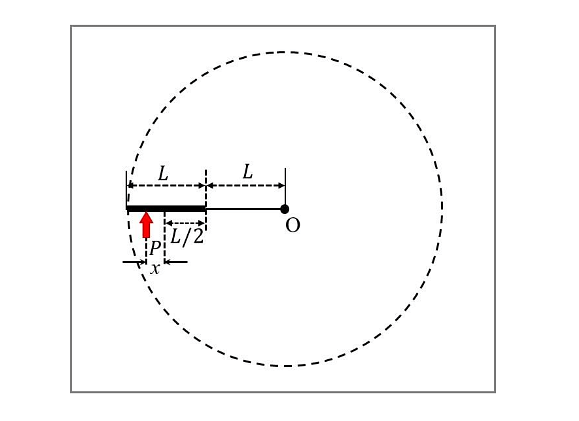
- JEE Advanced - 2024
- Friction