Question:medium
Treatment of buta-\(1,3\)-diyne with \(\mathrm{NaNH_2}\) (2 equivalents), followed by reaction with excess of trans-\(\mathrm{CH_3-CH=CH-CH_2-Br}\) gives \(X\) as the major product. The maximum number of carbon atoms that are collinear (in a straight line) in \(X\) is ____.
Treatment of buta-\(1,3\)-diyne with \(\mathrm{NaNH_2}\) (2 equivalents), followed by reaction with excess of trans-\(\mathrm{CH_3-CH=CH-CH_2-Br}\) gives \(X\) as the major product. The maximum number of carbon atoms that are collinear (in a straight line) in \(X\) is ____.
Show Hint
Remember:
\[
sp \text{-hybridized carbons}
\]
have bond angle:
\[
180^\circ
\]
Hence long chains containing consecutive:
\[
\mathrm{C{\equiv}C}
\]
units tend to become linear.
While counting collinear atoms:
• identify all \(sp\)-hybridized carbons
• extend the straight line as far as geometry permits
• identify all \(sp\)-hybridized carbons
• extend the straight line as far as geometry permits
Updated On: Jun 4, 2026
Show Solution
Correct Answer: 8
Solution and Explanation
Step 1: Understanding the Concept:
This question tests knowledge of terminal alkyne acidity, nucleophilic substitution, and molecular geometry.
Terminal alkynes ( \(-C\equiv C-H\) ) have acidic protons. Strong bases like sodamide (NaNH\(_2\)) can deprotonate them to form alkynide anions, which are excellent nucleophiles. These anions can then undergo \(S_N2\) reactions with primary alkyl halides.
Regarding geometry: Carbon atoms involved in a triple bond (\(sp\) hybridized) and the atoms directly attached to them are collinear (180\(^{\circ}\) bond angle).
Step 2: Key Formula or Approach:
1. Identify the structure of buta-1,3-diyne: \(H-C\equiv C-C\equiv C-H\). 2. Determine the result of deprotonation with 2 equivalents of NaNH\(_2\): \(Na^{+-}C\equiv C-C\equiv C^-Na^+\). 3. Perform the \(S_N2\) reaction with the alkyl bromide: Alkyl group: \(CH_3-CH=CH-CH_2-\).
Step 3: Detailed Explanation:
The reaction sequence is: \[ H-C\equiv C-C\equiv C-H \xrightarrow{2 NaNH_2} Na^+ C\equiv C-C\equiv C^- Na^+ \] \[ \dots \xrightarrow{\text{excess } R-Br} R-C\equiv C-C\equiv C-R \] where \(R = -CH_2-CH=CH-CH_3\). Full structure of X: \[ CH_3-CH=CH-CH_2-C\equiv C-C\equiv C-CH_2-CH=CH-CH_3 \] Analyzing Collinearity: The atoms that are collinear in an alkyne system include the two carbons of the triple bond and the atoms bonded to them. For a conjugated diyne system \(R-C_a\equiv C_b-C_c\equiv C_d-R'\): - The atoms bonded to \(C_a\) and \(C_d\) are also on the same line as the diyne axis. - Let's look at the specific atoms in X: (C5) of the R group - \(\mathbf{C4 - C3 - C2 - C1}\) (diyne) - (C5') of the second R group. Specifically, the carbon of the \(CH_2\) group attached to the triple bond is part of the linear chain. So, the chain is: \( (sp^3 \text{ carbon of } CH_2) - (sp \text{ carbon}) \equiv (sp \text{ carbon}) - (sp \text{ carbon}) \equiv (sp \text{ carbon}) - (sp^3 \text{ carbon of } CH_2) \). Total number of collinear carbon atoms = 1 (from first R) + 4 (from diyne) + 1 (from second R) = 6 carbons.
Step 4: Final Answer:
In the molecule X, the four \(sp\) hybridized carbons of the central diyne unit and the two \(sp^3\) hybridized carbons directly attached to them form a perfectly linear arrangement of 6 carbon atoms.
This question tests knowledge of terminal alkyne acidity, nucleophilic substitution, and molecular geometry.
Terminal alkynes ( \(-C\equiv C-H\) ) have acidic protons. Strong bases like sodamide (NaNH\(_2\)) can deprotonate them to form alkynide anions, which are excellent nucleophiles. These anions can then undergo \(S_N2\) reactions with primary alkyl halides.
Regarding geometry: Carbon atoms involved in a triple bond (\(sp\) hybridized) and the atoms directly attached to them are collinear (180\(^{\circ}\) bond angle).
Step 2: Key Formula or Approach:
1. Identify the structure of buta-1,3-diyne: \(H-C\equiv C-C\equiv C-H\). 2. Determine the result of deprotonation with 2 equivalents of NaNH\(_2\): \(Na^{+-}C\equiv C-C\equiv C^-Na^+\). 3. Perform the \(S_N2\) reaction with the alkyl bromide: Alkyl group: \(CH_3-CH=CH-CH_2-\).
Step 3: Detailed Explanation:
The reaction sequence is: \[ H-C\equiv C-C\equiv C-H \xrightarrow{2 NaNH_2} Na^+ C\equiv C-C\equiv C^- Na^+ \] \[ \dots \xrightarrow{\text{excess } R-Br} R-C\equiv C-C\equiv C-R \] where \(R = -CH_2-CH=CH-CH_3\). Full structure of X: \[ CH_3-CH=CH-CH_2-C\equiv C-C\equiv C-CH_2-CH=CH-CH_3 \] Analyzing Collinearity: The atoms that are collinear in an alkyne system include the two carbons of the triple bond and the atoms bonded to them. For a conjugated diyne system \(R-C_a\equiv C_b-C_c\equiv C_d-R'\): - The atoms bonded to \(C_a\) and \(C_d\) are also on the same line as the diyne axis. - Let's look at the specific atoms in X: (C5) of the R group - \(\mathbf{C4 - C3 - C2 - C1}\) (diyne) - (C5') of the second R group. Specifically, the carbon of the \(CH_2\) group attached to the triple bond is part of the linear chain. So, the chain is: \( (sp^3 \text{ carbon of } CH_2) - (sp \text{ carbon}) \equiv (sp \text{ carbon}) - (sp \text{ carbon}) \equiv (sp \text{ carbon}) - (sp^3 \text{ carbon of } CH_2) \). Total number of collinear carbon atoms = 1 (from first R) + 4 (from diyne) + 1 (from second R) = 6 carbons.
Step 4: Final Answer:
In the molecule X, the four \(sp\) hybridized carbons of the central diyne unit and the two \(sp^3\) hybridized carbons directly attached to them form a perfectly linear arrangement of 6 carbon atoms.
Was this answer helpful?
0
Top Questions on Hydrocarbons
- What are the 4 types of hydrocarbons?
- MHT CET - 2024
- Chemistry
- Hydrocarbons
- Which of the following is an example of an alkene?
- MHT CET - 2025
- Chemistry
- Hydrocarbons
- Which of the following is an alkene?
- BITSAT - 2025
- Chemistry
- Hydrocarbons
Major products A and B formed in the following reaction sequence , are

- NEET (UG) - 2024
- Chemistry
- Hydrocarbons
- Want to practice more? Try solving extra ecology questions todayView All Questions
Questions Asked in JEE Advanced exam
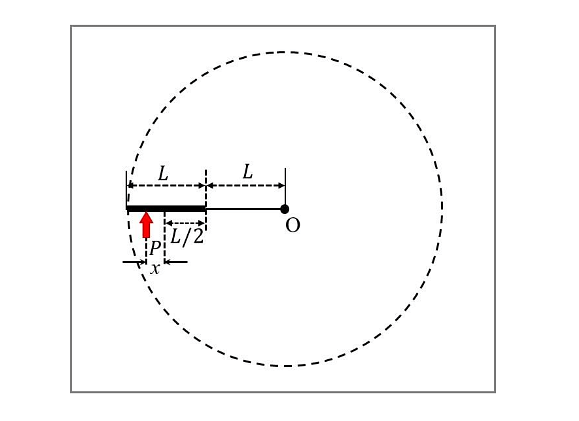
A thin uniform rod of length L and certain mass is kept on a frictionless horizontal table with a massless string of length L fixed to one end (top view is shown in the figure). The other end of the string is pivoted to a point O. If a horizontal impulse P is imparted to the rod at a distance x = L/n from the mid-point of the rod (see figure), then the rod and string revolve together around the point O, with the rod remaining aligned with the string. In such a case, the value of n is _____.
- JEE Advanced - 2024
- Friction