Question:medium
The total number of all possible isomers for the square planar complex with formula
\[
\mathrm{K[M(NCS)(NO_2)(gly)]}
\]
is _____.
\[
\mathrm{(M = metal\ ion\ and\ gly = NH_2CH_2COO^-)}
\]
The total number of all possible isomers for the square planar complex with formula
\[
\mathrm{K[M(NCS)(NO_2)(gly)]}
\]
is _____.
\[ \mathrm{(M = metal\ ion\ and\ gly = NH_2CH_2COO^-)} \]
\[ \mathrm{(M = metal\ ion\ and\ gly = NH_2CH_2COO^-)} \]
Show Hint
Important ambidentate ligands:
\[
\mathrm{NO_2^-}
\Rightarrow
\mathrm{NO_2^- / ONO^-}
\]
\[
\mathrm{SCN^-}
\Rightarrow
\mathrm{SCN^- / NCS^-}
\]
Always check:
• linkage isomerism
• geometrical isomerism
• symmetry reduction while counting coordination compound isomers.
• linkage isomerism
• geometrical isomerism
• symmetry reduction while counting coordination compound isomers.
Updated On: Jun 4, 2026
Show Solution
Correct Answer: 6
Solution and Explanation
Step 1: Understanding the Concept:
This problem involves coordination chemistry, specifically the isomerism of square planar complexes.
The complex is of the type [M(a)(b)(CD)], where 'a' and 'b' are monodentate ligands and 'CD' is a bidentate unsymmetrical ligand.
Ligands present: 1. NCS\(^-\): An ambidentate ligand that can coordinate via Nitrogen (isothiocyanato, -NCS) or Sulfur (thiocyanato, -SCN).
2. NO\(_2^-\): An ambidentate ligand that can coordinate via Nitrogen (nitro, -NO\(_2\)) or Oxygen (nitrito, -ONO).
3. Glycinato (gly): An unsymmetrical bidentate ligand coordinating via Nitrogen and Oxygen.
Step 2: Key Formula or Approach:
To find the total number of isomers, we must consider both Geometrical Isomerism (GI) and Linkage Isomerism (LI).
Square planar complexes do not show optical isomerism (unless the ligands themselves are chiral) because they possess a plane of symmetry.
First, we determine the number of linkage combinations.
Then, for each combination, we determine the number of geometrical isomers.
Step 3: Detailed Explanation:
1. Linkage Isomerism:
The two ambidentate ligands lead to the following combinations:
- (M-NCS) and (M-NO\(_2\))
- (M-NCS) and (M-ONO)
- (M-SCN) and (M-NO\(_2\))
- (M-SCN) and (M-ONO)
There are 4 possible linkage combinations.
2. Geometrical Isomerism:
Let's analyze one specific linkage combination, say [M(NCS)(NO\(_2\))(gly)].
In a square planar geometry with an unsymmetrical bidentate ligand (N-O), and two monodentate ligands (A, B): The monodentate ligands A and B can be arranged relative to the N and O atoms of the glycinato ligand.
Possible arrangements: - A can be trans to N (which forces B to be trans to O).
- A can be trans to O (which forces B to be trans to N).
This results in 2 distinct geometrical isomers for each linkage combination.
3. Total Isomers:
Total isomers = (Number of linkage combinations) \(\times\) (Number of geometrical isomers per combination).
Total isomers = \( 4 \times 2 = 8 \).
Step 4: Final Answer:
Considering the linkage isomerism provided by the two ambidentate ligands and the geometrical isomerism due to the unsymmetrical bidentate ligand in a square planar environment, the total number of isomers is 8.
This problem involves coordination chemistry, specifically the isomerism of square planar complexes.
The complex is of the type [M(a)(b)(CD)], where 'a' and 'b' are monodentate ligands and 'CD' is a bidentate unsymmetrical ligand.
Ligands present: 1. NCS\(^-\): An ambidentate ligand that can coordinate via Nitrogen (isothiocyanato, -NCS) or Sulfur (thiocyanato, -SCN).
2. NO\(_2^-\): An ambidentate ligand that can coordinate via Nitrogen (nitro, -NO\(_2\)) or Oxygen (nitrito, -ONO).
3. Glycinato (gly): An unsymmetrical bidentate ligand coordinating via Nitrogen and Oxygen.
Step 2: Key Formula or Approach:
To find the total number of isomers, we must consider both Geometrical Isomerism (GI) and Linkage Isomerism (LI).
Square planar complexes do not show optical isomerism (unless the ligands themselves are chiral) because they possess a plane of symmetry.
First, we determine the number of linkage combinations.
Then, for each combination, we determine the number of geometrical isomers.
Step 3: Detailed Explanation:
1. Linkage Isomerism:
The two ambidentate ligands lead to the following combinations:
- (M-NCS) and (M-NO\(_2\))
- (M-NCS) and (M-ONO)
- (M-SCN) and (M-NO\(_2\))
- (M-SCN) and (M-ONO)
There are 4 possible linkage combinations.
2. Geometrical Isomerism:
Let's analyze one specific linkage combination, say [M(NCS)(NO\(_2\))(gly)].
In a square planar geometry with an unsymmetrical bidentate ligand (N-O), and two monodentate ligands (A, B): The monodentate ligands A and B can be arranged relative to the N and O atoms of the glycinato ligand.
Possible arrangements: - A can be trans to N (which forces B to be trans to O).
- A can be trans to O (which forces B to be trans to N).
This results in 2 distinct geometrical isomers for each linkage combination.
3. Total Isomers:
Total isomers = (Number of linkage combinations) \(\times\) (Number of geometrical isomers per combination).
Total isomers = \( 4 \times 2 = 8 \).
Step 4: Final Answer:
Considering the linkage isomerism provided by the two ambidentate ligands and the geometrical isomerism due to the unsymmetrical bidentate ligand in a square planar environment, the total number of isomers is 8.
Was this answer helpful?
0
Top Questions on Isomerism in Coordination Compounds
- Which of the following coordination compounds shows linkage isomerism?
- BITSAT - 2025
- Chemistry
- Isomerism in Coordination Compounds
- Determine the values of X, Y, and Z for the following complexes and calculate the sum X + Y + Z.
X = Number of geometrical isomers of [Pt(NH3)(Cl)(Br)(Py)]
Y = Number of optically inactive isomers of [Cr(en)2Cl2]+
Z = Number of stereoisomers of [Co(NH3)3(NO3)3]- JEE Main - 2026
- Chemistry
- Isomerism in Coordination Compounds
- If Ni2– is replaced by Pt2– in the complex NiCl2Br2] 2– , which of the following properties are expected to get changed?
A. Geometry
B. Geometrical isomerism
C. Optical isomerism
D. Magnetic properties- JEE Main - 2023
- Chemistry
- Isomerism in Coordination Compounds
- The most stable ion is:
- BITSAT - 2011
- Chemistry
- Isomerism in Coordination Compounds
- Want to practice more? Try solving extra ecology questions todayView All Questions
Questions Asked in JEE Advanced exam
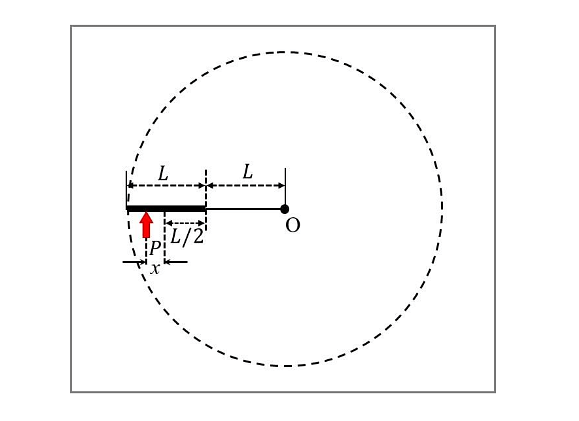
A thin uniform rod of length L and certain mass is kept on a frictionless horizontal table with a massless string of length L fixed to one end (top view is shown in the figure). The other end of the string is pivoted to a point O. If a horizontal impulse P is imparted to the rod at a distance x = L/n from the mid-point of the rod (see figure), then the rod and string revolve together around the point O, with the rod remaining aligned with the string. In such a case, the value of n is _____.
- JEE Advanced - 2024
- Friction