Question:medium
The number of possible real solution(ss) of \(y\) in the equation \(y^2 - 2y\cos x + 1 = 0\) is:
The number of possible real solution(ss) of \(y\) in the equation \(y^2 - 2y\cos x + 1 = 0\) is:
Show Hint
Divide the equation by y and recall that \(y+\dfrac{1}{y}\) never lies strictly between \(-2\) and \(2\) for a real, nonzero y.
Updated On: Jul 10, 2026
- 0
- 1
- 2
- 3
Show Solution
The Correct Option is C
Solution and Explanation
A quicker route uses the bound on $y+\frac{1}{y}$ for real, nonzero $y$, instead of computing a discriminant.
- Rule out $y=0$: putting $y=0$ into $y^2-2y\cos x+1=0$ gives $1=0$, which is false, so $y=0$ is never a solution and we can safely divide the equation by $y$.
- Divide the equation by $y$: this gives $y - 2\cos x + \frac{1}{y} = 0$, i.e. $y+\frac{1}{y} = 2\cos x$.
- Bound the left side: for real, nonzero $y$, either $y>0$ and AM-GM gives $y+\frac{1}{y}\geq2$, or $y<0$, and applying AM-GM to $-y>0$ gives $y+\frac{1}{y}\leq-2$. So $y+\frac{1}{y}$ never falls strictly between $-2$ and $2$.
- Bound the right side: $2\cos x$ always lies in $[-2,2]$ since $\cos x\in[-1,1]$.
- Find where the two ranges meet: the only values common to 'at least $2$ or at most $-2$' and 'between $-2$ and $2$ inclusive' are exactly the two endpoints, $2$ and $-2$.
So $y+\frac{1}{y}=2$ forces $y=1$ (from $y^2-2y+1=(y-1)^2=0$), and $y+\frac{1}{y}=-2$ forces $y=-1$ (from $y^2+2y+1=(y+1)^2=0$). No other real value of $y$ can satisfy the original equation for any choice of $x$.
Let's summarize:
- Dividing by $y$ turns the equation into $y+\frac{1}{y}=2\cos x$.
- The left side only ever reaches $2$ or $-2$ among the values allowed on the right, giving exactly two possible real values of $y$: $1$ and $-1$.
So the number of possible real solutions of $y$ is $2$.
Was this answer helpful?
0
Top Questions on Quadratic Equations
- The equation \( (\cos p - 1)x^2 + (\cos p)x + \sin p = 0 \), where \( x \) is a variable with real roots. Then the interval of \( p \) may be any one of the following:
- MHT CET - 2024
- Mathematics
- Quadratic Equations
- If the roots of the quadratic equation \( x^2 - 7x + 12 = 0 \) are \( \alpha \) and \( \beta \), then the value of \( \alpha + \beta \) is:
- MHT CET - 2025
- Mathematics
- Quadratic Equations
- Find the roots of the quadratic equation $ x^2 - 5x + 6 = 0 $.
- MHT CET - 2025
- Mathematics
- Quadratic Equations
- Find the sum of the roots of the quadratic equation $ 2x^2 - 5x + 3 = 0 $.
- MHT CET - 2025
- Mathematics
- Quadratic Equations
- Want to practice more? Try solving extra ecology questions todayView All Questions
Questions Asked in XAT exam
Applicants have been shortlisted for interviews for some data analyst positions. Some of the applicants have advanced expertise in one or more fields among the following: data analysis, database handling and coding. The numbers of applicants with different advanced expertise are given in the 2 × 8 table below.
The number of applicants with advanced expertise in all three fields is given as x in the table, where x is a non-negative integer.
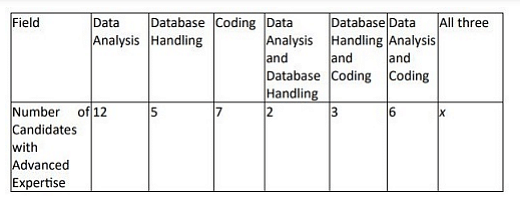
The number of applicants with advanced expertise in all three fields is given as x in the table, where x is a non-negative integer.
- XAT - 2024
- Data Interpretation