Question:medium
The length of the sides of a triangle are \(x + 1\), \(9 - x\) and \(5x - 3\). The number of values of x for which the triangle is isosceles is:
The length of the sides of a triangle are \(x + 1\), \(9 - x\) and \(5x - 3\). The number of values of x for which the triangle is isosceles is:
Show Hint
First equate each pair of sides to find candidate x-values, then check the triangle inequality on each candidate since not every algebraic solution gives real side lengths.
Updated On: Jul 13, 2026
- 0
- 1
- 2
- 3
Show Solution
The Correct Option is B
Solution and Explanation
Step 1: Understanding the Concept.
A triangle is isosceles when two of its three sides are equal, but before that we always need the three given lengths to actually close into a triangle in the first place. That means every pair of sides must add up to more than the remaining side. We test each of the three possible equal pair equations one at a time and then filter out any case that cannot physically form a triangle.
Step 2: List all pairings and solve each.
Pairing 1: $x + 1 = 9 - x$ gives $2x = 8$, so $x = 4$.
Pairing 2: $x + 1 = 5x - 3$ gives $4x = 4$, so $x = 1$.
Pairing 3: $9 - x = 5x - 3$ gives $6x = 12$, so $x = 2$.
So algebraically there seem to be three candidate values: $1$, $2$ and $4$.
Step 3: Test each candidate against the triangle rule.
For $x=4$: sides are $5, 5, 17$. Smallest two add to $10$, and $10 < 17$, so this figure is impossible. Two short sides of length $5$ simply cannot stretch across a base of $17$.
For $x=1$: sides are $2, 8, 2$. Smallest two add to $4$, and $4 < 8$, so this is impossible too.
For $x=2$: sides are $3, 7, 7$. Check all pairs: $3+7=10>7$ and $7+7=14>3$. Every pair clears the third side, so this triangle is valid.
Step 4: Final Answer.
Only the pairing that gives $x=2$ survives the triangle test, since the other two pairings produce side lengths that cannot form any triangle at all, let alone an isosceles one. So there is only one value of $x$ that makes the triangle isosceles. \[ \boxed{1} \]
A triangle is isosceles when two of its three sides are equal, but before that we always need the three given lengths to actually close into a triangle in the first place. That means every pair of sides must add up to more than the remaining side. We test each of the three possible equal pair equations one at a time and then filter out any case that cannot physically form a triangle.
Step 2: List all pairings and solve each.
Pairing 1: $x + 1 = 9 - x$ gives $2x = 8$, so $x = 4$.
Pairing 2: $x + 1 = 5x - 3$ gives $4x = 4$, so $x = 1$.
Pairing 3: $9 - x = 5x - 3$ gives $6x = 12$, so $x = 2$.
So algebraically there seem to be three candidate values: $1$, $2$ and $4$.
Step 3: Test each candidate against the triangle rule.
For $x=4$: sides are $5, 5, 17$. Smallest two add to $10$, and $10 < 17$, so this figure is impossible. Two short sides of length $5$ simply cannot stretch across a base of $17$.
For $x=1$: sides are $2, 8, 2$. Smallest two add to $4$, and $4 < 8$, so this is impossible too.
For $x=2$: sides are $3, 7, 7$. Check all pairs: $3+7=10>7$ and $7+7=14>3$. Every pair clears the third side, so this triangle is valid.
Step 4: Final Answer.
Only the pairing that gives $x=2$ survives the triangle test, since the other two pairings produce side lengths that cannot form any triangle at all, let alone an isosceles one. So there is only one value of $x$ that makes the triangle isosceles. \[ \boxed{1} \]
Was this answer helpful?
0
Top Questions on Triangles
Fill in the blanks using the correct word given in the brackets :
(i) All circles are __________. (congruent, similar)
(ii) All squares are __________. (similar, congruent)
(iii) All __________ triangles are similar. (isosceles, equilateral)
(iv) Two polygons of the same number of sides are similar, if (a) their corresponding angles are __________ and (b) their corresponding sides are __________. (equal, proportional)- CBSE Class X
- Mathematics
- Triangles
- Give two different examples of a pair of
(i) Similar figures
(ii)Non-similar figures- CBSE Class X
- Mathematics
- Triangles
- State whether the following quadrilaterals are similar or not:

- CBSE Class X
- Mathematics
- Triangles
- In figure below (i) and (ii), DE || BC. Find EC in (i) and AD in (ii).
(i)
(ii)
- CBSE Class X
- Mathematics
- Triangles
- Want to practice more? Try solving extra ecology questions todayView All Questions
Questions Asked in XAT exam
Applicants have been shortlisted for interviews for some data analyst positions. Some of the applicants have advanced expertise in one or more fields among the following: data analysis, database handling and coding. The numbers of applicants with different advanced expertise are given in the 2 × 8 table below.
The number of applicants with advanced expertise in all three fields is given as x in the table, where x is a non-negative integer.
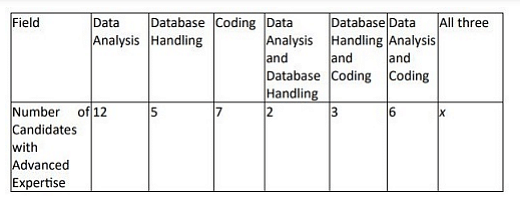
The number of applicants with advanced expertise in all three fields is given as x in the table, where x is a non-negative integer.
- XAT - 2024
- Data Interpretation