Question:hard
The four sentences (labelled 1, 2, 3, 4) given below, when properly sequenced, form a coherent paragraph. Read the sentences and decide on the correct order for the paragraph.
1. So too it is impossible for there to be any propositions of ethics. Propositions can express nothing that is higher.
2. The sense of the world must lie outside the world. In the world everything is as it is, and everything happens as it does happen: in it no value exists, and if it did exist it would have no value. If there is any value that does have value, it must lie outside the whole sphere of what happens and is the case. For all that happens and is the case is accidental. What makes it non-accidental cannot lie within the world, since if it did it would itself be accidental. It must lie outside the world.
3. It is clear that ethics cannot be put into words. Ethics is transcendental.
4. All propositions are of equal value.
Which of the following is the correct order?
The four sentences (labelled 1, 2, 3, 4) given below, when properly sequenced, form a coherent paragraph. Read the sentences and decide on the correct order for the paragraph.
1. So too it is impossible for there to be any propositions of ethics. Propositions can express nothing that is higher.
2. The sense of the world must lie outside the world. In the world everything is as it is, and everything happens as it does happen: in it no value exists, and if it did exist it would have no value. If there is any value that does have value, it must lie outside the whole sphere of what happens and is the case. For all that happens and is the case is accidental. What makes it non-accidental cannot lie within the world, since if it did it would itself be accidental. It must lie outside the world.
3. It is clear that ethics cannot be put into words. Ethics is transcendental.
4. All propositions are of equal value.
Which of the following is the correct order?
1. So too it is impossible for there to be any propositions of ethics. Propositions can express nothing that is higher.
2. The sense of the world must lie outside the world. In the world everything is as it is, and everything happens as it does happen: in it no value exists, and if it did exist it would have no value. If there is any value that does have value, it must lie outside the whole sphere of what happens and is the case. For all that happens and is the case is accidental. What makes it non-accidental cannot lie within the world, since if it did it would itself be accidental. It must lie outside the world.
3. It is clear that ethics cannot be put into words. Ethics is transcendental.
4. All propositions are of equal value.
Which of the following is the correct order?
Show Hint
Look for the sentence that sounds like a wrap-up conclusion (it will use a summarizing phrase) and place it last; then find which sentence has nothing to refer back to, since that one must open the paragraph.
Updated On: Jul 10, 2026
- 4-2-1-3
- 2-1-3-4
- 1-3-4-2
- 4-3-1-2
Show Solution
The Correct Option is A
Solution and Explanation
This is a para-jumble made of four numbered statements about ethics and value. Instead of building the paragraph forward from the first line, it is often faster to attack it by testing which given ordering options survive a few quick checks, since only one of the five arrangements can be fully consistent.
- 4-2-1-3 (option A): Start by checking if statement 4 (All propositions are of equal value) can open the paragraph. It is a plain, self-contained claim with no pronoun or connector referring backward, so it works well as an opening line. Next check if 2 can follow 4: statement 2 talks about value lying outside the world, picking up directly on the word value from statement 4, so 4 followed by 2 reads smoothly. Then check 2 followed by 1: statement 1 begins 'So too it is impossible...', and 'so too' needs a preceding sentence that already talked about something being impossible or non-existent, which statement 2 does. Finally, statement 3 closes the paragraph as a natural summary of the whole idea. Every link in this chain holds up.
- 2-1-3-4 (option B): This opens with statement 2, but statement 2 refers to the sense of the world and value existing or not, which reads like a sentence continuing an established discussion rather than opening one. There is no earlier context for it to build on if it is placed first, so this ordering is weak from the very first sentence.
- 1-3-4-2 (option C): This opens with statement 1, which begins with 'So too,' a phrase that explicitly needs something before it to refer back to. Since there is nothing before the first sentence of a paragraph, this ordering is invalid at the very start.
- 4-3-1-2 (option D): This keeps 4 as the opener, which is fine, but then jumps straight to statement 3, the concluding, summarizing sentence, in the second position. Placing the conclusion so early breaks the logical build-up, and it also separates statement 4 from statement 2, even though those two are linked by the shared idea of value.
- 3-1-2-4 (option E): This opens with statement 3, the sentence that uses 'it is clear that,' a phrase that signals a conclusion has been reached. A conclusion cannot logically be the first sentence of a paragraph that has not yet made its argument, so this ordering is rejected immediately.
Only option A survives every check: statement 4 opens with a general premise, statement 2 continues the theme of value, statement 1 uses 'so too' to logically follow from 2, and statement 3 closes the paragraph with the summarizing statement about ethics being transcendental.
Let's summarize:
- A sentence starting with a back-referring phrase like 'so too' or a summarizing phrase like 'it is clear that' cannot be the opening line.
- Track repeated words like value across sentences to find which pairs of statements belong together.
- Testing each option against these two checks quickly eliminates four of the five choices.
The correct order is 4-2-1-3, which is option A.
Was this answer helpful?
0
Top Questions on Para Jumbles
- Five jumbled up sentences (labelled 1, 2, 3, 4 and 5), related to a topic, are given below. Four of them can be put together to form a coherent paragraph. Identify the odd sentence and key in the number of that sentence as your answer.
- Five jumbled up sentences (labelled 1, 2, 3, 4 and 5), related to a topic, are given below. Four of them can be put together to form a coherent paragraph. Identify the odd sentence and key in the number of that sentence as your answer.
- Five jumbled up sentences (labelled 1, 2, 3, 4 and 5), related to a topic, are given below. Four of them can be put together to form a coherent paragraph. Identify the odd sentence and key in the number of that sentence as your answer.
- Five jumbled up sentences (labelled 1, 2, 3, 4 and 5), related to a topic, are given below. Four of them can be put together to form a coherent paragraph. Identify the odd sentence and key in the number of that sentence as your answer.
- Want to practice more? Try solving extra ecology questions todayView All Questions
Questions Asked in XAT exam
Applicants have been shortlisted for interviews for some data analyst positions. Some of the applicants have advanced expertise in one or more fields among the following: data analysis, database handling and coding. The numbers of applicants with different advanced expertise are given in the 2 × 8 table below.
The number of applicants with advanced expertise in all three fields is given as x in the table, where x is a non-negative integer.
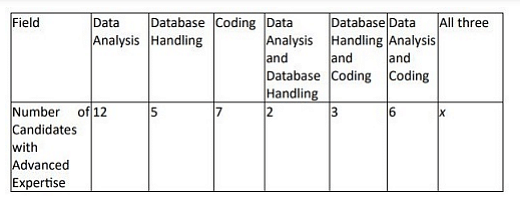
The number of applicants with advanced expertise in all three fields is given as x in the table, where x is a non-negative integer.
- XAT - 2024
- Data Interpretation