Question:medium
The first negative term in the expansion \(\sqrt{(1+2x)^7}\) is the:
The first negative term in the expansion \(\sqrt{(1+2x)^7}\) is the:
Show Hint
Expand \((1+2x)^{7/2}\) as a binomial series and find the first value of r where the coefficient factor n-r+1 turns negative.
Updated On: Jul 13, 2026
- 4th term
- 5th term
- 6th term
- 7th term
Show Solution
The Correct Option is C
Solution and Explanation
Step 1: Rewrite the root as a fractional power.
$\sqrt{(1+2x)^7} = (1+2x)^{7/2}$. Take $n=7/2$ and expand using the general binomial series $(1+y)^n = 1 + ny + \frac{n(n-1)}{2!}y^2 + \frac{n(n-1)(n-2)}{3!}y^3+\cdots$, with $y=2x$.
Step 2: Compute each binomial coefficient as a fraction.
Using $C(n,r) = C(n,r-1)\times\frac{n-r+1}{r}$, starting from $C(7/2,0)=1$:
$C(7/2,1) = 1 \times \frac{7/2}{1} = \frac{7}{2}$
$C(7/2,2) = \frac{7}{2}\times\frac{5/2}{2} = \frac{35}{8}$
$C(7/2,3) = \frac{35}{8}\times\frac{3/2}{3} = \frac{35}{16}$
$C(7/2,4) = \frac{35}{16}\times\frac{1/2}{4} = \frac{35}{128}$
$C(7/2,5) = \frac{35}{128}\times\frac{-1/2}{5} = -\frac{7}{256}$
Step 3: Spot where the sign flips.
All the coefficients up to $C(7/2,4)$ come out positive: $1, \frac{7}{2}, \frac{35}{8}, \frac{35}{16}, \frac{35}{128}$. The very next one, $C(7/2,5) = -\frac{7}{256}$, is negative. Since $(2x)^r$ does not change sign when $x>0$, this is exactly the point where the term itself turns negative.
Step 4: Match the coefficient index to the term number.
$C(7/2,r)$ belongs to term number $r+1$, so $r=5$ gives the 6th term. This confirms the first negative term is the 6th term, so options (A), (B) and (D) do not fit.
Final Answer:
The first negative term of the expansion is the 6th term.
\[ \boxed{\text{6th term}} \]
$\sqrt{(1+2x)^7} = (1+2x)^{7/2}$. Take $n=7/2$ and expand using the general binomial series $(1+y)^n = 1 + ny + \frac{n(n-1)}{2!}y^2 + \frac{n(n-1)(n-2)}{3!}y^3+\cdots$, with $y=2x$.
Step 2: Compute each binomial coefficient as a fraction.
Using $C(n,r) = C(n,r-1)\times\frac{n-r+1}{r}$, starting from $C(7/2,0)=1$:
$C(7/2,1) = 1 \times \frac{7/2}{1} = \frac{7}{2}$
$C(7/2,2) = \frac{7}{2}\times\frac{5/2}{2} = \frac{35}{8}$
$C(7/2,3) = \frac{35}{8}\times\frac{3/2}{3} = \frac{35}{16}$
$C(7/2,4) = \frac{35}{16}\times\frac{1/2}{4} = \frac{35}{128}$
$C(7/2,5) = \frac{35}{128}\times\frac{-1/2}{5} = -\frac{7}{256}$
Step 3: Spot where the sign flips.
All the coefficients up to $C(7/2,4)$ come out positive: $1, \frac{7}{2}, \frac{35}{8}, \frac{35}{16}, \frac{35}{128}$. The very next one, $C(7/2,5) = -\frac{7}{256}$, is negative. Since $(2x)^r$ does not change sign when $x>0$, this is exactly the point where the term itself turns negative.
Step 4: Match the coefficient index to the term number.
$C(7/2,r)$ belongs to term number $r+1$, so $r=5$ gives the 6th term. This confirms the first negative term is the 6th term, so options (A), (B) and (D) do not fit.
Final Answer:
The first negative term of the expansion is the 6th term.
\[ \boxed{\text{6th term}} \]
Was this answer helpful?
0
Top Questions on Binomial theorem
- If \( A \) and \( B \) are the two real values of \( k \) for which the system of equations \( x + 2y + z = 1 \), \( x + 3y + 4z = k \), \( x + 5y + 10z = k^2 \) is consistent, then \( A + B = \): (a) 3
- VITEEE - 2024
- Mathematics
- Binomial theorem
- Suppose \( 2 - p \), \( p \), \( 2 - \alpha \), \( \alpha \) are the coefficients of four consecutive terms in the expansion of \( (1 + x)^n \). Then the value of \( p^2 - \alpha^2 + 6\alpha + 2p \) equals
- JEE Main - 2024
- Mathematics
- Binomial theorem
- Let \( \alpha = \sum_{k=0}^{n} \left( \frac{\binom{n}{k}}{k+1} \right)^2 \) and \( \beta = \sum_{k=0}^{n-1} \left( \frac{\binom{n}{k} \binom{n}{k+1}}{k+2} \right) \).
If \( 5\alpha = 6\beta \), then \( n \) equals __________.- JEE Main - 2024
- Mathematics
- Binomial theorem
- \(^{n-1}C_r = (k^2 - 8) ^{n}C_{r+1}\) if and only if:
- JEE Main - 2024
- Mathematics
- Binomial theorem
- Want to practice more? Try solving extra ecology questions todayView All Questions
Questions Asked in XAT exam
Applicants have been shortlisted for interviews for some data analyst positions. Some of the applicants have advanced expertise in one or more fields among the following: data analysis, database handling and coding. The numbers of applicants with different advanced expertise are given in the 2 × 8 table below.
The number of applicants with advanced expertise in all three fields is given as x in the table, where x is a non-negative integer.
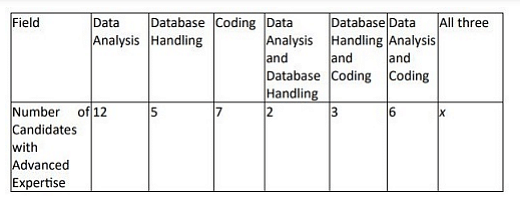
The number of applicants with advanced expertise in all three fields is given as x in the table, where x is a non-negative integer.
- XAT - 2024
- Data Interpretation