Question:hard
The expression \(\dfrac{x^2 - 2x + a^2 + b^2}{x^2 + 2x + a^2 + b^2}\) lies between:
The expression \(\dfrac{x^2 - 2x + a^2 + b^2}{x^2 + 2x + a^2 + b^2}\) lies between:
Show Hint
Treat the expression as y, cross multiply to get a quadratic in x, and use the real-roots (discriminant greater than or equal to 0) condition to find the range of y.
Updated On: Jul 13, 2026
- \(\dfrac{\sqrt{a^2+b^2}+1}{\sqrt{a^2+b^2}-1}\) and \(\dfrac{\sqrt{a^2+b^2}-1}{\sqrt{a^2+b^2}+1}\)
- a and b
- \(\dfrac{\sqrt{a^2+b^2}+1}{\sqrt{a^2+b^2}-1}\) and 1
- \(\dfrac{\sqrt{a^2+b^2}-1}{\sqrt{a^2+b^2}+1}\)
Show Solution
The Correct Option is A
Solution and Explanation
Step 1: Understanding the Concept.
Instead of jumping straight to a discriminant, notice a neat symmetry in this expression first. Write $k=\sqrt{a^2+b^2}$ and $f(x)=\dfrac{x^2-2x+k^2}{x^2+2x+k^2}$. Replacing $x$ by $-x$ swaps the numerator and denominator of $f$, so $f(-x) = \dfrac{1}{f(x)}$. This tells us the set of values $f$ can take must be symmetric under taking the reciprocal, which already hints that the two boundary values of the range are reciprocals of each other.
Step 2: Key Formula or Approach.
To pin down the actual boundary values, treat $y=f(x)$ and rewrite the equation as a quadratic in $x$:
\[ (y-1)x^2 + 2(y+1)x + (y-1)k^2 = 0 \]
For a real $x$ to exist, the discriminant of this quadratic (in $x$) must be non-negative.
Step 3: Detailed Explanation.
Discriminant condition:
\[ 4(y+1)^2 - 4k^2(y-1)^2 \ge 0 \]
\[ (y+1)^2 \ge k^2(y-1)^2 \]
This reduces cleanly to the factored inequality
\[ [y(1-k)+(1+k)]\,[y(1+k)+(1-k)] \ge 0 \]
Solving $y(1-k)+(1+k)=0$ gives $y=\dfrac{k+1}{k-1}$.
Solving $y(1+k)+(1-k)=0$ gives $y=\dfrac{k-1}{k+1}$.
These two values are reciprocals of each other, exactly matching the symmetry noticed in Step 1. Since the leading coefficient of the quadratic in $y$ is negative (because $k>1$ makes $1-k^2<0$), the expression is non-negative between its two roots, so $y$ is confined between $\dfrac{k-1}{k+1}$ and $\dfrac{k+1}{k-1}$.
Step 4: Final Answer.
Substituting back $k=\sqrt{a^2+b^2}$, the expression always lies between $\dfrac{\sqrt{a^2+b^2}-1}{\sqrt{a^2+b^2}+1}$ and $\dfrac{\sqrt{a^2+b^2}+1}{\sqrt{a^2+b^2}-1}$, a reciprocal pair of bounds, confirming the symmetry argument from the start. \[ \boxed{\dfrac{\sqrt{a^2+b^2}-1}{\sqrt{a^2+b^2}+1} \le y \le \dfrac{\sqrt{a^2+b^2}+1}{\sqrt{a^2+b^2}-1}} \]
Instead of jumping straight to a discriminant, notice a neat symmetry in this expression first. Write $k=\sqrt{a^2+b^2}$ and $f(x)=\dfrac{x^2-2x+k^2}{x^2+2x+k^2}$. Replacing $x$ by $-x$ swaps the numerator and denominator of $f$, so $f(-x) = \dfrac{1}{f(x)}$. This tells us the set of values $f$ can take must be symmetric under taking the reciprocal, which already hints that the two boundary values of the range are reciprocals of each other.
Step 2: Key Formula or Approach.
To pin down the actual boundary values, treat $y=f(x)$ and rewrite the equation as a quadratic in $x$:
\[ (y-1)x^2 + 2(y+1)x + (y-1)k^2 = 0 \]
For a real $x$ to exist, the discriminant of this quadratic (in $x$) must be non-negative.
Step 3: Detailed Explanation.
Discriminant condition:
\[ 4(y+1)^2 - 4k^2(y-1)^2 \ge 0 \]
\[ (y+1)^2 \ge k^2(y-1)^2 \]
This reduces cleanly to the factored inequality
\[ [y(1-k)+(1+k)]\,[y(1+k)+(1-k)] \ge 0 \]
Solving $y(1-k)+(1+k)=0$ gives $y=\dfrac{k+1}{k-1}$.
Solving $y(1+k)+(1-k)=0$ gives $y=\dfrac{k-1}{k+1}$.
These two values are reciprocals of each other, exactly matching the symmetry noticed in Step 1. Since the leading coefficient of the quadratic in $y$ is negative (because $k>1$ makes $1-k^2<0$), the expression is non-negative between its two roots, so $y$ is confined between $\dfrac{k-1}{k+1}$ and $\dfrac{k+1}{k-1}$.
Step 4: Final Answer.
Substituting back $k=\sqrt{a^2+b^2}$, the expression always lies between $\dfrac{\sqrt{a^2+b^2}-1}{\sqrt{a^2+b^2}+1}$ and $\dfrac{\sqrt{a^2+b^2}+1}{\sqrt{a^2+b^2}-1}$, a reciprocal pair of bounds, confirming the symmetry argument from the start. \[ \boxed{\dfrac{\sqrt{a^2+b^2}-1}{\sqrt{a^2+b^2}+1} \le y \le \dfrac{\sqrt{a^2+b^2}+1}{\sqrt{a^2+b^2}-1}} \]
Was this answer helpful?
0
Top Questions on Algebraic Expressions
- If \( A = 4x + \frac{1}{x} \), then the value of \( A + \frac{1}{A} \) is:
- JEECUP - 2024
- Mathematics
- Algebraic Expressions
- The value of \( \left( x - \frac{2}{x} \right) \left( x^2 + 2 + \frac{4}{x^2} \right) \) is equal to:
- JEECUP - 2024
- Mathematics
- Algebraic Expressions
- If \( \left( x + \frac{1}{x} \right) = \sqrt{3} \), then the value of \( \left( x^3 + \frac{1}{x^3} \right) \) will be:
- JEECUP - 2024
- Mathematics
- Algebraic Expressions
- Want to practice more? Try solving extra ecology questions todayView All Questions
Questions Asked in XAT exam
Applicants have been shortlisted for interviews for some data analyst positions. Some of the applicants have advanced expertise in one or more fields among the following: data analysis, database handling and coding. The numbers of applicants with different advanced expertise are given in the 2 × 8 table below.
The number of applicants with advanced expertise in all three fields is given as x in the table, where x is a non-negative integer.
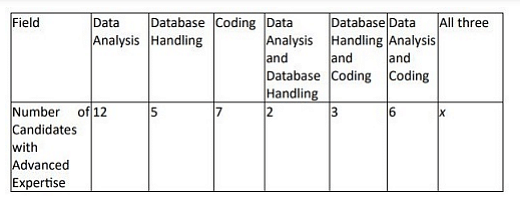
The number of applicants with advanced expertise in all three fields is given as x in the table, where x is a non-negative integer.
- XAT - 2024
- Data Interpretation