Question:hard
The curve \(y = 4x^2\) and \(y^2 = 2x\) meet at the origin O and at a point P, forming a loop. The straight line OP divides the loop into two parts. What is the ratio of the areas of the two parts of the loop?
The curve \(y = 4x^2\) and \(y^2 = 2x\) meet at the origin O and at a point P, forming a loop. The straight line OP divides the loop into two parts. What is the ratio of the areas of the two parts of the loop?
Show Hint
Find where the two curves meet, write both curves as x in terms of y, then integrate to compare the area on each side of the chord OP.
Updated On: Jul 13, 2026
- 3 : 1
- 3 : 2
- 2 : 1
- 1 : 1
Show Solution
The Correct Option is D
Solution and Explanation
Step 1: Find the point of intersection P of the two curves.
Substituting $y=4x^2$ into $y^2=2x$ gives $16x^4=2x$, so $x(8x^3-1)=0$, leading to $x=0$ or $x=\frac{1}{2}$. At $x=\frac{1}{2}$, $y=1$, so $P=(\frac12,1)$ and the line $OP$ is $y=2x$.
Step 2: Rescale the x-axis so the intersection point becomes a simple reference point.
Let $X = 2x$ and $Y = y$, so that $P=(\frac12,1)$ maps to $(X,Y)=(1,1)$. Rescaling one axis by a constant factor changes the size of a region but does not change the ratio of areas between two parts of the same region, so any area ratio found in the new coordinates is exactly the same as in the original ones.
Step 3: Rewrite the two curves and the line in the new coordinates.
Curve $y=4x^2$ becomes $Y = 4\left(\frac{X}{2}\right)^2 = X^2$.
Curve $y^2=2x$ becomes $Y^2 = 2\cdot\frac{X}{2} = X$, i.e. $X = Y^2$.
Line $OP$ ($y=2x$) becomes $Y = 2\cdot\frac{X}{2} = X$, the simple diagonal line $Y=X$.
Step 4: Notice the mirror symmetry of the rescaled picture.
The loop is now bounded by $Y=X^2$ and $X=Y^2$ between $(0,0)$ and $(1,1)$. Swapping $X$ and $Y$ in $Y=X^2$ gives exactly $X=Y^2$, so these two curves are mirror images of each other across the line $Y=X$. Since the dividing line $OP$ is precisely $Y=X$, the axis of this mirror symmetry, it must split the loop into two halves that are exact reflections of each other.
Step 5: Conclude the two areas are equal.
A shape and its mirror image always cover the same amount of area, since reflecting a region does not change its area. So the two parts of the loop, on either side of the line $OP$, must be equal in area.
\[ \text{Area}_1 : \text{Area}_2 = 1:1 \]
This symmetry argument reaches the same conclusion as direct integration, without needing to compute either integral explicitly.
Final Answer:
\[ \boxed{1:1} \]
Substituting $y=4x^2$ into $y^2=2x$ gives $16x^4=2x$, so $x(8x^3-1)=0$, leading to $x=0$ or $x=\frac{1}{2}$. At $x=\frac{1}{2}$, $y=1$, so $P=(\frac12,1)$ and the line $OP$ is $y=2x$.
Step 2: Rescale the x-axis so the intersection point becomes a simple reference point.
Let $X = 2x$ and $Y = y$, so that $P=(\frac12,1)$ maps to $(X,Y)=(1,1)$. Rescaling one axis by a constant factor changes the size of a region but does not change the ratio of areas between two parts of the same region, so any area ratio found in the new coordinates is exactly the same as in the original ones.
Step 3: Rewrite the two curves and the line in the new coordinates.
Curve $y=4x^2$ becomes $Y = 4\left(\frac{X}{2}\right)^2 = X^2$.
Curve $y^2=2x$ becomes $Y^2 = 2\cdot\frac{X}{2} = X$, i.e. $X = Y^2$.
Line $OP$ ($y=2x$) becomes $Y = 2\cdot\frac{X}{2} = X$, the simple diagonal line $Y=X$.
Step 4: Notice the mirror symmetry of the rescaled picture.
The loop is now bounded by $Y=X^2$ and $X=Y^2$ between $(0,0)$ and $(1,1)$. Swapping $X$ and $Y$ in $Y=X^2$ gives exactly $X=Y^2$, so these two curves are mirror images of each other across the line $Y=X$. Since the dividing line $OP$ is precisely $Y=X$, the axis of this mirror symmetry, it must split the loop into two halves that are exact reflections of each other.
Step 5: Conclude the two areas are equal.
A shape and its mirror image always cover the same amount of area, since reflecting a region does not change its area. So the two parts of the loop, on either side of the line $OP$, must be equal in area.
\[ \text{Area}_1 : \text{Area}_2 = 1:1 \]
This symmetry argument reaches the same conclusion as direct integration, without needing to compute either integral explicitly.
Final Answer:
\[ \boxed{1:1} \]
Was this answer helpful?
0
Questions Asked in XAT exam
Applicants have been shortlisted for interviews for some data analyst positions. Some of the applicants have advanced expertise in one or more fields among the following: data analysis, database handling and coding. The numbers of applicants with different advanced expertise are given in the 2 × 8 table below.
The number of applicants with advanced expertise in all three fields is given as x in the table, where x is a non-negative integer.
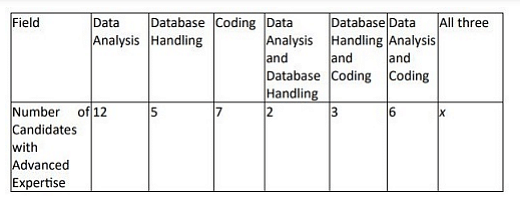
The number of applicants with advanced expertise in all three fields is given as x in the table, where x is a non-negative integer.
- XAT - 2024
- Data Interpretation