Question:medium
The correct statement(s) regarding the periodic properties of elements is(are)
The correct statement(s) regarding the periodic properties of elements is(are)
Show Hint
Compare second ionisation enthalpies of C and B, the radii of isoelectronic ions, the densities of K and Na, and the bond enthalpies of H-H and F-F.
Updated On: Nov 19, 2026
- Second ionization enthalpy of carbon atom is less than that of boron atom.
- Increasing order of ionic radii: \(\text{Al}^{3+} < \text{Mg}^{2+} < \text{Na}^{+}\)
- Under identical conditions, in solid state, the density of potassium metal is more than density of sodium metal.
- The H–H bond is weaker than F–F bond.
Show Solution
The Correct Option is A, B
Solution and Explanation
Step 1: Approach:
We settle each statement with a number or a clear rule.
Step 2: Statement (A): look at the electron configuration after one ionisation:
Carbon after the first ionisation is $1s^2 2s^2 2p^1$. Boron after the first ionisation is $1s^2 2s^2$.
Taking an electron from a full $2s$ subshell (boron) is hard. Taking the $2p$ electron from carbon is easier, even though carbon has the bigger nuclear charge.
Data: $IE_2$ of C = 2353 kJ per mol and $IE_2$ of B = 2427 kJ per mol. (A) is TRUE.
Step 3: Statement (B): isoelectronic ions:
All three ions have the neon configuration with 10 electrons.
Radius is roughly proportional to $1/Z_{eff}$. With $Z$ = 11, 12, 13, the radius goes down from Na$^+$ to Al$^{3+}$.
So $\text{Al}^{3+} < \text{Mg}^{2+} < \text{Na}^+$ is the right order. (B) is TRUE.
Step 4: Statement (C): density is mass over volume:
Going down group 1, density usually rises. Potassium is the exception, because the jump in atomic volume (from 23.7 to 45.5 cm$^3$ per mol) is bigger than the jump in molar mass.
Molar volume ratio is about 1.9 and mass ratio is about 1.7. So K is less dense than Na (0.86 against 0.97 g per cm$^3$). (C) is FALSE.
Step 5: Statement (D): bond strength:
F-F is unusually weak because the lone pairs on two very small atoms repel each other. Its enthalpy is 158 kJ per mol.
H-H has no lone pairs and is 436 kJ per mol. So H-H is the stronger bond and (D) is FALSE.
Final Answer:
Options (A) and (B) are correct. \[ \boxed{\text{A, B}} \]
Was this answer helpful?
0
Top Questions on Periodic Classification of Elements
- A metal and a non-metal that exists in liquid state at the room temperature are respectively :
- CBSE Class X - 2024
- Science
- Periodic Classification of Elements
- Given below are two statements:
Statement (I): The 4f and 5f-series of elements are placed separately in the Periodic table to preserve the principle of classification.
Statement (II): s-block elements can be found in pure form in nature.
In the light of the above statements, choose the most appropriate answer from the options given below:- JEE Main - 2024
- Chemistry
- Periodic Classification of Elements
- The correct order of ionic radii for the ions, P\(^{3-}\), S\(^{2-}\), Ca\(^{2+}\), K\(^{+}\), Cl\(^{-}\) is:
- JEE Main - 2021
- Chemistry
- Periodic Classification of Elements
- The correct statement(s) regarding the periodic properties of elements is(are)
- JEE Advanced - 2026
- Chemistry
- Periodic Classification of Elements
- Want to practice more? Try solving extra ecology questions todayView All Questions
Questions Asked in JEE Advanced exam
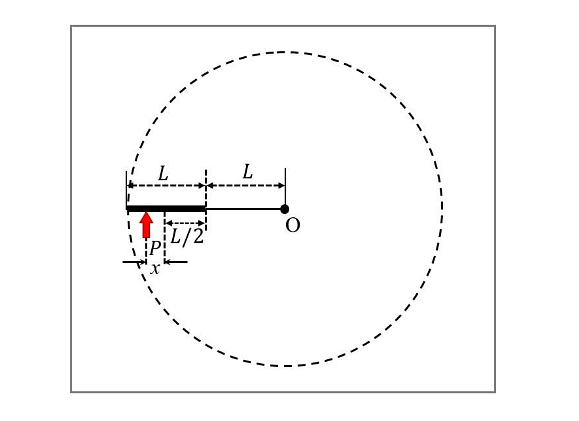
A thin uniform rod of length L and certain mass is kept on a frictionless horizontal table with a massless string of length L fixed to one end (top view is shown in the figure). The other end of the string is pivoted to a point O. If a horizontal impulse P is imparted to the rod at a distance x = L/n from the mid-point of the rod (see figure), then the rod and string revolve together around the point O, with the rod remaining aligned with the string. In such a case, the value of n is _____.
- JEE Advanced - 2024
- Friction