Question:medium
The correct statement(s) regarding sugars is(are):
Given: Specific rotations of L-(-)-glucose and L-(+)-fructose are \(-52.5^\circ\) and \(+92.5^\circ\), respectively.
The correct statement(s) regarding sugars is(are):
Given: Specific rotations of L-(-)-glucose and L-(+)-fructose are \(-52.5^\circ\) and \(+92.5^\circ\), respectively.
Show Hint
Glucose itself is oxidised to saccharic acid by nitric acid. Invert sugar is an equimolar glucose and fructose mixture, so its rotation is the average, which is -20 degrees.
Updated On: Nov 19, 2026
- On treatment with HNO$_3$, gluconic acid is oxidized to saccharic acid, whereas glucose is not oxidized to saccharic acid.
- Fructose gives a positive Fehling's test because it isomerises to glucose and another aldohexose in the presence of Fehling's reagent.
- Invert sugar is an equimolar mixture of D-glucose and D-fructose formed after hydrolysis of the corresponding disaccharide.
- Specific rotation of invert sugar is $-40^{\circ}$.
Show Solution
The Correct Option is B, C
Solution and Explanation
Step 1: Idea:
We test each statement with a known fact. For (D) we need a small calculation.
Step 2: Statement (A) fails:
Saccharic acid has COOH at both ends of the six carbon chain.
Nitric acid oxidises glucose all the way to this diacid. So the claim that glucose is not oxidised to saccharic acid is wrong.
(A) is FALSE.
Step 3: Statement (B) holds:
Fehling's solution is alkaline. In alkali a ketose like fructose rearranges via an enediol to give aldoses.
The aldoses formed are glucose and mannose (the C-2 epimer of glucose), both aldohexoses.
Aldoses reduce Cu(II), so fructose shows a positive test. (B) is TRUE.
Step 4: Statement (C) holds:
Sucrose + water gives glucose + fructose, one mole of each.
This 1 : 1 mixture is called invert sugar, because the sign of rotation flips from positive to negative. (C) is TRUE.
Step 5: Statement (D) uses the given data:
The enantiomer has the opposite rotation. So D-glucose is $+52.5^\circ$ and D-fructose is $-92.5^\circ$.
With equal moles, each sugar contributes half of its rotation.
\[ 0.5(52.5) + 0.5(-92.5) = 26.25 - 46.25 = -20^\circ \]
This is not $-40^\circ$. (D) is FALSE.
Final Answer:
Options (B) and (C) are correct. \[ \boxed{\text{B, C}} \]
Was this answer helpful?
0
Top Questions on Carbohydrates
- What is the structural feature of glucose that makes it a reducing sugar?
- MHT CET - 2024
- Chemistry
- Carbohydrates
- Carbohydrates are essential for life in both plants and animals. Carbohydrates are used as storage molecules as starch in plants and glycogen in animals. Chemically, they are polyhydroxy aldehydes or ketones. On the basis of their behavior on hydrolysis, carbohydrates are classified as monosaccharides, oligosaccharides, and polysaccharides.
All monosaccharides are reducing sugars, i.e., they are oxidized by Tollens' reagent and Fehling’s solution. A monosaccharide like glucose is an aldose, and its molecular formula was found to be C6H12O6. After reacting with different reagents like HI, H2N–OH, Bromine water, (CH3)2O, etc., its structure was found to contain one aldehyde group, one primary alcoholic group (–CH2OH), and four secondary alcoholic groups (>CHOH).
Despite having the aldehyde group, glucose does not give some of the reactions of aldehyde groups like Schiff’s test or NaHSO3 addition. This explains the existence of glucose in two cyclic hemiacetal forms, which differ only in the configuration of the hydroxyl group at C–1.- CBSE Class XII - 2024
- Chemistry
- Carbohydrates
- What happens when D-glucose is treated with the following reagents?
(a) Br$_2$ water
(b) HCN- CBSE Class XII - 2024
- Chemistry
- Carbohydrates
- The suitable Grignard reagent used for the synthesis of

with methanal is:- CBSE Class XII - 2024
- Chemistry
- Carbohydrates
- Want to practice more? Try solving extra ecology questions todayView All Questions
Questions Asked in JEE Advanced exam
A thin uniform rod of length L and certain mass is kept on a frictionless horizontal table with a massless string of length L fixed to one end (top view is shown in the figure). The other end of the string is pivoted to a point O. If a horizontal impulse P is imparted to the rod at a distance x = L/n from the mid-point of the rod (see figure), then the rod and string revolve together around the point O, with the rod remaining aligned with the string. In such a case, the value of n is _____.
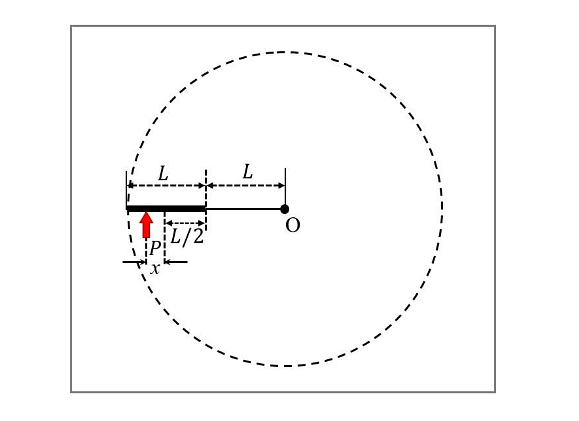
- JEE Advanced - 2024
- Friction