Question:medium
The correct order of dipole moments for the given species is
The correct order of dipole moments for the given species is
Show Hint
While comparing dipole moments, always check:
• Molecular geometry
• Symmetry of the molecule
• Direction of bond dipoles
• Effect of lone pairs A very important exception is: \[ \mu(\mathrm{NH_3}) > \mu(\mathrm{NF_3}) \] even though fluorine is more electronegative, because in \( \mathrm{NF_3} \) the lone pair dipole and bond dipoles oppose each other.
• Molecular geometry
• Symmetry of the molecule
• Direction of bond dipoles
• Effect of lone pairs A very important exception is: \[ \mu(\mathrm{NH_3}) > \mu(\mathrm{NF_3}) \] even though fluorine is more electronegative, because in \( \mathrm{NF_3} \) the lone pair dipole and bond dipoles oppose each other.
Updated On: Jun 4, 2026
- \( \mathrm{BF_3 = NH_4^+ < NF_3 < NH_3} \)
- \( \mathrm{BF_3 < NH_4^+ < NF_3 < NH_3} \)
- \( \mathrm{NH_4^+ < BF_3 < NH_3 < NF_3} \)
- \( \mathrm{BF_3 < NH_4^+ < NH_3 < NF_3} \)
Show Solution
The Correct Option is B
Solution and Explanation
Step 1: Understanding the Concept:
Dipole moment (\(\mu\)) is a vector quantity that depends on bond polarity (electronegativity difference) and molecular geometry (symmetry). A perfectly symmetrical molecule has a net dipole moment of zero because the individual bond dipoles cancel out.
Step 3: Detailed Explanation:
1. BF\(_3\): Trigonal planar geometry (sp\(^2\) hybridized B). The three B-F bond dipoles are equal in magnitude and directed at 120\(^{\circ}\) from each other. Vector sum is zero. \(\mu = 0\).
2. NH\(_4^+\): Tetrahedral geometry (sp\(^3\) hybridized N). Due to the perfect tetrahedral symmetry, the four N-H bond dipoles cancel each other out. \(\mu = 0\). Thus, BF\(_3 = \) NH\(_4^+\).
3. NH\(_3\) vs NF\(_3\): Both have pyramidal geometry. - In NH\(_3\), N is more electronegative than H. The bond dipoles point towards N. The lone pair dipole also points away from N in the same direction. They add up, resulting in a large net dipole. - In NF\(_3\), F is more electronegative than N. The bond dipoles point towards F. The lone pair dipole points in the opposite direction. They partially cancel out. Therefore, \(\mu(\text{NH}_3)>\mu(\text{NF}_3)\). Comparing all: \(0 = 0<\mu(\text{NF}_3)<\mu(\text{NH}_3)\).
Step 4: Final Answer:
The symmetrical molecules have zero dipole moment. NH\(_3\) has a higher dipole moment than NF\(_3\) because its bond dipoles and lone pair dipole reinforce each other.
Dipole moment (\(\mu\)) is a vector quantity that depends on bond polarity (electronegativity difference) and molecular geometry (symmetry). A perfectly symmetrical molecule has a net dipole moment of zero because the individual bond dipoles cancel out.
Step 3: Detailed Explanation:
1. BF\(_3\): Trigonal planar geometry (sp\(^2\) hybridized B). The three B-F bond dipoles are equal in magnitude and directed at 120\(^{\circ}\) from each other. Vector sum is zero. \(\mu = 0\).
2. NH\(_4^+\): Tetrahedral geometry (sp\(^3\) hybridized N). Due to the perfect tetrahedral symmetry, the four N-H bond dipoles cancel each other out. \(\mu = 0\). Thus, BF\(_3 = \) NH\(_4^+\).
3. NH\(_3\) vs NF\(_3\): Both have pyramidal geometry. - In NH\(_3\), N is more electronegative than H. The bond dipoles point towards N. The lone pair dipole also points away from N in the same direction. They add up, resulting in a large net dipole. - In NF\(_3\), F is more electronegative than N. The bond dipoles point towards F. The lone pair dipole points in the opposite direction. They partially cancel out. Therefore, \(\mu(\text{NH}_3)>\mu(\text{NF}_3)\). Comparing all: \(0 = 0<\mu(\text{NF}_3)<\mu(\text{NH}_3)\).
Step 4: Final Answer:
The symmetrical molecules have zero dipole moment. NH\(_3\) has a higher dipole moment than NF\(_3\) because its bond dipoles and lone pair dipole reinforce each other.
Was this answer helpful?
0
Top Questions on Inorganic chemistry
- Identify the incorrect statement about PCl5:
- NEET (UG) - 2024
- Chemistry
- Inorganic chemistry
- Out of the following complex compounds, which of the compound will be having the minimum conductance in solution?
- NEET (UG) - 2025
- Chemistry
- Inorganic chemistry
- Given below are two statements:
Statement I: Like nitrogen that can form ammonia, arsenic can form arsine.
Statement II: Antimony cannot form antimony pentoxide.
In the light of the above statements, choose the most appropriate answer from the options given below:- NEET (UG) - 2025
- Chemistry
- Inorganic chemistry
Which of the following statements are true?
A. Unlike Ga that has a very high melting point, Cs has a very low melting point.
B. On Pauling scale, the electronegativity values of N and C are not the same.
C. $Ar, K^{+}, Cl^{–}, Ca^{2+} and S^{2–}$ are all isoelectronic species.
D. The correct order of the first ionization enthalpies of Na, Mg, Al, and Si is Si $>$ Al $>$ Mg $>$ Na.
E. The atomic radius of Cs is greater than that of Li and Rb.
Choose the correct answer from the options given below:- NEET (UG) - 2025
- Chemistry
- Inorganic chemistry
- Want to practice more? Try solving extra ecology questions todayView All Questions
Questions Asked in JEE Advanced exam
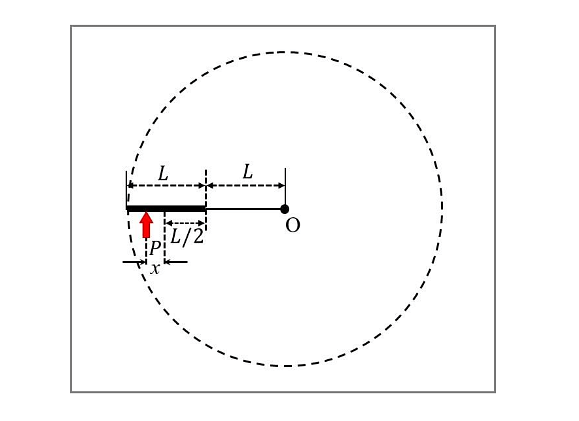
A thin uniform rod of length L and certain mass is kept on a frictionless horizontal table with a massless string of length L fixed to one end (top view is shown in the figure). The other end of the string is pivoted to a point O. If a horizontal impulse P is imparted to the rod at a distance x = L/n from the mid-point of the rod (see figure), then the rod and string revolve together around the point O, with the rod remaining aligned with the string. In such a case, the value of n is _____.
- JEE Advanced - 2024
- Friction