Question:medium
The \(2s\) and the \(2p\) orbital energies of hydrogen atom are \(E_{2s}(\mathrm{H})\) and \(E_{2p}(\mathrm{H})\), respectively. The \(2s\) and the \(2p\) orbital energies of lithium atom are \(E_{2s}(\mathrm{Li})\) and \(E_{2p}(\mathrm{Li})\), respectively. The correct option(s) about the orbital energies is(are)
The \(2s\) and the \(2p\) orbital energies of hydrogen atom are \(E_{2s}(\mathrm{H})\) and \(E_{2p}(\mathrm{H})\), respectively. The \(2s\) and the \(2p\) orbital energies of lithium atom are \(E_{2s}(\mathrm{Li})\) and \(E_{2p}(\mathrm{Li})\), respectively. The correct option(s) about the orbital energies is(are)
Show Hint
For hydrogen-like species:
\[
\text{Energy depends only on } n
\]
Hence,
\[
2s = 2p
\]
For multi-electron atoms:
\[
\text{Energy depends on both } n \text{ and } l
\]
Due to better penetration:
\[
s < p < d < f
\]
in energy for the same principal quantum number.
Updated On: Jun 4, 2026
- \(E_{2s}(\mathrm{Li}) < E_{2p}(\mathrm{Li})\)
- \(E_{2s}(\mathrm{H}) = E_{2p}(\mathrm{H})\)
- \(E_{2p}(\mathrm{H}) < E_{2s}(\mathrm{Li})\)
- \(E_{2s}(\mathrm{H}) > E_{2s}(\mathrm{Li})\)
Show Solution
The Correct Option is A
Solution and Explanation
Step 1: Understanding the Concept:
Orbital energies depend on the nuclear charge (\(Z\)) and the presence of other electrons. - Hydrogen-like species (single electron): The energy of an orbital depends only on the principal quantum number (\(n\)). Orbitals with the same \(n\) but different \(l\) are degenerate. - Multi-electron atoms (like Li): Due to electron-electron repulsion and the screening/shielding effect, the energy depends on both \(n\) and \(l\). s-orbitals are more penetrating and less shielded than p-orbitals of the same shell.
Step 3: Detailed Explanation:
1. Hydrogen atom (B): Since it has only one electron, energy is determined only by \(n\). Thus, \(E_{2s}(H) = E_{2p}(H)\). Statement (B) is True. 2. Lithium atom (A): In multi-electron atoms, the 2s electron is more penetrating and closer to the nucleus than the 2p electron. It experiences a higher effective nuclear charge (\(Z_{eff}\)) and lower shielding. Thus, the 2s orbital is lower in energy. \(E_{2s}(Li)<E_{2p}(Li)\). Statement (A) is True. 3. Comparison between H and Li (D): Energy is proportional to \(-Z_{eff}^2 / n^2\). For H, \(Z=1\). For Li, the valence 2s electron experiences a \(Z_{eff}>1\) (though screened by 1s electrons, it's still higher than 1). Also, the absolute value of the energy of an electron in Li is much more negative (more stable). In chemistry, "higher energy" usually means less stable (closer to zero). \(E = -13.6 \times (Z_{eff}^2/n^2)\) eV. For H: \(E_{2s} = -13.6/4 = -3.4\) eV. For Li: \(E_{2s} \approx -5.39\) eV. Thus, \(-3.4>-5.39\). So \(E_{2s}(H)>E_{2s}(Li)\). Statement (D) is True.
Step 4: Final Answer:
The degeneracy in hydrogen is removed in multi-electron atoms due to shielding. Higher nuclear charge leads to more negative (lower) energy levels.
Orbital energies depend on the nuclear charge (\(Z\)) and the presence of other electrons. - Hydrogen-like species (single electron): The energy of an orbital depends only on the principal quantum number (\(n\)). Orbitals with the same \(n\) but different \(l\) are degenerate. - Multi-electron atoms (like Li): Due to electron-electron repulsion and the screening/shielding effect, the energy depends on both \(n\) and \(l\). s-orbitals are more penetrating and less shielded than p-orbitals of the same shell.
Step 3: Detailed Explanation:
1. Hydrogen atom (B): Since it has only one electron, energy is determined only by \(n\). Thus, \(E_{2s}(H) = E_{2p}(H)\). Statement (B) is True. 2. Lithium atom (A): In multi-electron atoms, the 2s electron is more penetrating and closer to the nucleus than the 2p electron. It experiences a higher effective nuclear charge (\(Z_{eff}\)) and lower shielding. Thus, the 2s orbital is lower in energy. \(E_{2s}(Li)<E_{2p}(Li)\). Statement (A) is True. 3. Comparison between H and Li (D): Energy is proportional to \(-Z_{eff}^2 / n^2\). For H, \(Z=1\). For Li, the valence 2s electron experiences a \(Z_{eff}>1\) (though screened by 1s electrons, it's still higher than 1). Also, the absolute value of the energy of an electron in Li is much more negative (more stable). In chemistry, "higher energy" usually means less stable (closer to zero). \(E = -13.6 \times (Z_{eff}^2/n^2)\) eV. For H: \(E_{2s} = -13.6/4 = -3.4\) eV. For Li: \(E_{2s} \approx -5.39\) eV. Thus, \(-3.4>-5.39\). So \(E_{2s}(H)>E_{2s}(Li)\). Statement (D) is True.
Step 4: Final Answer:
The degeneracy in hydrogen is removed in multi-electron atoms due to shielding. Higher nuclear charge leads to more negative (lower) energy levels.
Was this answer helpful?
0
Top Questions on Quantum Mechanical Model of Atom
- Which of the following quantum numbers determines the shape of an orbital?
- MHT CET - 2025
- Chemistry
- Quantum Mechanical Model of Atom
- A photon has an energy of \( 3.2 \times 10^{-19} \, \text{J} \). What is the frequency of the photon?
- MHT CET - 2025
- Physics
- Quantum Mechanical Model of Atom
- In the case of a particle in a one-dimensional infinite potential well (box), what is the probability of finding the particle in the first half of the box for the ground state?
- MHT CET - 2025
- Physics
- Quantum Mechanical Model of Atom
- The quantum numbers of four electrons are given below:
I. \( n = 4; l = 2; m_l = -2; s = -\frac{1}{2} \)
II. \( n = 3; l = 2; m_l = 1; s = +\frac{1}{2} \)
III. \( n = 4; l = 1; m_l = 0; s = +\frac{1}{2} \)
IV. \( n = 3; l = 1; m_l = -1; s = +\frac{1}{2} \)
The correct decreasing order of energy of these electrons is:- NEET (UG) - 2024
- Chemistry
- Quantum Mechanical Model of Atom
- Want to practice more? Try solving extra ecology questions todayView All Questions
Questions Asked in JEE Advanced exam
A thin uniform rod of length L and certain mass is kept on a frictionless horizontal table with a massless string of length L fixed to one end (top view is shown in the figure). The other end of the string is pivoted to a point O. If a horizontal impulse P is imparted to the rod at a distance x = L/n from the mid-point of the rod (see figure), then the rod and string revolve together around the point O, with the rod remaining aligned with the string. In such a case, the value of n is _____.
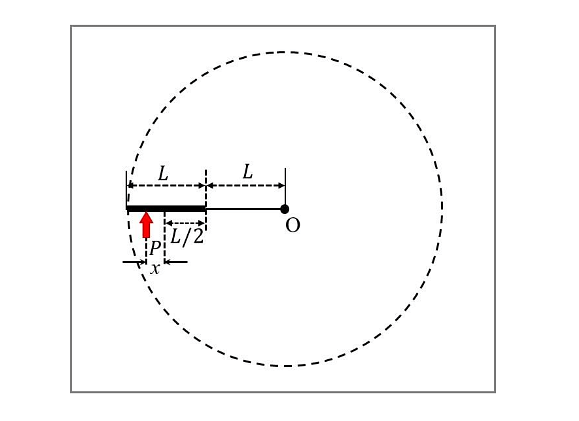
- JEE Advanced - 2024
- Friction