Question:hard
Suppose the function \(f\) satisfies the equation \(f(x+y) = f(x)f(y)\) for all \(x\) and \(y\). Here \(f(x) = 1 + xg(x)\), where \(\displaystyle\lim_{x \to 0} g(x) = T\), and \(T\) is a positive integer. If \(f^{n}(x) = kf(x)\), where \(f^{n}(x)\) denotes the \(n\)th derivative of \(f\), then \(k\) is equal to:
Suppose the function \(f\) satisfies the equation \(f(x+y) = f(x)f(y)\) for all \(x\) and \(y\). Here \(f(x) = 1 + xg(x)\), where \(\displaystyle\lim_{x \to 0} g(x) = T\), and \(T\) is a positive integer. If \(f^{n}(x) = kf(x)\), where \(f^{n}(x)\) denotes the \(n\)th derivative of \(f\), then \(k\) is equal to:
Show Hint
Differentiate the functional equation to show f'(x) = Tf(x), then repeat this n times to find the nth derivative in terms of f(x).
Updated On: Jul 13, 2026
- \(T\)
- \(T^n\)
- \(\log T\)
- \((\log T)^n\)
Show Solution
The Correct Option is B
Solution and Explanation
Here is a different way to reach the same result, using induction instead of solving the differential equation outright.
- Find f(0): putting $x=y=0$ into $f(x+y)=f(x)f(y)$ gives $f(0)=f(0)^2$, so $f(0)=0$ or $f(0)=1$. Since $f(x)=1+xg(x)$ forces $f(0)=1$, we keep $f(0)=1$.
- Find f'(0): from $f(x)=1+xg(x)$, for small $h$ we get $f(h)-1=hg(h)$, so $\frac{f(h)-1}{h}=g(h)$. Taking $h \to 0$ gives $f'(0)=\lim_{h\to0}g(h)=T$. This is the instantaneous rate of change of $f$ right at $x=0$.
- Show f'(x) = Tf(x) everywhere: differentiate $f(x+h)=f(x)f(h)$ with respect to $h$ and then set $h=0$. This gives $f'(x)=f(x)f'(0)=Tf(x)$ for every $x$, not only at $x=0$.
- Induction base case: for $n=1$, $f'(x)=Tf(x)$ is already shown above, so $k=T^1=T$ works for $n=1$.
- Induction step: assume $f^{(n)}(x)=T^nf(x)$ holds for some $n$. Differentiating both sides gives $f^{(n+1)}(x)=T^nf'(x)=T^n \cdot Tf(x)=T^{n+1}f(x)$, so the formula also holds for $n+1$.
By induction, $f^{(n)}(x)=T^nf(x)$ for every positive integer $n$. Comparing with the given relation $f^{n}(x)=kf(x)$, we read off $k=T^n$.
Let's summarize:
- The functional equation plus the given form of $f$ pin down $f'(0)=T$.
- The same functional equation forces $f'(x)=Tf(x)$ at every point, not just at $0$.
- Repeating differentiation $n$ times multiplies in a factor of $T$ each time, giving $k=T^n$.
So $k=T^n$, matching option (B). A logarithm of $T$ never enters this relation; that only appears if you try to solve for $f(x)$ itself, which is a different quantity from $k$.
Was this answer helpful?
0
Questions Asked in XAT exam
Applicants have been shortlisted for interviews for some data analyst positions. Some of the applicants have advanced expertise in one or more fields among the following: data analysis, database handling and coding. The numbers of applicants with different advanced expertise are given in the 2 × 8 table below.
The number of applicants with advanced expertise in all three fields is given as x in the table, where x is a non-negative integer.
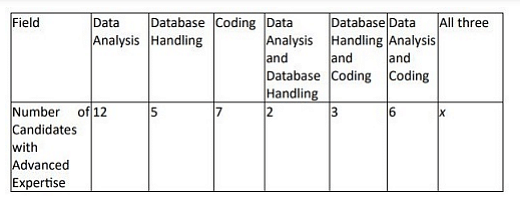
The number of applicants with advanced expertise in all three fields is given as x in the table, where x is a non-negative integer.
- XAT - 2024
- Data Interpretation