Question:medium
Suppose that Box I contains \(6\) red balls and \(9\) green balls, and Box II contains \(8\) red balls and \(12\) green balls. All the balls of Box I and Box II are mixed together and a ball is chosen at random from them. Let \(E_1\) be the event that the ball chosen belonged to Box I and let \(E_2\) be the event that the ball chosen belonged to Box II. Let \(F_1\) be the event that the ball chosen is red and let \(F_2\) be the event that the ball chosen is green.
Then which of the following statements is (are) TRUE?
Suppose that Box I contains \(6\) red balls and \(9\) green balls, and Box II contains \(8\) red balls and \(12\) green balls. All the balls of Box I and Box II are mixed together and a ball is chosen at random from them. Let \(E_1\) be the event that the ball chosen belonged to Box I and let \(E_2\) be the event that the ball chosen belonged to Box II. Let \(F_1\) be the event that the ball chosen is red and let \(F_2\) be the event that the ball chosen is green.
Then which of the following statements is (are) TRUE?
Show Hint
Before doing any big calculation, check whether every box has the same red-to-green ratio. If it does, picking a box tells you nothing about colour, and that one observation answers most of the independence-type statements immediately.
Updated On: Aug 18, 2026
- The events \(E_1\) and \(F_1\) are independent
- The events \(E_2\) and \(F_2\) are dependent
- The conditional probability \(P(F_1|E_1)\) is equal to the conditional probability \(P(F_1|E_2)\)
- The conditional probability \(P(F_1|E_1)\) is greater than the conditional probability \(P(F_2|E_2)\)
Show Solution
The Correct Option is A
Solution and Explanation
Step 1: Understanding the Concept:
Two events \( A \) and \( B \) are independent if \( P(A|B) = P(A) \). In the context of probability experiments with subsets (boxes), independence occurs if the proportion of the desired trait (e.g., color) is exactly the same across all subsets.
Step 2: Key Formula or Approach:
Box I: Red (\( R \)) = 6, Green (\( G \)) = 9, Total (\( T_1 \)) = 15.
Box II: \( R \) = 8, \( G \) = 12, Total (\( T_2 \)) = 20.
Total balls mixed = 35.
Step 3: Detailed Explanation:
1. Probabilities of Box Selection:
Since there are 15 balls in Box I and 20 in Box II, and all are mixed:
\( P(E_1) = 15/35 = 3/7 \).
\( P(E_2) = 20/35 = 4/7 \).
2. Conditional Probabilities of Colors:
If we know a ball is from Box I: \( P(F_1 | E_1) = 6/15 = 2/5 = 0.4 \).
If we know a ball is from Box II: \( P(F_1 | E_2) = 8/20 = 2/5 = 0.4 \).
Since \( P(F_1 | E_1) = P(F_1 | E_2) \), statement (C) is True.
3. Marginal Probabilities:
\( P(F_1) = P(E_1)P(F_1|E_1) + P(E_2)P(F_1|E_2) = (3/7)(2/5) + (4/7)(2/5) = 2/5 \).
\( P(F_2) = 1 - 2/5 = 3/5 \).
4. Independence check (A and B):
\( P(F_1 | E_1) = 2/5 = P(F_1) \). This implies \( E_1 \) and \( F_1 \) are independent. Statement (A) is True.
Similarly, \( P(F_2 | E_2) = 12/20 = 3/5 = P(F_2) \). This implies \( E_2 \) and \( F_2 \) are independent. Statement (B) is False.
5. Reverse Conditional check (D):
\( P(E_1 | F_1) = \frac{P(E_1 \cap F_1)}{P(F_1)} = \frac{(3/7)(2/5)}{2/5} = 3/7 \approx 0.428 \).
\( P(E_2 | F_2) = \frac{P(E_2 \cap F_2)}{P(F_2)} = \frac{(4/7)(3/5)}{3/5} = 4/7 \approx 0.571 \).
\( 3/7<4/7 \), so statement (D) is False.
Step 4: Final Answer:
Statements (A) and (C) are the correct choices.
Two events \( A \) and \( B \) are independent if \( P(A|B) = P(A) \). In the context of probability experiments with subsets (boxes), independence occurs if the proportion of the desired trait (e.g., color) is exactly the same across all subsets.
Step 2: Key Formula or Approach:
Box I: Red (\( R \)) = 6, Green (\( G \)) = 9, Total (\( T_1 \)) = 15.
Box II: \( R \) = 8, \( G \) = 12, Total (\( T_2 \)) = 20.
Total balls mixed = 35.
Step 3: Detailed Explanation:
1. Probabilities of Box Selection:
Since there are 15 balls in Box I and 20 in Box II, and all are mixed:
\( P(E_1) = 15/35 = 3/7 \).
\( P(E_2) = 20/35 = 4/7 \).
2. Conditional Probabilities of Colors:
If we know a ball is from Box I: \( P(F_1 | E_1) = 6/15 = 2/5 = 0.4 \).
If we know a ball is from Box II: \( P(F_1 | E_2) = 8/20 = 2/5 = 0.4 \).
Since \( P(F_1 | E_1) = P(F_1 | E_2) \), statement (C) is True.
3. Marginal Probabilities:
\( P(F_1) = P(E_1)P(F_1|E_1) + P(E_2)P(F_1|E_2) = (3/7)(2/5) + (4/7)(2/5) = 2/5 \).
\( P(F_2) = 1 - 2/5 = 3/5 \).
4. Independence check (A and B):
\( P(F_1 | E_1) = 2/5 = P(F_1) \). This implies \( E_1 \) and \( F_1 \) are independent. Statement (A) is True.
Similarly, \( P(F_2 | E_2) = 12/20 = 3/5 = P(F_2) \). This implies \( E_2 \) and \( F_2 \) are independent. Statement (B) is False.
5. Reverse Conditional check (D):
\( P(E_1 | F_1) = \frac{P(E_1 \cap F_1)}{P(F_1)} = \frac{(3/7)(2/5)}{2/5} = 3/7 \approx 0.428 \).
\( P(E_2 | F_2) = \frac{P(E_2 \cap F_2)}{P(F_2)} = \frac{(4/7)(3/5)}{3/5} = 4/7 \approx 0.571 \).
\( 3/7<4/7 \), so statement (D) is False.
Step 4: Final Answer:
Statements (A) and (C) are the correct choices.
Was this answer helpful?
0
Top Questions on Bayes' Theorem
- If a box contains 19 unbiased coins and 1 biased coin with both faces heads, and a coin is randomly chosen from this box and tossed. If the head appears, then the probability that the unbiased coin was selected is:
- JEE Main - 2025
- Mathematics
- Bayes' Theorem
- Three urn A, B, C, A has 7 red and 5 black balls, B has 5 red and 7 black balls, C has 6 red and 6 black balls. One urn is selected and black ball is taken out. Find probability that the selected urn is A.
- JEE Main
- Mathematics
- Bayes' Theorem
- For \( k = 1, 2, 3 \), the box \( B_k \) contains red balls and \( (k+1) \) white balls. Let \( P(B_1) = \frac{1}{2}, P(B_2) = \frac{1}{3}, P(B_3) = \frac{1}{6} \). A box is selected at random and a ball is drawn from it. If a red ball is drawn, then the probability that it came from box \( B_2 \) is
- BITSAT - 2013
- Mathematics
- Bayes' Theorem
- \(25 \%\) of the population are smokers A smoker has 27 times more chances to develop lung cancer than a non smoker A person is diagnosed with lung cancer and the probability that this person is a smoker is \(\frac{k}{10}\), Then the value of \(k\) is____
- JEE Main - 2023
- Mathematics
- Bayes' Theorem
- Want to practice more? Try solving extra ecology questions todayView All Questions
Questions Asked in JEE Advanced exam
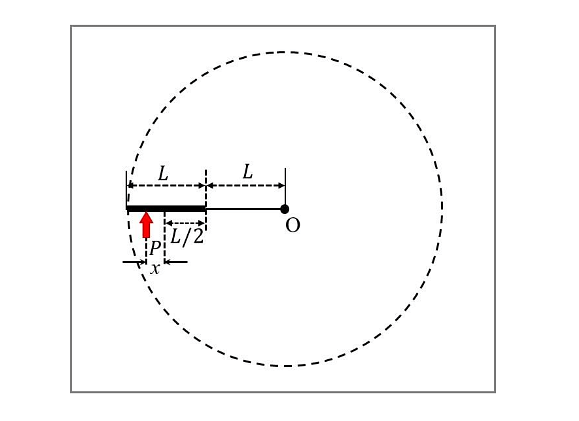
A thin uniform rod of length L and certain mass is kept on a frictionless horizontal table with a massless string of length L fixed to one end (top view is shown in the figure). The other end of the string is pivoted to a point O. If a horizontal impulse P is imparted to the rod at a distance x = L/n from the mid-point of the rod (see figure), then the rod and string revolve together around the point O, with the rod remaining aligned with the string. In such a case, the value of n is _____.
- JEE Advanced - 2024
- Friction