Question:medium
Suppose \(S\) and \(T\) are sets of vectors, where \(S = \{(1,0,0), (0, 0, -5), (0, 3, 4)\}\) and \(T = \{(5, 2, 3), (5, -3, 4)\}\), then:
Suppose \(S\) and \(T\) are sets of vectors, where \(S = \{(1,0,0), (0, 0, -5), (0, 3, 4)\}\) and \(T = \{(5, 2, 3), (5, -3, 4)\}\), then:
Show Hint
Check if the determinant formed by the three vectors of S is nonzero, and check whether either vector of T is a scalar multiple of the other.
Updated On: Jul 13, 2026
- S and T both sets are linearly independent vectors
- S is a set of linearly independent vectors, but T is not
- T is a set of linearly independent vectors, but S is not
- Neither S nor T is a set of linearly independent vectors
Show Solution
The Correct Option is A
Solution and Explanation
Here is a different way to reach the same result, by solving the defining equations directly instead of computing a determinant.
- Set up the homogeneous system for S: for $S = \{(1,0,0), (0,0,-5), (0,3,4)\}$, write $a(1,0,0) + b(0,0,-5) + c(0,3,4) = (0,0,0)$. Adding the components gives the vector $(a, 3c, -5b+4c)$, so the equations are $a=0$, $3c=0$, and $-5b+4c=0$.
- Solve this system: from $a=0$ and $3c=0$ we get $a=0, c=0$. Putting $c=0$ into the third equation gives $-5b=0$, so $b=0$. The only solution is $a=b=c=0$, the trivial one, which means S is linearly independent.
- Check T using ratios: for $T = \{(5,2,3), (5,-3,4)\}$, two vectors are dependent only when every pair of matching coordinates is in the same ratio. Compare $5/5=1$, $2/(-3)\approx -0.67$, and $3/4=0.75$. Since these three ratios are not all equal, the vectors cannot be scalar multiples of each other.
- Conclude for T: because no single scalar relates the two vectors, T is also linearly independent.
Both the system-of-equations check for S and the ratio check for T confirm that neither set contains a vector that depends on the others. So both S and T qualify as linearly independent sets.
Let's summarize:
- Solving $a(1,0,0)+b(0,0,-5)+c(0,3,4)=0$ forces $a=b=c=0$, so S is independent.
- The coordinate ratios of the two vectors in T are not all equal, so T is independent too.
So the correct choice is that both S and T are linearly independent, matching option (A).
Was this answer helpful?
0
Top Questions on Vector Algebra
- A vector parallel to the line of intersection of the planes \[ \overrightarrow{r} \cdot (3\hat{i} - \hat{j} + \hat{k}) = 1 \quad \text{and} \quad \overrightarrow{r} \cdot (\hat{i} + 4\hat{j} - 2\hat{k}) = 2 \] is:
- MHT CET - 2024
- Mathematics
- Vector Algebra
- Let \( p: \) I am brave, \( q: \) I will climb the Mount Everest. The symbolic form of a statement, 'I am neither brave nor I will climb the Mount Everest' is:
- MHT CET - 2024
- Mathematics
- Vector Algebra
If \( X \) is a random variable such that \( P(X = -2) = P(X = -1) = P(X = 2) = P(X = 1) = \frac{1}{6} \), and \( P(X = 0) = \frac{1}{3} \), then the mean of \( X \) is
- MHT CET - 2024
- Mathematics
- Vector Algebra
- Which of the following is correct?
- MHT CET - 2024
- Mathematics
- Vector Algebra
- Want to practice more? Try solving extra ecology questions todayView All Questions
Questions Asked in XAT exam
Applicants have been shortlisted for interviews for some data analyst positions. Some of the applicants have advanced expertise in one or more fields among the following: data analysis, database handling and coding. The numbers of applicants with different advanced expertise are given in the 2 × 8 table below.
The number of applicants with advanced expertise in all three fields is given as x in the table, where x is a non-negative integer.
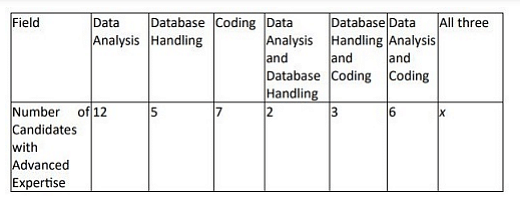
The number of applicants with advanced expertise in all three fields is given as x in the table, where x is a non-negative integer.
- XAT - 2024
- Data Interpretation