Six square states of equal area are arranged in two columns running north to south in a country. State 1, State 3, and State 5 lie on the western side, from north to south, and State 2, State 4, and State 6 lie on the eastern side, from north to south, so the states directly across the street from each other are State 1 and State 2, State 3 and State 4, and State 5 and State 6. Two states share a boundary if they sit next to each other in the same column (north-south) or directly across from each other (east-west). Within these six states there are exactly eight institutions in total: four medical institutes, two management institutes, and two technical institutes, placed according to these rules:
1. No institution is located in more than one state.
2. No state contains more than one management institute, and no state contains more than one technical institute.
3. No state contains both a management institute and a technical institute.
4. Every management institute is located in a state that also contains at least one medical institute.
5. The two technical institutes are located in states that do not share a common boundary.
6. State 3 contains a technical institute, and State 6 contains a management institute.
If each of the six states contains at least one of the eight institutions, then which one of the following must be true?
1. No institution is located in more than one state.
2. No state contains more than one management institute, and no state contains more than one technical institute.
3. No state contains both a management institute and a technical institute.
4. Every management institute is located in a state that also contains at least one medical institute.
5. The two technical institutes are located in states that do not share a common boundary.
6. State 3 contains a technical institute, and State 6 contains a management institute.
If each of the six states contains at least one of the eight institutions, then which one of the following must be true?
Show Hint
- There is a management institute in State 1
- There is a medical institute in State 2
- There is a medical institute in State 3
- There is a medical institute in State 4
The Correct Option is D
Solution and Explanation
The extra condition here, that every one of the six states must hold at least one institution, is the key that turns a "could be true" question into a "must be true" question. Before this condition, State 1, State 4 and State 5 were free to be empty. After it, none of them can be.
Count what is left to distribute. The 8 institutions are 4 medical, 2 management and 2 technical. State 2 and State 3 already use up the 2 technical institutes. State 6 already uses up 1 management institute and, by the rule that a management institute needs a medical institute in its own state, 1 medical institute too. That leaves 1 management institute and 3 medical institutes still to be placed, and they can only go into State 1, State 4 and State 5, since State 2, State 3 and State 6 are already accounted for.
Since each of State 1, State 4 and State 5 must now get at least one institution, and there are exactly 4 institutions left for exactly 3 states, one state gets 2 institutions, the leftover management institute plus a medical institute, since management needs a medical partner, and the other two states get 1 medical institute each. Every possible way of doing this still gives all three states a medical institute.
- Management institute in State 1: only holds in the one arrangement where State 1 is chosen to carry the leftover management institute, not in the other two, so it does not always hold.
- Medical institute in State 2: cannot hold, State 2's institution slot is already taken by a technical institute, and using it for medical too would strand one of State 1, State 4 or State 5 without any institution.
- Medical institute in State 3: cannot hold, for the same reason as State 2.
- Medical institute in State 4: always holds, because every possible way of sharing out the leftover management institute and 3 medical institutes among State 1, State 4 and State 5 gives State 4 at least one medical institute.
So the statement that always holds, no matter how the remaining institutes are shared out, is that State 4 has a medical institute.
Let's summarize:
- State 2 and State 3 are full with technical institutes, so they cannot take on a medical institute without breaking the "every state has something" rule.
- The last management institute and the last 3 medical institutes must be shared among State 1, State 4 and State 5, each of which needs at least one institution.
- Every possible sharing gives all three of State 1, State 4 and State 5 a medical institute, so this is guaranteed for State 4 specifically.
The correct answer is that there is a medical institute in State 4.
Top Questions on Complex Arrangement
- Four married couples competed in a singing competition. Each couple had a unique team name. Points scored by the teams were 2, 4, 6 and 8. The 'Sweet Couple' won 2 points. The 'Bindas Singers' won two more points than Laxman's team. Mukesh's team won four points more than Lina's team, but Lina's team didn't score the least amount of points. 'Just Singing' won 6 points. Waheda wasn't on the team called 'New Singers'. Sanjeev's team won 4 points. Divya wasn't on the 'Bindas Singers' team. Tapas and Sania were on the same team, but it wasn't the 'Sweet Couple'.
Laxman's teammate and team's name were:- XAT - 2009
- Decision Making
- Complex Arrangement
- Four married couples competed in a singing competition. Each couple had a unique team name. Points scored by the teams were 2, 4, 6 and 8. The 'Sweet Couple' won 2 points. The 'Bindas Singers' won two more points than Laxman's team. Mukesh's team won four points more than Lina's team, but Lina's team didn't score the least amount of points. 'Just Singing' won 6 points. Waheda wasn't on the team called 'New Singers'. Sanjeev's team won 4 points. Divya wasn't on the 'Bindas Singers' team. Tapas and Sania were on the same team, but it wasn't the 'Sweet Couple'.
The teams arranged in the ascending order of points are:- XAT - 2009
- Decision Making
- Complex Arrangement
- Four married couples competed in a singing competition. Each couple had a unique team name. Points scored by the teams were 2, 4, 6 and 8. The 'Sweet Couple' won 2 points. The 'Bindas Singers' won two more points than Laxman's team. Mukesh's team won four points more than Lina's team, but Lina's team didn't score the least amount of points. 'Just Singing' won 6 points. Waheda wasn't on the team called 'New Singers'. Sanjeev's team won 4 points. Divya wasn't on the 'Bindas Singers' team. Tapas and Sania were on the same team, but it wasn't the 'Sweet Couple'.
The combination which has the couples rightly paired is:- XAT - 2009
- Decision Making
- Complex Arrangement
The regular mathematics faculty could not teach because of being sick. As a stop-gap arrangement, different visiting faculty taught different topics on 4 different days in a week. The scheduled time for class was 7:00 am, with a maximum permissible delay of 20 minutes. The monsoon made the city bus schedules erratic, so the classes started at different times on different days.
Mr. Singh did not teach on Thursday. Calculus was taught in the class that started at 7:20 am. Mr. Chatterjee took the class on Wednesday, but he did not teach probability. The class on Monday started at 7:00 am, but Mr. Singh did not teach it. Mr. Dutta did not teach ratio and proportion. Mr. Banerjee, who did not teach set theory, taught a class that started five minutes later than the class in which probability was taught. The teacher in Friday's class taught set theory. Wednesday's class did not start at 7:10 am. No two classes started at the same time.
77. The class on Wednesday started at:
- XAT - 2009
- Decision Making
- Complex Arrangement
- Want to practice more? Try solving extra ecology questions todayView All Questions
Questions Asked in XAT exam
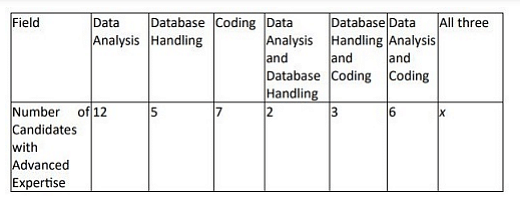
The number of applicants with advanced expertise in all three fields is given as x in the table, where x is a non-negative integer.
- XAT - 2024
- Data Interpretation