Question:medium
Set of real numbers 'x, y', satisfying the inequations \(x - 3y \geq 0\), \(x + y \geq -2\) and \(3x - y \leq -2\) is:
Set of real numbers 'x, y', satisfying the inequations \(x - 3y \geq 0\), \(x + y \geq -2\) and \(3x - y \leq -2\) is:
Show Hint
Convert each inequality into a bound on y in terms of x, then check whether the resulting range of valid x and y values is empty, a single point, or a full region.
Updated On: Jul 13, 2026
- Empty
- Finite
- Infinite
- Cannot be determined
Show Solution
The Correct Option is C
Solution and Explanation
Step 1: Turn each inequality into a bound on y.
Rewrite each condition so $y$ is isolated:
From $x - 3y \geq 0$: $y \leq \frac{x}{3}$.
From $x + y \geq -2$: $y \geq -2 - x$.
From $3x - y \leq -2$: $y \geq 3x + 2$.
So for a given $x$, $y$ must satisfy $\max(-2-x, \, 3x+2) \leq y \leq \frac{x}{3}$.
Step 2: Find which of the two lower bounds is larger, depending on x.
Compare $-2-x$ and $3x+2$: $-2-x \geq 3x+2 \iff -4 \geq 4x \iff x \leq -1$.
So for $x \leq -1$, the lower bound is $-2-x$; for $x > -1$, the lower bound is $3x+2$.
Step 3: Find the range of x for which the lower bound does not exceed the upper bound.
For $x \leq -1$: need $-2-x \leq \frac{x}{3}$, which gives $-6-3x \leq x$, so $x \geq -\frac{3}{2}$. Combined with $x \leq -1$, this gives $-\frac{3}{2} \leq x \leq -1$.
For $x > -1$: need $3x+2 \leq \frac{x}{3}$, which gives $9x+6 \leq x$, so $x \leq -\frac{3}{4}$. Combined with $x>-1$, this gives $-1 < x \leq -\frac{3}{4}$.
Putting both pieces together, $x$ ranges over the interval $\left[-\frac{3}{2}, -\frac{3}{4}\right]$, which is a proper interval containing infinitely many real values, not a single point.
Step 4: Check that each such x gives a real range of y, not just a single value.
Take $x = -1.2$, which lies inside the interval: lower bound $= -2-(-1.2) = -0.8$, upper bound $= \frac{-1.2}{3} = -0.4$. Since $-0.8 < -0.4$, $y$ can be any of the infinitely many real numbers between $-0.8$ and $-0.4$, and each choice gives a valid $(x,y)$ pair.
Step 5: Conclude.
Since there is a whole interval of valid $x$ values, and for each of these an entire interval of valid $y$ values, the total set of pairs $(x,y)$ satisfying all three inequalities is a two-dimensional region, not empty and not a finite list of isolated points.
\[ \boxed{\text{The solution set is infinite}} \]
Rewrite each condition so $y$ is isolated:
From $x - 3y \geq 0$: $y \leq \frac{x}{3}$.
From $x + y \geq -2$: $y \geq -2 - x$.
From $3x - y \leq -2$: $y \geq 3x + 2$.
So for a given $x$, $y$ must satisfy $\max(-2-x, \, 3x+2) \leq y \leq \frac{x}{3}$.
Step 2: Find which of the two lower bounds is larger, depending on x.
Compare $-2-x$ and $3x+2$: $-2-x \geq 3x+2 \iff -4 \geq 4x \iff x \leq -1$.
So for $x \leq -1$, the lower bound is $-2-x$; for $x > -1$, the lower bound is $3x+2$.
Step 3: Find the range of x for which the lower bound does not exceed the upper bound.
For $x \leq -1$: need $-2-x \leq \frac{x}{3}$, which gives $-6-3x \leq x$, so $x \geq -\frac{3}{2}$. Combined with $x \leq -1$, this gives $-\frac{3}{2} \leq x \leq -1$.
For $x > -1$: need $3x+2 \leq \frac{x}{3}$, which gives $9x+6 \leq x$, so $x \leq -\frac{3}{4}$. Combined with $x>-1$, this gives $-1 < x \leq -\frac{3}{4}$.
Putting both pieces together, $x$ ranges over the interval $\left[-\frac{3}{2}, -\frac{3}{4}\right]$, which is a proper interval containing infinitely many real values, not a single point.
Step 4: Check that each such x gives a real range of y, not just a single value.
Take $x = -1.2$, which lies inside the interval: lower bound $= -2-(-1.2) = -0.8$, upper bound $= \frac{-1.2}{3} = -0.4$. Since $-0.8 < -0.4$, $y$ can be any of the infinitely many real numbers between $-0.8$ and $-0.4$, and each choice gives a valid $(x,y)$ pair.
Step 5: Conclude.
Since there is a whole interval of valid $x$ values, and for each of these an entire interval of valid $y$ values, the total set of pairs $(x,y)$ satisfying all three inequalities is a two-dimensional region, not empty and not a finite list of isolated points.
\[ \boxed{\text{The solution set is infinite}} \]
Was this answer helpful?
0
Top Questions on linear inequalities
- If \( AX = B \), where \[ A = \begin{bmatrix} 1 & -1 & 1 \\ 2 & 1 & -3 \\ 1 & 1 & 1 \end{bmatrix}, \quad X = \begin{bmatrix} x \\ y \\ z \end{bmatrix}, \quad B = \begin{bmatrix} 4 \\ 0 \\ 2 \end{bmatrix}, \] then \( 2x + y - z \) is:
- MHT CET - 2024
- Mathematics
- linear inequalities
- If \[ A = \begin{bmatrix} 0 & 1 & 2 \\ 1 & 2 & 3 \\ 3 & a & 1 \end{bmatrix} \] and \[ A^{-1} = \frac{1}{2} \begin{bmatrix} 1 & -1 & 1 \\ -8 & 6 & 2c \\ 5 & -3 & 1 \end{bmatrix}, \] then the values of \( a \) and \( c \) are respectively:
- MHT CET - 2024
- Mathematics
- linear inequalities
- The sum of the ages of a father and his son is 60 years. The father is three times as old as the son. What is the son's age?
- MHT CET - 2025
- Mathematics
- linear inequalities
- Solve the system of equations: \[ x + y = 5 \] \[ 2x - y = 4 \]
- MHT CET - 2025
- Mathematics
- linear inequalities
- Want to practice more? Try solving extra ecology questions todayView All Questions
Questions Asked in XAT exam
Applicants have been shortlisted for interviews for some data analyst positions. Some of the applicants have advanced expertise in one or more fields among the following: data analysis, database handling and coding. The numbers of applicants with different advanced expertise are given in the 2 × 8 table below.
The number of applicants with advanced expertise in all three fields is given as x in the table, where x is a non-negative integer.
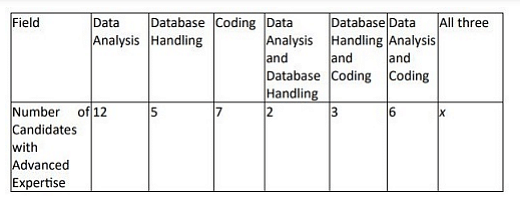
The number of applicants with advanced expertise in all three fields is given as x in the table, where x is a non-negative integer.
- XAT - 2024
- Data Interpretation