Sangeeta and Swati bought two wristwatches from Jamshedpur Electronics at 11:40 AM IST. After buying them, they found that when 60 minutes pass on a correct clock (IST), Sangeeta's wristwatch registers 62 minutes, while Swati's wristwatch registers 56 minutes. Later that day, Sangeeta's wristwatch reads 10:00 PM. What time does Swati's wristwatch show at that moment?
Show Hint
- 8:40 PM
- 9:00 PM
- 9:20 PM
- 9:40 PM
The Correct Option is B
Solution and Explanation
A faster route: skip the real clock altogether and directly compare the two watches' speeds against each other.
Sangeeta's watch runs at $62$ units while $60$ real minutes pass, and Swati's watch runs at $56$ units over the same $60$ real minutes. So the ratio of Sangeeta's watch-minutes to Swati's watch-minutes, for the same stretch of real time, is:
\[ \frac{62}{56} = \frac{31}{28} \]This means whenever Sangeeta's watch advances by $31$ units, Swati's watch advances by exactly $28$ units, since both are being measured over the identical real time span.
From 11:40 AM to 10:00 PM, Sangeeta's watch has moved forward by $620$ minutes (10 hours 20 minutes). Scale this down by the $28/31$ ratio to get how far Swati's watch has moved:
\[ 620 \times \frac{28}{31} = 20 \times 28 = 560 \text{ minutes} \]Here $620/31=20$ exactly, which is why the ratio was written as $31:28$ rather than left as $62:56$, since it divides out cleanly.
560 minutes is 9 hours 20 minutes. Adding that to the starting time of 11:40 AM gives 11:40 AM + 9 hours 20 minutes = 9:00 PM.
So Swati's watch shows 9:00 PM at that moment, confirming option B.
Top Questions on Arithmetic
- There are 25 rooms in a hotel. Each room can accommodate at most three people. For each room, the single occupancy charge is Rs. 2000 per day, the double occupancy charge is Rs. 3000 per day, and the triple occupancy charge is Rs. 3500 per day. If there are 55 people staying in the hotel today, what is the maximum possible revenue from room occupancy charges today?
- Evaluate \(\sqrt[3]{1372} \times \sqrt[3]{1458}\)
- TS EDCET - 2025
- Quantitative Aptitude
- Arithmetic
- Gopi sold a watch to Ibrahim at 12% gain and Ibrahim sold it to John at a loss of 5%. If John paid ₹ 1,330, then find how much did Gopi sell it?
- TS EDCET - 2025
- Quantitative Aptitude
- Arithmetic
- Rani read \(\frac{3}{5}\) of a book. If she finds that there are still 80 pages left to read, then the total number of pages in the book is.
- TS EDCET - 2025
- Quantitative Aptitude
- Arithmetic
- Want to practice more? Try solving extra ecology questions todayView All Questions
Questions Asked in XAT exam
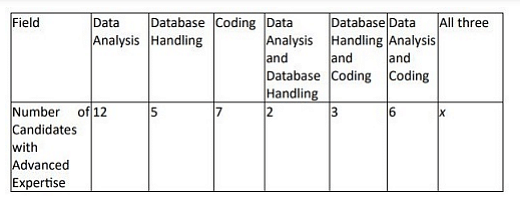
The number of applicants with advanced expertise in all three fields is given as x in the table, where x is a non-negative integer.
- XAT - 2024
- Data Interpretation