Question:medium
The market value of beams, made of a rare metal, has a unique property: the market value of any such beam is proportional to the square of its length. Due to an accident, one such beam got broken into two pieces having lengths in the ratio 4:9.
Considering each broken piece as a separate beam, how much gain or loss, with respect to the market value of the original beam before the accident, is incurred?
The market value of beams, made of a rare metal, has a unique property: the market value of any such beam is proportional to the square of its length. Due to an accident, one such beam got broken into two pieces having lengths in the ratio 4:9.
Considering each broken piece as a separate beam, how much gain or loss, with respect to the market value of the original beam before the accident, is incurred?
Show Hint
When dealing with proportional changes in values, square the lengths if the value is proportional to the square of the length.
Updated On: Jul 15, 2026
- 74.23% gain
- No gain or loss
- 31.77% loss
- 42.60% loss
- 57.40% loss
Show Solution
The Correct Option is A
Solution and Explanation
Step 1: Establish the original beam's length and value.
Let the original beam's length be \( L \). Its market value is proportional to \( L^2 \), represented as \( kL^2 \), where \( k \) is the constant of proportionality.The beam is divided into two segments with lengths \( 4x \) and \( 9x \). The market value of the first segment is proportional to \( (4x)^2 = 16x^2 \), and the second segment's value is proportional to \( (9x)^2 = 81x^2 \).
Step 2: Determine the aggregate value of the fragmented pieces.
The combined market value of the two pieces is:\[16x^2 + 81x^2 = 97x^2\]
Step 3: Compare the initial and final values.
The initial value was \( kL^2 \). Given that \( L = 13x \) (as the sum of the lengths of the broken pieces equals the original length), the initial value is:\[kL^2 = k(13x)^2 = 169k x^2\]The total market value post-fracture is \( 97k x^2 \). The difference in value is:\[\text{Difference} = 169k x^2 - 97k x^2 = 72k x^2\]
Step 4: Quantify the percentage change.
The percentage gain is calculated as:\[\frac{72k x^2}{97k x^2} \times 100 = 74.23% \text{ gain}\]
Final Answer: \[\boxed{74.23% \text{ gain}}\]
Let the original beam's length be \( L \). Its market value is proportional to \( L^2 \), represented as \( kL^2 \), where \( k \) is the constant of proportionality.The beam is divided into two segments with lengths \( 4x \) and \( 9x \). The market value of the first segment is proportional to \( (4x)^2 = 16x^2 \), and the second segment's value is proportional to \( (9x)^2 = 81x^2 \).
Step 2: Determine the aggregate value of the fragmented pieces.
The combined market value of the two pieces is:\[16x^2 + 81x^2 = 97x^2\]
Step 3: Compare the initial and final values.
The initial value was \( kL^2 \). Given that \( L = 13x \) (as the sum of the lengths of the broken pieces equals the original length), the initial value is:\[kL^2 = k(13x)^2 = 169k x^2\]The total market value post-fracture is \( 97k x^2 \). The difference in value is:\[\text{Difference} = 169k x^2 - 97k x^2 = 72k x^2\]
Step 4: Quantify the percentage change.
The percentage gain is calculated as:\[\frac{72k x^2}{97k x^2} \times 100 = 74.23% \text{ gain}\]
Final Answer: \[\boxed{74.23% \text{ gain}}\]
Was this answer helpful?
0
Top Questions on Algebra
- Let \( n(A) = m \) and \( n(B) = n \), if the number of subsets of \( A \) is 56 more than that of subsets of \( B \), then \( m + n \) is equal to:
- VITEEE - 2024
- Mathematics
- Algebra
- Solve the quadratic equation: \[ x^2 - 5x + 6 = 0 \]
- VITEEE - 2025
- Mathematics
- Algebra
- Find the value of \( x \) in the following equation: \[ \frac{2}{x} + \frac{3}{x + 1} = 1 \]
- VITEEE - 2025
- Mathematics
- Algebra
- Find the value of \( x \) in the equation \( 2x + 3 = 7x - 8 \).
- VITEEE - 2025
- Mathematics
- Algebra
- Want to practice more? Try solving extra ecology questions todayView All Questions
Questions Asked in XAT exam
Applicants have been shortlisted for interviews for some data analyst positions. Some of the applicants have advanced expertise in one or more fields among the following: data analysis, database handling and coding. The numbers of applicants with different advanced expertise are given in the 2 × 8 table below.
The number of applicants with advanced expertise in all three fields is given as x in the table, where x is a non-negative integer.
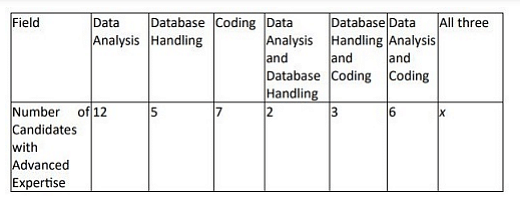
The number of applicants with advanced expertise in all three fields is given as x in the table, where x is a non-negative integer.
- XAT - 2024
- Data Interpretation