Question:medium
If \( a, b, c \) are all positive integers, with \( 4a>b \), then which of the following conditions is BOTH NECESSARY AND SUFFICIENT for the expression
\[
\sqrt{(3)^a (21)^{3a-b} (49)^{2b+c}}
\]
to be a positive integer?
If \( a, b, c \) are all positive integers, with \( 4a>b \), then which of the following conditions is BOTH NECESSARY AND SUFFICIENT for the expression
\[
\sqrt{(3)^a (21)^{3a-b} (49)^{2b+c}}
\]
to be a positive integer?
Show Hint
When working with powers, ensure that the exponents satisfy the conditions for the expression to be a perfect square, such as even exponents for all primes.
Updated On: Jul 15, 2026
- \( a - b = c \)
- \( a - b + 2c \) is divisible by 3
- \( a, b, \) and \( c \) are divisible by 3
- \( a - b \) and \( c \) are divisible by 3
- None of the other conditions is both necessary and sufficient
Show Solution
The Correct Option is B
Solution and Explanation
Step 1: Express the given equation as a product of powers of prime factors.
We express each term in \( \sqrt{(3)^a (21)^{3a-b} (49)^{2b+c}} \) as powers of primes. - \( 3^a \) is already in prime factor form. - Since \( 21 = 3 \times 7 \), \( 21^{3a-b} = 3^{3a-b} \times 7^{3a-b} \). - Since \( 49 = 7^2 \), \( 49^{2b+c} = 7^{4b+2c} \). The expression becomes:\[\sqrt{3^a \times 3^{3a-b} \times 7^{3a-b} \times 7^{4b+2c}}\]Simplifying:\[\sqrt{3^{a + 3a - b} \times 7^{3a - b + 4b + 2c}} = \sqrt{3^{4a - b} \times 7^{3a + 3b + 2c}}\]
Step 2: Conditions for the expression to be a perfect square.
For the expression to be a perfect square, the exponents of all prime factors must be even. - The exponent \( 4a - b \) for prime 3 must be even. - The exponent \( 3a + 3b + 2c \) for prime 7 must be even.
Step 3: Analyze the conditions.
From \( 4a - b \) being even, it implies \( a - b \) must be even. From \( 3a + 3b + 2c \) being even, it implies \( a - b + 2c \) must be divisible by 3. This condition is both necessary and sufficient.
Final Answer: \[\boxed{\text{(B) } a - b + 2c \text{ is divisible by 3}}\]
We express each term in \( \sqrt{(3)^a (21)^{3a-b} (49)^{2b+c}} \) as powers of primes. - \( 3^a \) is already in prime factor form. - Since \( 21 = 3 \times 7 \), \( 21^{3a-b} = 3^{3a-b} \times 7^{3a-b} \). - Since \( 49 = 7^2 \), \( 49^{2b+c} = 7^{4b+2c} \). The expression becomes:\[\sqrt{3^a \times 3^{3a-b} \times 7^{3a-b} \times 7^{4b+2c}}\]Simplifying:\[\sqrt{3^{a + 3a - b} \times 7^{3a - b + 4b + 2c}} = \sqrt{3^{4a - b} \times 7^{3a + 3b + 2c}}\]
Step 2: Conditions for the expression to be a perfect square.
For the expression to be a perfect square, the exponents of all prime factors must be even. - The exponent \( 4a - b \) for prime 3 must be even. - The exponent \( 3a + 3b + 2c \) for prime 7 must be even.
Step 3: Analyze the conditions.
From \( 4a - b \) being even, it implies \( a - b \) must be even. From \( 3a + 3b + 2c \) being even, it implies \( a - b + 2c \) must be divisible by 3. This condition is both necessary and sufficient.
Final Answer: \[\boxed{\text{(B) } a - b + 2c \text{ is divisible by 3}}\]
Was this answer helpful?
0
Top Questions on Algebra
- Let \( n(A) = m \) and \( n(B) = n \), if the number of subsets of \( A \) is 56 more than that of subsets of \( B \), then \( m + n \) is equal to:
- VITEEE - 2024
- Mathematics
- Algebra
- Solve the quadratic equation: \[ x^2 - 5x + 6 = 0 \]
- VITEEE - 2025
- Mathematics
- Algebra
- Find the value of \( x \) in the following equation: \[ \frac{2}{x} + \frac{3}{x + 1} = 1 \]
- VITEEE - 2025
- Mathematics
- Algebra
- Find the value of \( x \) in the equation \( 2x + 3 = 7x - 8 \).
- VITEEE - 2025
- Mathematics
- Algebra
- Want to practice more? Try solving extra ecology questions todayView All Questions
Questions Asked in XAT exam
Applicants have been shortlisted for interviews for some data analyst positions. Some of the applicants have advanced expertise in one or more fields among the following: data analysis, database handling and coding. The numbers of applicants with different advanced expertise are given in the 2 × 8 table below.
The number of applicants with advanced expertise in all three fields is given as x in the table, where x is a non-negative integer.
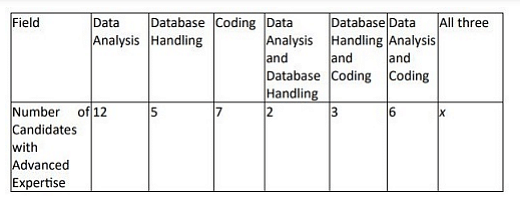
The number of applicants with advanced expertise in all three fields is given as x in the table, where x is a non-negative integer.
- XAT - 2024
- Data Interpretation