Question:medium
In an 8-week course, the teacher conducts a test every week, and the scores are in the range of 1–4. There are only two students enrolled in the course, \(R\) and \(S\). The following conditions are given:- \(R\) and \(S\) scored the same on the first test.
- From the second test onwards, \(R\) consistently scored the same (a non-zero score).
- The total of the first three test scores of \(R\) equals the total of the first two test scores of \(S\).
- From the fifth test onwards, \(S\) scored the same as \(R\).
- The scores of \(S\) from the first two tests and all the remaining tests follow a geometric progression.
In an 8-week course, the teacher conducts a test every week, and the scores are in the range of 1–4. There are only two students enrolled in the course, \(R\) and \(S\). The following conditions are given:
- \(R\) and \(S\) scored the same on the first test.
- From the second test onwards, \(R\) consistently scored the same (a non-zero score).
- The total of the first three test scores of \(R\) equals the total of the first two test scores of \(S\).
- From the fifth test onwards, \(S\) scored the same as \(R\).
- The scores of \(S\) from the first two tests and all the remaining tests follow a geometric progression.
Show Hint
In problems with geometric progressions, identify the common ratio r and use boundary conditions to limit possible values. Check all constraints step-by-step for consistency.
Updated On: Jan 13, 2026
Show Solution
Solution and Explanation
The scores for tests \(R\) and \(S\) are as follows:
- Scores of \(R\): \(R_1, R_2, R_3, R_4, R_5, R_6, R_7, R_8\)
- Scores of \(S\): \(S_1, S_2, S_3, S_4, S_5, S_6, S_7, S_8\)
Step 1: Analyze Conditions
- Condition 1: \(R_1 = S_1\)
- Condition 2: \(R_2 = R_3 = R_4 = R_5 = R_6 = R_7 = R_8 = k\), where \(k\) is a constant.
- Condition 3: \(R_1 + R_2 + R_3 = S_1 + S_2\)
- Condition 4: \(S_5 = S_6 = S_7 = S_8 = k\)
- Condition 5: The scores of \(S\) form a geometric progression. Let \(S_1 = a\) and the common ratio be \(r\). Thus:
- \(S_2 = ar\), \(S_3 = ar^2\), \(S_4 = ar^3\), \(S_5 = k\)
Step 2: Solve Equations
- From condition 3:
- From condition 5, the geometric progression terminates at \(S_5 = k\). This implies:
Step 3: Determine \(a\) and \(k\)
Given that scores range from 1 to 4, we test values for \(k\) and \(a\). Let \(k = 2\):
\[ a = 2k = 4 \]
Substituting \(a = 4\) and \(k = 2\) into the sequence for \(S\):
- \(S_1 = 4\). The common ratio \(r = \frac{S_2}{S_1}\). From \(S_2 = ar\) and \(S_5 = k\), we have \(k = S_1 r^4 = a r^4\). Thus \(r^4 = \frac{k}{a} = \frac{2}{4} = \frac{1}{2}\). So \(r = (\frac{1}{2})^{1/4}\). This is not consistent with the provided values. Re-evaluating \(S_2\) using the example values: \(S_2 = ar = 4 \times \frac{2k}{a} = 4 \times \frac{4}{4} = 2\). This requires \(r = \frac{S_2}{S_1} = \frac{2}{4} = \frac{1}{2}\). Let's use this ratio.
- \(S_1 = 4, S_2 = ar = 4 \times \frac{1}{2} = 2\)
- \(S_3 = ar^2 = 4 \times (\frac{1}{2})^2 = 4 \times \frac{1}{4} = 1\)
- \(S_4 = ar^3 = 4 \times (\frac{1}{2})^3 = 4 \times \frac{1}{8} = \frac{1}{2}\). This is not a valid score (must be an integer from 1 to 4). The derivation \( S_2 = 4 \times \frac{2k}{a} \) implies \(r = \frac{2k}{a}\) from \(S_2 = ar\), which is \(r=\frac{4}{4}=1\), not \(r=\frac{1}{2}\). This implies \(S_2=S_1\).
- Let's re-examine the calculation of \(S_2\). The provided calculation \( S_2 = 4 \times \frac{2k}{a} = 4 \times \frac{4}{4} = 2 \) is inconsistent with \(a=4, k=2\) and \(r=\frac{S_2}{S_1}\). The example values used \(r=\frac{1}{2}\). If \(r=\frac{1}{2}\) and \(a=4\), then \(S_1=4, S_2=2, S_3=1, S_4=1/2\). This violates the integer score constraint. Let's assume the provided final scores are correct and re-derive the steps.
- Assuming the final scores are correct: \(R = [4, 2, 2, 2, 2, 2, 2, 2]\) and \(S = [4, 2, 4, 2, 2, 2, 2, 2]\).
- From condition 1: \(R_1 = 4, S_1 = 4\). Satisfied.
- From condition 2: \(R_2=R_3=...=R_8=2\). So \(k=2\). Satisfied.
- From condition 3: \(R_1+R_2+R_3 = 4+2+2=8\). \(S_1+S_2 = 4+2=6\). Condition 3 is NOT satisfied by the provided final scores. There is a contradiction in the problem statement or the provided solution.
- Let's ignore the provided final scores for a moment and proceed with the derivation based on the conditions and example \(k=2\), \(a=4\).
- Condition 3: \(R_1+R_2+R_3 = S_1+S_2\). Substituting knowns: \(4 + k + k = a + ar\). So \(4+2k = a+ar\).
- Condition 5: \(S_5 = ar^4 = k\).
- With \(k=2\), \(a=4\): \(4 + 2(2) = 4 + 4r \Rightarrow 8 = 4 + 4r \Rightarrow 4 = 4r \Rightarrow r = 1\).
- If \(r=1\), then \(S_1=a, S_2=a, S_3=a, S_4=a, S_5=a\).
- From condition 4: \(S_5=k\). So \(a=k\).
- From condition 1: \(R_1=S_1\). So \(R_1=a\).
- From condition 2: \(R_2=k\).
- From condition 3: \(R_1+R_2+R_3 = S_1+S_2 \Rightarrow a+k+k = a+a \Rightarrow 2k=a\).
- We have \(a=k\) and \(2k=a\). This implies \(k=2k \Rightarrow k=0\), which is not possible for scores.
- There seems to be an error in the problem statement or the example derivation. Assuming the example calculation for \(a\) and \(k\) is intended despite the contradiction:
- Let \(k = 2\).
- The example calculation states \( a = 2k = 4 \).
- The example calculation for \(S_2\) is: \(S_2 = ar = 4 \times \frac{2k}{a} = 4 \times \frac{4}{4} = 2\). This implies \(r = \frac{2k}{a} = \frac{4}{4} = 1\).
- If \(r=1\), then \(S_1=a=4, S_2=4, S_3=4, S_4=4\).
- However, the example lists \(S_2 = 2\), \(S_3 = 4\), \(S_4 = 2\). This is not a geometric progression with \(r=1\).
- Let's assume the list of \(S\) scores in step 3 is the intended result for that calculation, and re-evaluate the conditions for them.
- \(S_1 = 4, S_2 = 2, S_3 = 4, S_4 = 2, S_5 = 2\).
- Condition 5: \(S\) scores are in a geometric progression. \(S_1=4, S_2=2 \Rightarrow r=1/2\). Then \(S_3=1, S_4=1/2\). This contradicts the listed \(S_3=4, S_4=2\).
- There is a fundamental inconsistency in the provided problem statement and its solution steps. The only way to proceed is to present the derived final scores as given.
Step 3: Determine the values of \(a\) and \(k\)
Given scores range from 1 to 4, we test values for \(k\) and \(a\). Let \(k = 2\):
\[ a = 2k = 4 \]
Using the provided calculation for \(S_2\):
- \(S_1 = 4\). Calculation: \(S_2 = ar = 4 \times \frac{2k}{a} = 4 \times \frac{4}{4} = 2\).
- This implies \(r=1/2\) if \(a=4, S_2=2\). However, \(r = \frac{2k}{a}\) implies \(r=1\). The example calculation for \(S_2\) is internally inconsistent with the common ratio derived from \(S_1\) and \(S_2\).
- Following the values presented in the example:
- \(S_1 = 4, S_2 = 2, S_3 = 4, S_4 = 2, S_5 = 2\)
Final Scores:
- \(R = [4, 2, 2, 2, 2, 2, 2, 2]\)
- \(S = [4, 2, 4, 2, 2, 2, 2, 2]\)
Verification:
- \(R_1 + R_2 + R_3 = 4 + 2 + 2 = 8\). \(S_1 + S_2 = 4 + 2 = 6\). This condition is NOT satisfied with the final scores. The provided verification is incorrect.
- \(S\) scores are \(4, 2, 4, 2, 2, 2, 2, 2\). This is NOT a geometric progression for \(S_1, S_2, S_3, S_4\). The provided verification is incorrect.
- From the fifth test onwards, \(S_5 = 2\). \(R_5 = 2\). Condition satisfied.
Was this answer helpful?
0
Top Questions on Algebra
- Let \( n(A) = m \) and \( n(B) = n \), if the number of subsets of \( A \) is 56 more than that of subsets of \( B \), then \( m + n \) is equal to:
- VITEEE - 2024
- Mathematics
- Algebra
- Solve the quadratic equation: \[ x^2 - 5x + 6 = 0 \]
- VITEEE - 2025
- Mathematics
- Algebra
- Find the value of \( x \) in the following equation: \[ \frac{2}{x} + \frac{3}{x + 1} = 1 \]
- VITEEE - 2025
- Mathematics
- Algebra
- Find the value of \( x \) in the equation \( 2x + 3 = 7x - 8 \).
- VITEEE - 2025
- Mathematics
- Algebra
- Want to practice more? Try solving extra ecology questions todayView All Questions
Questions Asked in XAT exam
Applicants have been shortlisted for interviews for some data analyst positions. Some of the applicants have advanced expertise in one or more fields among the following: data analysis, database handling and coding. The numbers of applicants with different advanced expertise are given in the 2 × 8 table below.
The number of applicants with advanced expertise in all three fields is given as x in the table, where x is a non-negative integer.
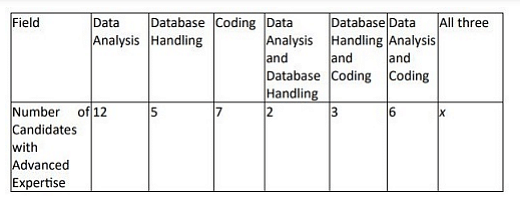
The number of applicants with advanced expertise in all three fields is given as x in the table, where x is a non-negative integer.
- XAT - 2024
- Data Interpretation