Question:medium
Read the following paragraph and answer the question that follows.
A. The treaty tests of a budget deficit no bigger than 3% of the GDP and a public debt converging towards a ceiling of 60% of a GDP seemed impossible for Italy to pass by 1999.
B. That Belgium also had a public debt above 100 percent of GDP helped, as did a special euro tax Mr. Prodi introduced.
C. Into the uncompromising environment came the first of a series of external shocks. One of the earliest was entry into the European single currency, the euro, in 1999.
D. But when it became clear in 1997 that Spain was determined to join from the start, Romano Prodi, then Italian prime minister, decided that Italy, as a founder member of the bloc, must be there too.
E. Germany had more or less designed the 1992 Maastricht treaty’s convergence criteria to keep out a profligate, chronically indebted Italy.
Which of the following sequences is the MOST logically ordered?
Read the following paragraph and answer the question that follows.
A. The treaty tests of a budget deficit no bigger than 3% of the GDP and a public debt converging towards a ceiling of 60% of a GDP seemed impossible for Italy to pass by 1999.
B. That Belgium also had a public debt above 100 percent of GDP helped, as did a special euro tax Mr. Prodi introduced.
C. Into the uncompromising environment came the first of a series of external shocks. One of the earliest was entry into the European single currency, the euro, in 1999.
D. But when it became clear in 1997 that Spain was determined to join from the start, Romano Prodi, then Italian prime minister, decided that Italy, as a founder member of the bloc, must be there too.
E. Germany had more or less designed the 1992 Maastricht treaty’s convergence criteria to keep out a profligate, chronically indebted Italy.
Which of the following sequences is the MOST logically ordered?
B. That Belgium also had a public debt above 100 percent of GDP helped, as did a special euro tax Mr. Prodi introduced.
C. Into the uncompromising environment came the first of a series of external shocks. One of the earliest was entry into the European single currency, the euro, in 1999.
D. But when it became clear in 1997 that Spain was determined to join from the start, Romano Prodi, then Italian prime minister, decided that Italy, as a founder member of the bloc, must be there too.
E. Germany had more or less designed the 1992 Maastricht treaty’s convergence criteria to keep out a profligate, chronically indebted Italy.
Which of the following sequences is the MOST logically ordered?
Show Hint
For para-jumble questions, look for:
1. Background/context setters.
2. Problem statements.
3. Supporting details/examples.
4. Final outcomes or decisions.
This natural order ensures coherence.
Updated On: Jul 13, 2026
- E, D, B, A, C
- C, B, D, E, A
- A, B, C, D, E
- E, A, B, C, D
- C, E, A, C, B
Show Solution
The Correct Option is D
Solution and Explanation
Step 1: Identify the introduction.
The passage concerns Italy's effort to qualify for the euro under the Maastricht treaty. E provides the initial context, establishing that Germany formulated the treaty's convergence criteria with the intention of excluding Italy.
Step 2: State Italy’s problem.
A follows, detailing the specific criteria—deficit and debt thresholds—that Italy struggled to meet.
Step 3: Provide relief and actions.
B is next, illustrating how Belgium's debt situation and Prodi's implementation of a special tax contributed to Italy's qualification.
Step 4: External developments.
C logically follows B, describing the broader context and the significant event of the euro's adoption in 1999.
Step 5: Italy’s final decision.
D concludes the sequence, showing Prodi's decision for Italy to join the euro after observing Spain's commitment.
Step 6: Verify.
The order E → A → B → C → D represents a progression from context → problem → support → external event → decision.
Final Answer: \[\boxed{\text{D (E, A, B, C, D)}}\]
The passage concerns Italy's effort to qualify for the euro under the Maastricht treaty. E provides the initial context, establishing that Germany formulated the treaty's convergence criteria with the intention of excluding Italy.
Step 2: State Italy’s problem.
A follows, detailing the specific criteria—deficit and debt thresholds—that Italy struggled to meet.
Step 3: Provide relief and actions.
B is next, illustrating how Belgium's debt situation and Prodi's implementation of a special tax contributed to Italy's qualification.
Step 4: External developments.
C logically follows B, describing the broader context and the significant event of the euro's adoption in 1999.
Step 5: Italy’s final decision.
D concludes the sequence, showing Prodi's decision for Italy to join the euro after observing Spain's commitment.
Step 6: Verify.
The order E → A → B → C → D represents a progression from context → problem → support → external event → decision.
Final Answer: \[\boxed{\text{D (E, A, B, C, D)}}\]
Was this answer helpful?
0
Top Questions on Para Jumbles
- Five jumbled up sentences (labelled 1, 2, 3, 4 and 5), related to a topic, are given below. Four of them can be put together to form a coherent paragraph. Identify the odd sentence and key in the number of that sentence as your answer.
- Five jumbled up sentences (labelled 1, 2, 3, 4 and 5), related to a topic, are given below. Four of them can be put together to form a coherent paragraph. Identify the odd sentence and key in the number of that sentence as your answer.
- Five jumbled up sentences (labelled 1, 2, 3, 4 and 5), related to a topic, are given below. Four of them can be put together to form a coherent paragraph. Identify the odd sentence and key in the number of that sentence as your answer.
- Five jumbled up sentences (labelled 1, 2, 3, 4 and 5), related to a topic, are given below. Four of them can be put together to form a coherent paragraph. Identify the odd sentence and key in the number of that sentence as your answer.
- Want to practice more? Try solving extra ecology questions todayView All Questions
Questions Asked in XAT exam
Applicants have been shortlisted for interviews for some data analyst positions. Some of the applicants have advanced expertise in one or more fields among the following: data analysis, database handling and coding. The numbers of applicants with different advanced expertise are given in the 2 × 8 table below.
The number of applicants with advanced expertise in all three fields is given as x in the table, where x is a non-negative integer.
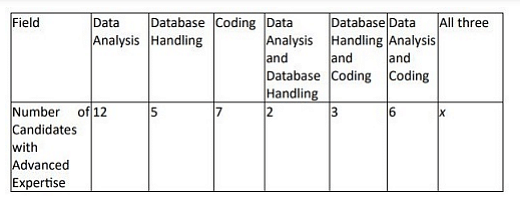
The number of applicants with advanced expertise in all three fields is given as x in the table, where x is a non-negative integer.
- XAT - 2024
- Data Interpretation