Read the following exchange between two poets and answer the question below.
Poet 1:
I do my thing and you do your thing.
I am not in this world to live up to your expectations...
and you are not in this world to live up to mine.
You are you...
and I am I.
And if, by chance, we find each other...
it's beautiful.
If not, it can't be helped.
Poet 2:
If I just do my thing and you do yours.
We stand in danger of losing each other
And ourselves.
I am not in this world to live up to your expectations;
But I am in this world to confirm you
as a unique human being.
And to be confirmed by you.
We are fully ourselves only in relation to each other;
The I detached from Thou
Disintegrates.
I do not find you by chance;
I find you by an active life
of reaching out.
Rather than passively letting things happen to me,
I can act intentionally to make them happen.
I must begin within myself, true;
But I must not end with myself:
The truth begins with two.
Amongst the perspectives listed below, which one would extend Poet 2's argument the most?
Poet 1:
I do my thing and you do your thing.
I am not in this world to live up to your expectations...
and you are not in this world to live up to mine.
You are you...
and I am I.
And if, by chance, we find each other...
it's beautiful.
If not, it can't be helped.
Poet 2:
If I just do my thing and you do yours.
We stand in danger of losing each other
And ourselves.
I am not in this world to live up to your expectations;
But I am in this world to confirm you
as a unique human being.
And to be confirmed by you.
We are fully ourselves only in relation to each other;
The I detached from Thou
Disintegrates.
I do not find you by chance;
I find you by an active life
of reaching out.
Rather than passively letting things happen to me,
I can act intentionally to make them happen.
I must begin within myself, true;
But I must not end with myself:
The truth begins with two.
Amongst the perspectives listed below, which one would extend Poet 2's argument the most?
Show Hint
- Human beings these days primarily conceive of themselves as isolated individual selves.
- Self-exploration is considered the most important pre-occupation by educated individuals.
- One's active stance towards life does not change fate.
- Society incorporates multiple simultaneous relationships.
The Correct Option is D
Solution and Explanation
Poet 2 makes two connected claims: we become fully ourselves only through our relationships with others, and connection with others should be actively sought rather than left to chance. We are asked which perspective would extend this argument, that is, build further on the same line of thinking rather than contradict or just restate a problem.
- Human beings these days primarily conceive of themselves as isolated individual selves: This describes the very problem Poet 2 is pushing back against, people wrongly seeing themselves as separate. It states a symptom rather than adding a new supporting idea, so it does not extend Poet 2's own claim.
- Self-exploration is considered the most important pre-occupation by educated individuals: This actually points inward, towards the self alone, while Poet 2's whole argument points outward, towards relationships with others. This works against Poet 2's claim rather than extending it.
- One's active stance towards life does not change fate: Poet 2 says the opposite directly, "I can act intentionally to make them happen," meaning active effort does shape outcomes. This option contradicts Poet 2 outright.
- Society incorporates multiple simultaneous relationships: Poet 2 argues that a person is completed only through relationships, and that connection should be actively built with more than just one other person over time. Saying that society itself is made up of many relationships happening at once reinforces exactly this idea, that human life is fundamentally woven together through multiple connections, not lived in isolation.
Only the fourth option adds further support to Poet 2's core claim that we are defined through our relationships with others, so it is the one that extends the argument the most.
Let's summarize:
- Options 1 and 2 describe problems or an inward focus that Poet 2's argument is actually working against.
- Option 3 directly contradicts Poet 2's claim that intentional action shapes outcomes.
- Option 4 reinforces Poet 2's central idea that people exist fully only through relationships with others.
So the correct answer is option 4.
Top Questions on Poems
- Read the following poem and answer the TWO questions that follow.
In the darkened room
a woman
cannot find her reflection in the mirror
waiting as usual
at the edge of sleep
In her hands she holds
the oil lamp
whose drunken yellow flames
know where her lonely body hides Read the following extracts and answer the questions
Aunt Jennifer's fingers fluttering through her wool
Find even the ivory needle hard to pull.
The massive weight of Uncle's wedding band
Sits heavily upon Aunt Jennifer's hand.
When Aunt is dead, her terrified hands will lie
Still ringed with ordeals she was mastered by.
The tigers in the panel that she made
Will go on prancing, proud and unafraid.
(Aunt Jennifer's Tigers)Driving from my parent's
home to Cochin last Friday
morning, I saw my mother, beside me,
doze, open mouthed, her face
ashen like that
of a corpse and realised with
pain
that she was as old as she
looked but soon
put that thought away, and
looked out at Young
Trees sprinting, the merry children spilling
out of their homes, .....
(My Mother at Sixty-six)- Why did the Mariner hold back the Wedding-Guest?
- Want to practice more? Try solving extra ecology questions todayView All Questions
Questions Asked in XAT exam
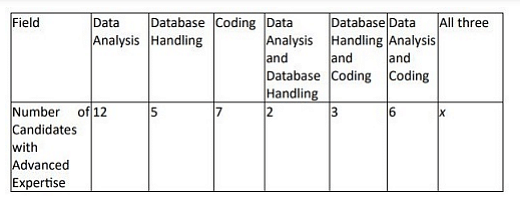
The number of applicants with advanced expertise in all three fields is given as x in the table, where x is a non-negative integer.
- XAT - 2024
- Data Interpretation