Question:hard
Read the following and answer this question based on the same:
The demand for a product (Q) is related to the price (P) of the product as follows: \(Q=100-2P\).
The cost (C) of manufacturing the product is related to the quantity produced in the following manner: \(C=Q^2-16Q+2000\).
As of now the corporate profit tax rate is zero. But the Government of India is thinking of imposing 25% tax on the profit of the company.
If the government imposes the 25% corporate profit tax, then what will be the profit maximizing output?
Read the following and answer this question based on the same:
The demand for a product (Q) is related to the price (P) of the product as follows: \(Q=100-2P\).
The cost (C) of manufacturing the product is related to the quantity produced in the following manner: \(C=Q^2-16Q+2000\).
As of now the corporate profit tax rate is zero. But the Government of India is thinking of imposing 25% tax on the profit of the company.
If the government imposes the 25% corporate profit tax, then what will be the profit maximizing output?
Show Hint
A flat percentage tax on profit scales the whole profit curve by a constant but never shifts its peak, so check whether the pre-tax optimum (22) appears among the options.
Updated On: Jul 13, 2026
- 16.5
- 16.125
- 15
- None of the above
Show Solution
The Correct Option is D
Solution and Explanation
Step 1: Write out the after-tax profit function fully.
The pre-tax profit is $\pi(Q)=66Q-1.5Q^2-2000$. With a 25% tax, the firm keeps 75% of this:
\[ \pi_{\text{after}}(Q)=0.75(66Q-1.5Q^2-2000) \]
Multiply out each term one at a time: $0.75\times66Q=49.5Q$, $0.75\times1.5Q^2=1.125Q^2$, and $0.75\times2000=1500$. So:
\[ \pi_{\text{after}}(Q)=49.5Q-1.125Q^2-1500 \]
Step 2: Differentiate this new function directly.
\[ \frac{d}{dQ}\pi_{\text{after}}(Q)=49.5-2.25Q \]
Setting the derivative to zero to find the maximum:
\[ 49.5-2.25Q=0 \implies Q=\frac{49.5}{2.25}=22 \]
Step 3: Confirm this is a maximum.
The coefficient of $Q^2$ in $\pi_{\text{after}}(Q)$ is $-1.125$, which is negative, so the graph is a downward parabola and $Q=22$ is indeed where profit is largest, not smallest.
Step 4: Test the given numeric options directly.
$\pi_{\text{after}}(16.5)=49.5(16.5)-1.125(16.5)^2-1500=816.75-306.28-1500=-989.53$.
$\pi_{\text{after}}(16.125)=49.5(16.125)-1.125(16.125)^2-1500=798.19-292.57-1500=-994.38$.
$\pi_{\text{after}}(15)=49.5(15)-1.125(15)^2-1500=742.5-253.125-1500=-1010.625$.
$\pi_{\text{after}}(22)=49.5(22)-1.125(22)^2-1500=1089-544.5-1500=-955.5$.
The profit at $Q=22$, $-955.5$, beats every one of 16.5, 16.125 and 15, confirming 22 really is the peak and the other three are not.
Step 5: Compare with the answer choices.
The output that maximizes after-tax profit is 22 units, worked out here by fully expanding and differentiating the after-tax profit function rather than relying on the scaling shortcut.
None of 16.5, 16.125 or 15 matches 22, and the direct profit comparison above confirms 22 is strictly better than all three.
Final Answer:
Since the correct profit-maximizing output, 22, is not among the numeric choices, the answer is None of the above.
$\boxed{\text{None of the above}}$
The pre-tax profit is $\pi(Q)=66Q-1.5Q^2-2000$. With a 25% tax, the firm keeps 75% of this:
\[ \pi_{\text{after}}(Q)=0.75(66Q-1.5Q^2-2000) \]
Multiply out each term one at a time: $0.75\times66Q=49.5Q$, $0.75\times1.5Q^2=1.125Q^2$, and $0.75\times2000=1500$. So:
\[ \pi_{\text{after}}(Q)=49.5Q-1.125Q^2-1500 \]
Step 2: Differentiate this new function directly.
\[ \frac{d}{dQ}\pi_{\text{after}}(Q)=49.5-2.25Q \]
Setting the derivative to zero to find the maximum:
\[ 49.5-2.25Q=0 \implies Q=\frac{49.5}{2.25}=22 \]
Step 3: Confirm this is a maximum.
The coefficient of $Q^2$ in $\pi_{\text{after}}(Q)$ is $-1.125$, which is negative, so the graph is a downward parabola and $Q=22$ is indeed where profit is largest, not smallest.
Step 4: Test the given numeric options directly.
$\pi_{\text{after}}(16.5)=49.5(16.5)-1.125(16.5)^2-1500=816.75-306.28-1500=-989.53$.
$\pi_{\text{after}}(16.125)=49.5(16.125)-1.125(16.125)^2-1500=798.19-292.57-1500=-994.38$.
$\pi_{\text{after}}(15)=49.5(15)-1.125(15)^2-1500=742.5-253.125-1500=-1010.625$.
$\pi_{\text{after}}(22)=49.5(22)-1.125(22)^2-1500=1089-544.5-1500=-955.5$.
The profit at $Q=22$, $-955.5$, beats every one of 16.5, 16.125 and 15, confirming 22 really is the peak and the other three are not.
Step 5: Compare with the answer choices.
The output that maximizes after-tax profit is 22 units, worked out here by fully expanding and differentiating the after-tax profit function rather than relying on the scaling shortcut.
None of 16.5, 16.125 or 15 matches 22, and the direct profit comparison above confirms 22 is strictly better than all three.
Final Answer:
Since the correct profit-maximizing output, 22, is not among the numeric choices, the answer is None of the above.
$\boxed{\text{None of the above}}$
Was this answer helpful?
0
Top Questions on Profit Maximization
Questions Asked in XAT exam
Applicants have been shortlisted for interviews for some data analyst positions. Some of the applicants have advanced expertise in one or more fields among the following: data analysis, database handling and coding. The numbers of applicants with different advanced expertise are given in the 2 × 8 table below.
The number of applicants with advanced expertise in all three fields is given as x in the table, where x is a non-negative integer.
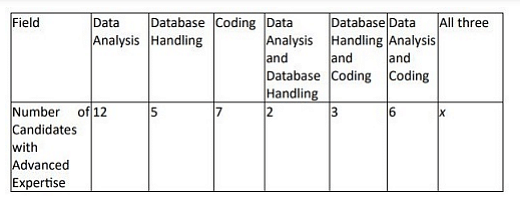
The number of applicants with advanced expertise in all three fields is given as x in the table, where x is a non-negative integer.
- XAT - 2024
- Data Interpretation