Question:medium
Read the following and answer this question based on the same:
The demand for a product (Q) is related to the price (P) of the product as follows: \(Q=100-2P\).
The cost (C) of manufacturing the product is related to the quantity produced in the following manner: \(C=Q^2-16Q+2000\).
As of now the corporate profit tax rate is zero. But the Government of India is thinking of imposing 25% tax on the profit of the company.
As of now, what is the profit-maximizing output?
Read the following and answer this question based on the same:
The demand for a product (Q) is related to the price (P) of the product as follows: \(Q=100-2P\).
The cost (C) of manufacturing the product is related to the quantity produced in the following manner: \(C=Q^2-16Q+2000\).
As of now the corporate profit tax rate is zero. But the Government of India is thinking of imposing 25% tax on the profit of the company.
As of now, what is the profit-maximizing output?
Show Hint
Write profit as \(\pi(Q)=66Q-1.5Q^2-2000\) and find the output where its slope is zero (or use the vertex of the parabola).
Updated On: Jul 13, 2026
- 22
- 21.5
- 20
- 19
Show Solution
The Correct Option is A
Solution and Explanation
Step 1: Build the profit function.
From $Q=100-2P$, price is $P=50-\frac{Q}{2}$, so revenue is $R=50Q-\frac{Q^2}{2}$.
Profit before tax is $\pi=R-C=50Q-\frac{Q^2}{2}-(Q^2-16Q+2000)$, which simplifies to
\[ \pi(Q)=-\frac{3}{2}Q^2+66Q-2000 \]
Step 2: Recognize this as a downward parabola in Q.
Profit is a quadratic in $Q$ of the form $\pi(Q)=aQ^2+bQ+c$, with $a=-\frac{3}{2}$ and $b=66$.
Since $a$ is negative, the graph of $\pi$ against $Q$ is a parabola opening downward, so it has a single highest point (a maximum), and no other critical point to worry about. This rules out the possibility that we have found a minimum by mistake.
Step 3: Use the vertex formula instead of calculus.
For any quadratic $aQ^2+bQ+c$, the vertex (the peak, here) sits at $Q^*=-\frac{b}{2a}$. This comes from writing the quadratic in completed-square form, $a(Q-Q^*)^2+(\text{constant})$, where the squared term is zero (and hence the expression is largest, since $a$ is negative) exactly at $Q=Q^*$.
\[ Q^*=-\frac{66}{2\times(-1.5)}=-\frac{66}{-3}=22 \]
Step 4: Match this with the profit function's meaning.
This vertex is exactly where profit is maximized, since a downward parabola's vertex is always its highest point.
This gives the same answer as differentiating $\pi(Q)$ and setting the slope to zero, but reaches it purely algebraically, without needing calculus at all.
Step 5: Sanity check against the wrong options.
Plug the vertex back in: $\pi(22)=-1.5(22)^2+66(22)-2000=-726+1452-2000=-1274$.
Now check option (B), $Q=21.5$: $\pi(21.5)=-1.5(21.5)^2+66(21.5)-2000=-693.375+1419-2000=-1274.375$, which is lower than $-1274$, so 21.5 is not the peak.
Check option (C), $Q=20$: $\pi(20)=-1.5(400)+1320-2000=-600+1320-2000=-1280$, again lower than $-1274$.
Check option (D), $Q=19$: $\pi(19)=-1.5(361)+1254-2000=-541.5+1254-2000=-1287.5$, the lowest of all four.
This confirms the vertex at $Q=22$ genuinely beats every other listed output.
Final Answer:
The profit-maximizing output before tax is 22 units, option (A).
$\boxed{22}$
From $Q=100-2P$, price is $P=50-\frac{Q}{2}$, so revenue is $R=50Q-\frac{Q^2}{2}$.
Profit before tax is $\pi=R-C=50Q-\frac{Q^2}{2}-(Q^2-16Q+2000)$, which simplifies to
\[ \pi(Q)=-\frac{3}{2}Q^2+66Q-2000 \]
Step 2: Recognize this as a downward parabola in Q.
Profit is a quadratic in $Q$ of the form $\pi(Q)=aQ^2+bQ+c$, with $a=-\frac{3}{2}$ and $b=66$.
Since $a$ is negative, the graph of $\pi$ against $Q$ is a parabola opening downward, so it has a single highest point (a maximum), and no other critical point to worry about. This rules out the possibility that we have found a minimum by mistake.
Step 3: Use the vertex formula instead of calculus.
For any quadratic $aQ^2+bQ+c$, the vertex (the peak, here) sits at $Q^*=-\frac{b}{2a}$. This comes from writing the quadratic in completed-square form, $a(Q-Q^*)^2+(\text{constant})$, where the squared term is zero (and hence the expression is largest, since $a$ is negative) exactly at $Q=Q^*$.
\[ Q^*=-\frac{66}{2\times(-1.5)}=-\frac{66}{-3}=22 \]
Step 4: Match this with the profit function's meaning.
This vertex is exactly where profit is maximized, since a downward parabola's vertex is always its highest point.
This gives the same answer as differentiating $\pi(Q)$ and setting the slope to zero, but reaches it purely algebraically, without needing calculus at all.
Step 5: Sanity check against the wrong options.
Plug the vertex back in: $\pi(22)=-1.5(22)^2+66(22)-2000=-726+1452-2000=-1274$.
Now check option (B), $Q=21.5$: $\pi(21.5)=-1.5(21.5)^2+66(21.5)-2000=-693.375+1419-2000=-1274.375$, which is lower than $-1274$, so 21.5 is not the peak.
Check option (C), $Q=20$: $\pi(20)=-1.5(400)+1320-2000=-600+1320-2000=-1280$, again lower than $-1274$.
Check option (D), $Q=19$: $\pi(19)=-1.5(361)+1254-2000=-541.5+1254-2000=-1287.5$, the lowest of all four.
This confirms the vertex at $Q=22$ genuinely beats every other listed output.
Final Answer:
The profit-maximizing output before tax is 22 units, option (A).
$\boxed{22}$
Was this answer helpful?
0
Top Questions on Profit Maximization
Questions Asked in XAT exam
Applicants have been shortlisted for interviews for some data analyst positions. Some of the applicants have advanced expertise in one or more fields among the following: data analysis, database handling and coding. The numbers of applicants with different advanced expertise are given in the 2 × 8 table below.
The number of applicants with advanced expertise in all three fields is given as x in the table, where x is a non-negative integer.
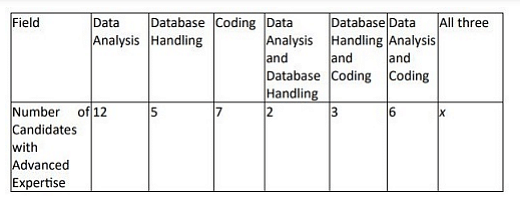
The number of applicants with advanced expertise in all three fields is given as x in the table, where x is a non-negative integer.
- XAT - 2024
- Data Interpretation