Question:medium
Questions 48 to 50 are followed by two statements labelled as (1) and (2). You have to decide if these statements are sufficient to conclusively answer the question. Give answer:
(A) If statement (1) alone or statement (2) alone is sufficient to answer the question
(B) If you can get the answer from (1) and (2) together but neither alone is sufficient
(C) If statement 1 alone is sufficient to answer the question and statement (2) alone is also sufficient
(D) If neither statement (1) nor statement (2) is sufficient to answer the question
A sequence of numbers \( a_1, a_2, \ldots \) is given by the rule \( a_n^2 = a_{n+1} \). Does 3 appear in the sequence?
Statement 1: \( a_1 = 2 \).
Statement 2: \( a_3 = 16 \).
Questions 48 to 50 are followed by two statements labelled as (1) and (2). You have to decide if these statements are sufficient to conclusively answer the question. Give answer:
(A) If statement (1) alone or statement (2) alone is sufficient to answer the question
(B) If you can get the answer from (1) and (2) together but neither alone is sufficient
(C) If statement 1 alone is sufficient to answer the question and statement (2) alone is also sufficient
(D) If neither statement (1) nor statement (2) is sufficient to answer the question
A sequence of numbers \( a_1, a_2, \ldots \) is given by the rule \( a_n^2 = a_{n+1} \). Does 3 appear in the sequence?
Statement 1: \( a_1 = 2 \).
Statement 2: \( a_3 = 16 \).
Show Hint
Work out the sequence forward from statement 1, and work backward carefully from statement 2, remembering a square cannot be negative; both pin the sequence down completely.
Updated On: Jul 13, 2026
- If statement (1) alone or statement (2) alone is sufficient to answer the question
- If you can get the answer from (1) and (2) together but neither alone is sufficient
- If statement 1 alone is sufficient to answer the question and statement (2) alone is also sufficient
- If neither statement (1) nor statement (2) is sufficient to answer the question
Show Solution
The Correct Option is C
Solution and Explanation
Step 1: Understanding the Concept:
The rule says each term is the square of the one before it. Once a term is bigger than 1, squaring it only makes it grow, and it grows very fast. This growth idea is the key to answering both statements without listing every term by hand.
Step 2: Key Formula or Approach:
If any term of the sequence is a whole number bigger than 1, then every later term is also a whole number, and the terms strictly increase term after term, since squaring a number greater than 1 gives an even bigger number. So once we know one term exactly, and that term is a whole number greater than 1, we can be sure the sequence never lands back on a smaller specific number like 3, because it only moves upward from there, and we can check the handful of terms below it directly.
Step 3: Detailed Explanation:
Statement 1 gives $a_1 = 2$. Squaring repeatedly: $a_2 = 4$, $a_3 = 16$, $a_4 = 256$, each one a perfect power of 2 climbing fast. None of $2, 4, 16, 256, \ldots$ equals 3, and the sequence keeps growing forever after, so 3 can never turn up later either. Statement 1 alone settles the question with a clear no.
Statement 2 gives $a_3 = 16$. We do not know $a_1$ directly, but we can pin it down. Since $a_2^2 = 16$, $a_2$ is 4 or -4; but $a_2$ itself must be a square, since $a_2 = a_1^2$, and a square can never be negative, so $a_2 = 4$ is the only option. Then $a_1^2 = 4$ gives $a_1 = 2$ or $a_1 = -2$.
In both cases, $a_1$ is 2 or -2, and from $a_2 = 4$ onward the sequence is identical to the one built from statement 1: 4, 16, 256, and so on, growing without bound. Checking the only terms that could possibly be small, $a_1$, which is 2 or -2, shows neither is 3, and every term from $a_2$ onward is 4 or larger and only increasing, so 3 is ruled out everywhere. Statement 2 alone also settles the question with a clear no.
Step 4: Final Answer:
Both statements, used completely separately, are each able to prove on their own that 3 never appears in the sequence, so both statement (1) alone and statement (2) alone are sufficient.
\[ \boxed{\text{Each statement alone is sufficient}} \]
The rule says each term is the square of the one before it. Once a term is bigger than 1, squaring it only makes it grow, and it grows very fast. This growth idea is the key to answering both statements without listing every term by hand.
Step 2: Key Formula or Approach:
If any term of the sequence is a whole number bigger than 1, then every later term is also a whole number, and the terms strictly increase term after term, since squaring a number greater than 1 gives an even bigger number. So once we know one term exactly, and that term is a whole number greater than 1, we can be sure the sequence never lands back on a smaller specific number like 3, because it only moves upward from there, and we can check the handful of terms below it directly.
Step 3: Detailed Explanation:
Statement 1 gives $a_1 = 2$. Squaring repeatedly: $a_2 = 4$, $a_3 = 16$, $a_4 = 256$, each one a perfect power of 2 climbing fast. None of $2, 4, 16, 256, \ldots$ equals 3, and the sequence keeps growing forever after, so 3 can never turn up later either. Statement 1 alone settles the question with a clear no.
Statement 2 gives $a_3 = 16$. We do not know $a_1$ directly, but we can pin it down. Since $a_2^2 = 16$, $a_2$ is 4 or -4; but $a_2$ itself must be a square, since $a_2 = a_1^2$, and a square can never be negative, so $a_2 = 4$ is the only option. Then $a_1^2 = 4$ gives $a_1 = 2$ or $a_1 = -2$.
In both cases, $a_1$ is 2 or -2, and from $a_2 = 4$ onward the sequence is identical to the one built from statement 1: 4, 16, 256, and so on, growing without bound. Checking the only terms that could possibly be small, $a_1$, which is 2 or -2, shows neither is 3, and every term from $a_2$ onward is 4 or larger and only increasing, so 3 is ruled out everywhere. Statement 2 alone also settles the question with a clear no.
Step 4: Final Answer:
Both statements, used completely separately, are each able to prove on their own that 3 never appears in the sequence, so both statement (1) alone and statement (2) alone are sufficient.
\[ \boxed{\text{Each statement alone is sufficient}} \]
Was this answer helpful?
0
Top Questions on Sequence and series
- If the sum of the first \( n \) terms of an arithmetic progression (AP) is given by \( S_n = 3n^2 + 2n \), find the 4th term of the AP.
- MHT CET - 2025
- Mathematics
- Sequence and series
- The sum of the infinite geometric series $ S = \frac{a}{1-r} $ is 24, and the sum of the first three terms is 21. Find $ a $ and $ r $.
- BITSAT - 2025
- Mathematics
- Sequence and series
- Find the sum of 2 + \(\frac{1}{2}\)+ \(\frac{1}{3}\) + \(\frac{1}{4}\) + \(\frac{1}{8}\)+ \(\frac{1}{9}\) + \(\frac{1}{16}\) +\(\frac{1}{27}\).
- GATE AR
- Data Science and Artificial Intelligence
- Sequence and series
- \(3, a, b, c\) are in Ap and \(3, a-1, b+1, c+9\) are in GP. Then AM of \(a, b, c\) is
- JEE Main - 2024
- Mathematics
- Sequence and series
- Want to practice more? Try solving extra ecology questions todayView All Questions
Questions Asked in XAT exam
Applicants have been shortlisted for interviews for some data analyst positions. Some of the applicants have advanced expertise in one or more fields among the following: data analysis, database handling and coding. The numbers of applicants with different advanced expertise are given in the 2 × 8 table below.
The number of applicants with advanced expertise in all three fields is given as x in the table, where x is a non-negative integer.
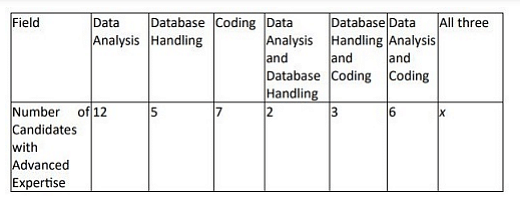
The number of applicants with advanced expertise in all three fields is given as x in the table, where x is a non-negative integer.
- XAT - 2024
- Data Interpretation