Questions 48 to 50 are followed by two statements labelled as (1) and (2). You have to decide if these statements are sufficient to conclusively answer the question. Give answer:
(A) If statement (1) alone or statement (2) alone is sufficient to answer the question
(B) If you can get the answer from (1) and (2) together but neither alone is sufficient
(C) If statement 1 alone is sufficient to answer the question and statement (2) alone is also sufficient
(D) If neither statement (1) nor statement (2) is sufficient to answer the question
A, B, C, D, E are five positive numbers.
\( A + B < C + D \), \( B + C < D + E \), \( C + D < E + A \).
Is 'A' the greatest?
Statement 1: \( D + E < A + B \).
Statement 2: \( E < C \).
Questions 48 to 50 are followed by two statements labelled as (1) and (2). You have to decide if these statements are sufficient to conclusively answer the question. Give answer:
(A) If statement (1) alone or statement (2) alone is sufficient to answer the question
(B) If you can get the answer from (1) and (2) together but neither alone is sufficient
(C) If statement 1 alone is sufficient to answer the question and statement (2) alone is also sufficient
(D) If neither statement (1) nor statement (2) is sufficient to answer the question
A, B, C, D, E are five positive numbers.
\( A + B < C + D \), \( B + C < D + E \), \( C + D < E + A \).
Is 'A' the greatest?
Statement 1: \( D + E < A + B \).
Statement 2: \( E < C \).
Show Hint
- If statement (1) alone or statement (2) alone is sufficient to answer the question
- If you can get the answer from (1) and (2) together but neither alone is sufficient
- If statement 1 alone is sufficient to answer the question and statement (2) alone is also sufficient
- If neither statement (1) nor statement (2) is sufficient to answer the question
The Correct Option is A
Solution and Explanation
Five positive numbers A, B, C, D, E obey three chained inequalities, and we must decide, using the two extra clues one at a time, whether we can always tell that A is the largest of the five.
Step 2: Key Formula or Approach:
The trick with chained inequalities like these is to add or compare them in pairs so that common terms cancel, leaving a direct comparison between just two of the letters at a time. We do this systematically, letter pair by letter pair, first using only the stem, then bringing in each statement.
Step 3: Detailed Explanation:
From the stem: $A+B<C+D$ and $C+D<E+A$ share the block $C+D$, so $A+B<E+A$, which gives $B<E$ once A cancels. This is true regardless of any statement.
Now bring in statement 1, $D+E<A+B$. Since the stem gives $A+B<C+D$, stacking these two: $D+E<A+B<C+D$, so $D+E<C+D$, and cancelling D gives $E<C$.
Next, use statement 1 again with the stem's second inequality $B+C<D+E$: stacking $B+C<D+E<A+B$, the second half from statement 1, gives $B+C<A+B$, and cancelling B gives $C<A$.
So far, under statement 1: $E<C<A$, and separately $B<E$, so altogether $B<E<C<A$, meaning B, C and E are each below A.
For D, rearrange statement 1 as $D<A+B-E$. Because $B<E$, the quantity $B-E$ is negative, so $A+B-E$ is strictly less than A. So $D<A+B-E<A$, meaning D is below A too.
With all of B, C, D, E shown to be less than A, statement 1 by itself settles the question with a clear yes, A is the greatest.
Now check statement 2, $E<C$, by itself, without statement 1. Pick sample positive values that satisfy the three stem inequalities plus $E<C$: let $D = 5$, $E = 8$, $C = 12$, and solve for A and B so all three stem conditions hold, for example $B = 0.5$ and $A = 10$. Every stem inequality and $E<C$ checks out with these numbers, yet $C = 12$ exceeds $A = 10$. Since A fails to be the greatest in this valid case, statement 2 by itself cannot guarantee the answer.
Step 4: Final Answer:
Statement 1 by itself is strong enough to force B, C, D and E all below A, so it alone answers the question. Statement 2 by itself allows a counter-example where A is not the greatest, so it alone is not enough. The correct choice is that statement (1) alone is sufficient.
\[ \boxed{\text{Statement (1) alone is sufficient}} \]
Top Questions on Data Sufficiency
- Statement: Company has made it Compulsory to mark online attendance using facial recognition software — Notice in an office.
Assumptions: 1) Notice will be read 2) Online attendance will benefit the company- SNAP - 2024
- Logical Reasoning
- Data Sufficiency
- Who among Shyam, Nath, Varun and Muneer is youngest ? A. Varun is younger than Muneer but older than Shyam and Nath B. Muneeris the oldest C. Shyamisolder than Nath
- JEECUP - 2024
- Logical Reasoning
- Data Sufficiency
- What is the value of \(x\)?
Statement I: \(2^2 + 5x + 6 = 0\)
Statement II: \(2^2 + 7x + 12 = 0\)- CUET (UG) - 2025
- General Aptitude
- Data Sufficiency
What is the total mark in the examination?
Statements:
I. A student secures 36% but fails by 6 marks.
II. The pass mark is 60.- KMAT KERALA - 2026
- Logical Reasoning
- Data Sufficiency
- Want to practice more? Try solving extra ecology questions todayView All Questions
Questions Asked in XAT exam
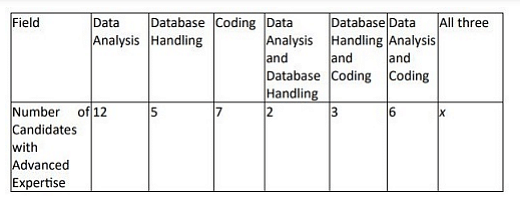
The number of applicants with advanced expertise in all three fields is given as x in the table, where x is a non-negative integer.
- XAT - 2024
- Data Interpretation