Questions 48 to 50 are followed by two statements labelled as (1) and (2). You have to decide if these statements are sufficient to conclusively answer the question. Give answer:
(A) If statement (1) alone or statement (2) alone is sufficient to answer the question
(B) If you can get the answer from (1) and (2) together but neither alone is sufficient
(C) If statement 1 alone is sufficient to answer the question and statement (2) alone is also sufficient
(D) If neither statement (1) nor statement (2) is sufficient to answer the question
Around a circular table six persons A, B, C, D, E and F are sitting. Who is on the immediate left to A?
Statement 1: B is opposite to C and D is opposite to E.
Statement 2: F is on the immediate left to B and D is to the left of B.
Questions 48 to 50 are followed by two statements labelled as (1) and (2). You have to decide if these statements are sufficient to conclusively answer the question. Give answer:
(A) If statement (1) alone or statement (2) alone is sufficient to answer the question
(B) If you can get the answer from (1) and (2) together but neither alone is sufficient
(C) If statement 1 alone is sufficient to answer the question and statement (2) alone is also sufficient
(D) If neither statement (1) nor statement (2) is sufficient to answer the question
Around a circular table six persons A, B, C, D, E and F are sitting. Who is on the immediate left to A?
Statement 1: B is opposite to C and D is opposite to E.
Statement 2: F is on the immediate left to B and D is to the left of B.
Show Hint
- If statement (1) alone or statement (2) alone is sufficient to answer the question
- If you can get the answer from (1) and (2) together but neither alone is sufficient
- If statement 1 alone is sufficient to answer the question and statement (2) alone is also sufficient
- If neither statement (1) nor statement (2) is sufficient to answer the question
The Correct Option is B
Solution and Explanation
This is a seating puzzle around a round table with six chairs, and the real question buried inside it is whether we have enough clues to nail down one specific neighbour of A. It helps to remember that on a circular table, saying two people are "opposite" fixes a relationship but not an absolute chair number, while saying someone is "immediately left" of another is a much stronger, chair-by-chair clue; this puzzle is built so that you need one of each type before the whole table locks into place. Let's check what each clue actually locks down.
- Statement 1 (B opposite C, D opposite E): A round table with six seats has only three seats-facing-each-other pairs. Two of them are spoken for here, B-C and D-E, so the third pair has to be A and F, meaning A and F face each other. That is useful, but it only tells us a relationship between two people; it says nothing about which way the seating runs or exactly which chair holds which person, so several different valid seatings still fit this clue, each placing a different person at A's left. Not enough on its own.
- Statement 2 (F immediately left of B, D to the left of B): This clue only connects B, D and F to each other. A, C and E do not appear in it at all, so A's own seat is left completely open. Not enough on its own either.
- Both statements together: Now put B down first and work outward. F sits right next to B, from statement 2, and since A faces F directly, from statement 1, A's seat is fixed three places round from F. B facing C fixes C's seat the same way. That leaves two chairs for D and E, and since D is said to be on the left side near B, we can tell D from E and complete the circle. Every one of the six chairs now has exactly one named person in it, so the person sitting at A's left comes out as a single, forced answer. This confirms that we truly needed information from both clues to get there, not just one.
Working through an actual seating, calling B's chair seat 1 and moving clockwise, gives: B at seat 1, F at seat 2, D at seat 3, C at seat 4, A at seat 5, E at seat 6. That puts E right after A going clockwise, so E sits at A's left, and this seating is the only one consistent with both clues at once.
Let's summarize:
- Statement 1 fixes only who sits opposite whom, not the exact chairs, so it cannot fix A's left neighbour alone.
- Statement 2 fixes only the B, D, F cluster and never mentions A, so it cannot fix A's left neighbour alone either.
- Only when the opposite-pair facts from statement 1 are combined with the adjacency facts from statement 2 does every chair become fixed, giving one definite answer.
So the correct choice is that the two statements together, but neither alone, are sufficient to answer the question.
Top Questions on Data Sufficiency
- Statement: Company has made it Compulsory to mark online attendance using facial recognition software — Notice in an office.
Assumptions: 1) Notice will be read 2) Online attendance will benefit the company- SNAP - 2024
- Logical Reasoning
- Data Sufficiency
- Who among Shyam, Nath, Varun and Muneer is youngest ? A. Varun is younger than Muneer but older than Shyam and Nath B. Muneeris the oldest C. Shyamisolder than Nath
- JEECUP - 2024
- Logical Reasoning
- Data Sufficiency
- What is the value of \(x\)?
Statement I: \(2^2 + 5x + 6 = 0\)
Statement II: \(2^2 + 7x + 12 = 0\)- CUET (UG) - 2025
- General Aptitude
- Data Sufficiency
What is the total mark in the examination?
Statements:
I. A student secures 36% but fails by 6 marks.
II. The pass mark is 60.- KMAT KERALA - 2026
- Logical Reasoning
- Data Sufficiency
- Want to practice more? Try solving extra ecology questions todayView All Questions
Questions Asked in XAT exam
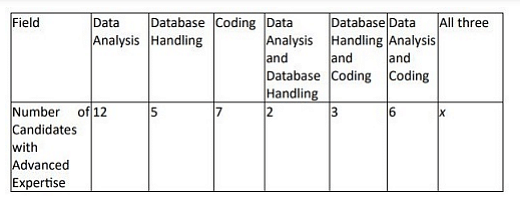
The number of applicants with advanced expertise in all three fields is given as x in the table, where x is a non-negative integer.
- XAT - 2024
- Data Interpretation