Question:hard
Questions 43 and 44 are based on the following instructions: each question gives a statement followed by three conclusions, I, II and III. Pick the option that tells you which of the three conclusions can be derived from the statement alone.
Statement: Let \(A\), \(B\), \(C\) be real numbers satisfying \(A < B < C\), \(A + B + C = 6\), and \(AB + BC + CA = 9\).
Conclusion I: \(1 < B < 3\)
Conclusion II: \(2 < A < 3\)
Conclusion III: \(0 < C < 1\)
Questions 43 and 44 are based on the following instructions: each question gives a statement followed by three conclusions, I, II and III. Pick the option that tells you which of the three conclusions can be derived from the statement alone.
Statement: Let \(A\), \(B\), \(C\) be real numbers satisfying \(A < B < C\), \(A + B + C = 6\), and \(AB + BC + CA = 9\).
Conclusion I: \(1 < B < 3\)
Conclusion II: \(2 < A < 3\)
Conclusion III: \(0 < C < 1\)
Statement: Let \(A\), \(B\), \(C\) be real numbers satisfying \(A < B < C\), \(A + B + C = 6\), and \(AB + BC + CA = 9\).
Conclusion I: \(1 < B < 3\)
Conclusion II: \(2 < A < 3\)
Conclusion III: \(0 < C < 1\)
Show Hint
Treat A and C as the two roots of a quadratic equation whose coefficients depend on B, then use the condition that B must lie strictly between those two roots.
Updated On: Jul 10, 2026
- Using the given statement, only conclusion I can be derived.
- Using the given statement, only conclusion II can be derived.
- Using the given statement, only conclusion III can be derived.
- Using the given statement, all conclusions can be derived.
Show Solution
The Correct Option is A
Solution and Explanation
Step 1: Rewrite the problem using the gaps between A, B and C.
Let $x = B - A$ and $y = C - B$; both are positive since $A < B < C$. Then $C - A = x + y$.
A useful identity connects the sum of squares of the pairwise differences to the given sums: $(A-B)^2+(B-C)^2+(C-A)^2 = 2(A^2+B^2+C^2) - 2(AB+BC+CA)$.
Step 2: Find $A^2+B^2+C^2$ from the given data.
Since $(A+B+C)^2 = A^2+B^2+C^2+2(AB+BC+CA)$, we get $36 = A^2+B^2+C^2 + 2(99)$, so $A^2+B^2+C^2 = 36 - 18 = 18$.
Step 3: Compute the sum of squared gaps and simplify.
$x^2+y^2+(x+y)^2 = 2(18) - 2(99) = 18$.
Expanding $(x+y)^2 = x^2+2xy+y^2$, this becomes $2x^2+2xy+2y^2 = 18$, so $x^2+xy+y^2 = 9$, with $x>0$ and $y>0$.
Step 4: Express B in terms of x and y, then find its range.
From $A+B+C=6$ with $A=B-x$ and $C=B+y$: $(B-x)+B+(B+y)=6$, so $3B = 6+x-y$, giving $B = \frac{6+(x-y)}{3}$.
Let $u = x - y$. From $x^2+xy+y^2=9$ and $(x-y)^2 = x^2-2xy+y^2$, we get $xy = \frac{9-u^2}{3}$. For $x$ and $y$ to be positive real numbers we need $xy>0$, so $u^2 < 9$, that is $-3 < u < 3$.
Checking that positive $x$ and $y$ actually exist for every such $u$ confirms the full open range $u \in (-3,3)$ is reachable, with $x$ or $y$ shrinking to $0$ only at the excluded endpoints $u = \pm 3$.
So $B = \frac{6+u}{3}$ ranges over $\left(\frac{6-3}{3}, \frac{6+3}{3}\right) = (1,3)$, which proves Conclusion I.
Step 5: Show Conclusions II and III can fail using a sample case.
Take $u=1$: then $xy = \frac{9-1}{3} = \frac{8}{3}$ and $x+y = \sqrt{u^2+4xy} = \sqrt{1 + \frac{32}{3}} \approx 3.42$, giving $x \approx 2.21$ and $y \approx 1.21$.
Then $B = \frac{6+1}{3} \approx 2.33$, $A = B - x \approx 0.12$, and $C = B+y \approx 3.54$, and indeed $A < B < C$ holds.
Here $A \approx 0.12$ is not between 2 and 3, so Conclusion II fails, and $C \approx 3.54$ is not between 0 and 1, so Conclusion III fails as well.
Since this is one valid case where both II and III break down, neither of them can be a guaranteed consequence of the statement.
Final Answer:
Only Conclusion I is always true, so the statement supports option (AA) and no other.
Let $x = B - A$ and $y = C - B$; both are positive since $A < B < C$. Then $C - A = x + y$.
A useful identity connects the sum of squares of the pairwise differences to the given sums: $(A-B)^2+(B-C)^2+(C-A)^2 = 2(A^2+B^2+C^2) - 2(AB+BC+CA)$.
Step 2: Find $A^2+B^2+C^2$ from the given data.
Since $(A+B+C)^2 = A^2+B^2+C^2+2(AB+BC+CA)$, we get $36 = A^2+B^2+C^2 + 2(99)$, so $A^2+B^2+C^2 = 36 - 18 = 18$.
Step 3: Compute the sum of squared gaps and simplify.
$x^2+y^2+(x+y)^2 = 2(18) - 2(99) = 18$.
Expanding $(x+y)^2 = x^2+2xy+y^2$, this becomes $2x^2+2xy+2y^2 = 18$, so $x^2+xy+y^2 = 9$, with $x>0$ and $y>0$.
Step 4: Express B in terms of x and y, then find its range.
From $A+B+C=6$ with $A=B-x$ and $C=B+y$: $(B-x)+B+(B+y)=6$, so $3B = 6+x-y$, giving $B = \frac{6+(x-y)}{3}$.
Let $u = x - y$. From $x^2+xy+y^2=9$ and $(x-y)^2 = x^2-2xy+y^2$, we get $xy = \frac{9-u^2}{3}$. For $x$ and $y$ to be positive real numbers we need $xy>0$, so $u^2 < 9$, that is $-3 < u < 3$.
Checking that positive $x$ and $y$ actually exist for every such $u$ confirms the full open range $u \in (-3,3)$ is reachable, with $x$ or $y$ shrinking to $0$ only at the excluded endpoints $u = \pm 3$.
So $B = \frac{6+u}{3}$ ranges over $\left(\frac{6-3}{3}, \frac{6+3}{3}\right) = (1,3)$, which proves Conclusion I.
Step 5: Show Conclusions II and III can fail using a sample case.
Take $u=1$: then $xy = \frac{9-1}{3} = \frac{8}{3}$ and $x+y = \sqrt{u^2+4xy} = \sqrt{1 + \frac{32}{3}} \approx 3.42$, giving $x \approx 2.21$ and $y \approx 1.21$.
Then $B = \frac{6+1}{3} \approx 2.33$, $A = B - x \approx 0.12$, and $C = B+y \approx 3.54$, and indeed $A < B < C$ holds.
Here $A \approx 0.12$ is not between 2 and 3, so Conclusion II fails, and $C \approx 3.54$ is not between 0 and 1, so Conclusion III fails as well.
Since this is one valid case where both II and III break down, neither of them can be a guaranteed consequence of the statement.
Final Answer:
Only Conclusion I is always true, so the statement supports option (AA) and no other.
Was this answer helpful?
0
Top Questions on Quadratic Equations
- The equation \( (\cos p - 1)x^2 + (\cos p)x + \sin p = 0 \), where \( x \) is a variable with real roots. Then the interval of \( p \) may be any one of the following:
- MHT CET - 2024
- Mathematics
- Quadratic Equations
- If the roots of the quadratic equation \( x^2 - 7x + 12 = 0 \) are \( \alpha \) and \( \beta \), then the value of \( \alpha + \beta \) is:
- MHT CET - 2025
- Mathematics
- Quadratic Equations
- Find the roots of the quadratic equation $ x^2 - 5x + 6 = 0 $.
- MHT CET - 2025
- Mathematics
- Quadratic Equations
- Find the sum of the roots of the quadratic equation $ 2x^2 - 5x + 3 = 0 $.
- MHT CET - 2025
- Mathematics
- Quadratic Equations
- Want to practice more? Try solving extra ecology questions todayView All Questions
Questions Asked in XAT exam
Applicants have been shortlisted for interviews for some data analyst positions. Some of the applicants have advanced expertise in one or more fields among the following: data analysis, database handling and coding. The numbers of applicants with different advanced expertise are given in the 2 × 8 table below.
The number of applicants with advanced expertise in all three fields is given as x in the table, where x is a non-negative integer.
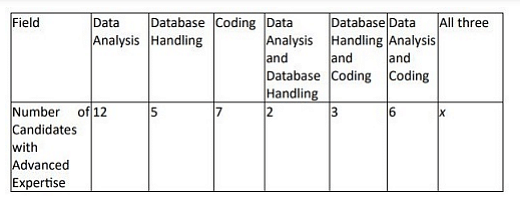
The number of applicants with advanced expertise in all three fields is given as x in the table, where x is a non-negative integer.
- XAT - 2024
- Data Interpretation