Question:hard
Questions 43 and 44 are based on the following instructions: each question gives a statement followed by three conclusions, I, II and III. Pick the option that tells you which of the three conclusions can be derived from the statement alone.
Statement: \(A_0, A_1, A_2, \ldots\) is a sequence of numbers with \(A_0 = 1\), \(A_1 = 3\), and \(A_t = (t+1)A_{t-1} - tA_{t-2}\) for \(t = 2, 3, 4, \ldots\)
Conclusion I: \(A_8 = 77\)
Conclusion II: \(A_{10} = 121\)
Conclusion III: \(A_{12} = 145\)
Questions 43 and 44 are based on the following instructions: each question gives a statement followed by three conclusions, I, II and III. Pick the option that tells you which of the three conclusions can be derived from the statement alone.
Statement: \(A_0, A_1, A_2, \ldots\) is a sequence of numbers with \(A_0 = 1\), \(A_1 = 3\), and \(A_t = (t+1)A_{t-1} - tA_{t-2}\) for \(t = 2, 3, 4, \ldots\)
Conclusion I: \(A_8 = 77\)
Conclusion II: \(A_{10} = 121\)
Conclusion III: \(A_{12} = 145\)
Statement: \(A_0, A_1, A_2, \ldots\) is a sequence of numbers with \(A_0 = 1\), \(A_1 = 3\), and \(A_t = (t+1)A_{t-1} - tA_{t-2}\) for \(t = 2, 3, 4, \ldots\)
Conclusion I: \(A_8 = 77\)
Conclusion II: \(A_{10} = 121\)
Conclusion III: \(A_{12} = 145\)
Show Hint
Look at the difference \(A_t - A_{t-1}\) between consecutive terms rather than recomputing every term from the recurrence; that difference follows a much simpler pattern than the original recurrence does.
Updated On: Jul 10, 2026
- Using the given statement, only conclusion I can be derived.
- Using the given statement, only conclusion II can be derived.
- Using the given statement, only conclusion III can be derived.
- Using the given statement, none of the three conclusions I, II and III can be derived.
Show Solution
The Correct Option is D
Solution and Explanation
Step 1: Understanding the Concept.
Instead of hunting for a general formula, just work out the sequence one term at a time straight from the recurrence, and check whether the given conclusions match.
Step 2: Compute the first few terms directly.
We know $A_0 = 1$ and $A_1 = 3$. For $t = 2$: $A_2 = (2+1)A_1 - 2A_0 = 3(33) - 2(11) = 9 - 2 = 7$.
For $t = 3$: $A_3 = 4A_2 - 3A_1 = 4(77) - 3(33) = 28 - 9 = 19$.
For $t = 4$: $A_4 = 5A_3 - 4A_2 = 5(19) - 4(77) = 95 - 28 = 67$.
For $t = 5$: $A_5 = 6A_4 - 5A_3 = 6(67) - 5(19) = 402 - 95 = 307$.
Step 3: Keep applying the recurrence up to $t = 8$.
For $t = 6$: $A_6 = 7A_5 - 6A_4 = 7(307) - 6(67) = 2149 - 402 = 1747$.
For $t = 7$: $A_7 = 8A_6 - 7A_5 = 8(1747) - 7(307) = 13976 - 2149 = 11827$.
For $t = 8$: $A_8 = 9A_7 - 8A_6 = 9(11827) - 8(1747) = 106443 - 13976 = 92467$.
This already tells us $A_8 = 92467$, nowhere near the value $77$ claimed in Conclusion I.
Step 4: Push the computation on to $t = 10$ and $t = 12$.
For $t = 9$: $A_9 = 10A_8 - 9A_7 = 10(92467) - 9(11827) = 924670 - 106443 = 818227$.
For $t = 10$: $A_{10} = 11A_9 - 10A_8 = 11(818227) - 10(92467) = 9000497 - 924670 = 8075827$.
For $t = 11$: $A_{11} = 12A_{10} - 11A_9 = 12(8075827) - 11(818227) = 96909924 - 9000497 = 87909427$.
For $t = 12$: $A_{12} = 13A_{11} - 12A_{10} = 13(87909427) - 12(8075827) = 1142822551 - 96909924 = 1045912627$.
Step 5: Match against the conclusions and pick the option.
$A_8 = 92467 \neq 77$, so Conclusion I is false.
$A_{10} = 8075827 \neq 121$, so Conclusion II is false.
$A_{12} = 1045912627 \neq 145$, so Conclusion III is false.
Since term by term computation rules out all three conclusions, none of them can be derived from the statement.
This matches option (EE), the same answer reached through the shortcut factorial formula, which confirms the result is not a one-off calculation slip.
Instead of hunting for a general formula, just work out the sequence one term at a time straight from the recurrence, and check whether the given conclusions match.
Step 2: Compute the first few terms directly.
We know $A_0 = 1$ and $A_1 = 3$. For $t = 2$: $A_2 = (2+1)A_1 - 2A_0 = 3(33) - 2(11) = 9 - 2 = 7$.
For $t = 3$: $A_3 = 4A_2 - 3A_1 = 4(77) - 3(33) = 28 - 9 = 19$.
For $t = 4$: $A_4 = 5A_3 - 4A_2 = 5(19) - 4(77) = 95 - 28 = 67$.
For $t = 5$: $A_5 = 6A_4 - 5A_3 = 6(67) - 5(19) = 402 - 95 = 307$.
Step 3: Keep applying the recurrence up to $t = 8$.
For $t = 6$: $A_6 = 7A_5 - 6A_4 = 7(307) - 6(67) = 2149 - 402 = 1747$.
For $t = 7$: $A_7 = 8A_6 - 7A_5 = 8(1747) - 7(307) = 13976 - 2149 = 11827$.
For $t = 8$: $A_8 = 9A_7 - 8A_6 = 9(11827) - 8(1747) = 106443 - 13976 = 92467$.
This already tells us $A_8 = 92467$, nowhere near the value $77$ claimed in Conclusion I.
Step 4: Push the computation on to $t = 10$ and $t = 12$.
For $t = 9$: $A_9 = 10A_8 - 9A_7 = 10(92467) - 9(11827) = 924670 - 106443 = 818227$.
For $t = 10$: $A_{10} = 11A_9 - 10A_8 = 11(818227) - 10(92467) = 9000497 - 924670 = 8075827$.
For $t = 11$: $A_{11} = 12A_{10} - 11A_9 = 12(8075827) - 11(818227) = 96909924 - 9000497 = 87909427$.
For $t = 12$: $A_{12} = 13A_{11} - 12A_{10} = 13(87909427) - 12(8075827) = 1142822551 - 96909924 = 1045912627$.
Step 5: Match against the conclusions and pick the option.
$A_8 = 92467 \neq 77$, so Conclusion I is false.
$A_{10} = 8075827 \neq 121$, so Conclusion II is false.
$A_{12} = 1045912627 \neq 145$, so Conclusion III is false.
Since term by term computation rules out all three conclusions, none of them can be derived from the statement.
This matches option (EE), the same answer reached through the shortcut factorial formula, which confirms the result is not a one-off calculation slip.
Was this answer helpful?
0
Top Questions on Sequence and Series
- Series Expansion $ n^6 + \frac{1}{2} n^4 + \frac{1}{3} n^2 + \cdots + \frac{1}{n} C_n + 1 \quad n \to \infty $
- MHT CET - 2025
- Mathematics
- Sequence and Series
- Krishna has certain number of coins numbered with a series of consecutive natural numbers starting with 1. He found that the sum of squares of all the numbers on the coins is 1753 times the sum of numbers on coins. How many coins does he have?
- IBSAT
- Quantitative Aptitude
- Sequence and Series
- A group of 630 children is arranged in rows for a photograph session. Each row contains three children lesser than the row in front of it. Which of the below mentioned number of rows is not possible?
- IBSAT
- Quantitative Aptitude
- Sequence and Series
- In each of the following questions a number series is given with one missing (?) term. The term is given as one of the alternatives among the five numbers given in the answer choic Find the term.
1, 27, 125, ? , 729, 1331- IBSAT
- Quantitative Aptitude
- Sequence and Series
- Want to practice more? Try solving extra ecology questions todayView All Questions
Questions Asked in XAT exam
Applicants have been shortlisted for interviews for some data analyst positions. Some of the applicants have advanced expertise in one or more fields among the following: data analysis, database handling and coding. The numbers of applicants with different advanced expertise are given in the 2 × 8 table below.
The number of applicants with advanced expertise in all three fields is given as x in the table, where x is a non-negative integer.
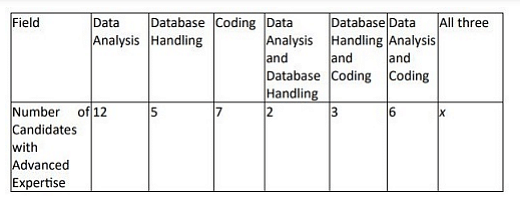
The number of applicants with advanced expertise in all three fields is given as x in the table, where x is a non-negative integer.
- XAT - 2024
- Data Interpretation