Question:medium
Mungeri Lal has two investment plans, A and B, to choose from. Plan A offers interest of 10% compounded annually, while plan B offers simple interest of 12% per annum. Till how many years is plan B a better investment?
Mungeri Lal has two investment plans, A and B, to choose from. Plan A offers interest of 10% compounded annually, while plan B offers simple interest of 12% per annum. Till how many years is plan B a better investment?
Show Hint
Compare \((1.10)^n\) with \(1+0.12n\) year by year until the compound value overtakes the simple value.
Updated On: Jul 10, 2026
- 3
- 4
- 5
- 6
Show Solution
The Correct Option is B
Solution and Explanation
Step 1: Set up the difference.
Let $D(n) = (1 + 0.12n) - (1.10)^n$, the extra amount Plan B gives over Plan A after $n$ years. Plan B is the better choice as long as $D(n) > 0$.
Step 2: Track $D(n)$ year by year.
$n=1$: $D = 1.12 - 1.10 = 0.02 > 0$.
$n=2$: $D = 1.24 - 1.21 = 0.03 > 0$.
$n=3$: $D = 1.36 - 1.331 = 0.029 > 0$.
$n=4$: $D = 1.48 - 1.4641 = 0.0159 > 0$, still positive but shrinking fast.
$n=5$: $D = 1.60 - 1.61051 = -0.01051 < 0$, Plan B has now fallen behind.
Step 3: Read off the crossover.
$D(n)$ stays positive through $n=4$ and turns negative at $n=5$. Compound growth is slow at first but eventually beats a fixed 12% add on every year, because compounding acts on an ever growing base while simple interest always adds the same fixed 12% of the original Re. 1.
Step 4: Final answer.
Plan B stays ahead for 4 full years before Plan A's compounding catches up.
\[ \boxed{4} \]
Let $D(n) = (1 + 0.12n) - (1.10)^n$, the extra amount Plan B gives over Plan A after $n$ years. Plan B is the better choice as long as $D(n) > 0$.
Step 2: Track $D(n)$ year by year.
$n=1$: $D = 1.12 - 1.10 = 0.02 > 0$.
$n=2$: $D = 1.24 - 1.21 = 0.03 > 0$.
$n=3$: $D = 1.36 - 1.331 = 0.029 > 0$.
$n=4$: $D = 1.48 - 1.4641 = 0.0159 > 0$, still positive but shrinking fast.
$n=5$: $D = 1.60 - 1.61051 = -0.01051 < 0$, Plan B has now fallen behind.
Step 3: Read off the crossover.
$D(n)$ stays positive through $n=4$ and turns negative at $n=5$. Compound growth is slow at first but eventually beats a fixed 12% add on every year, because compounding acts on an ever growing base while simple interest always adds the same fixed 12% of the original Re. 1.
Step 4: Final answer.
Plan B stays ahead for 4 full years before Plan A's compounding catches up.
\[ \boxed{4} \]
Was this answer helpful?
0
Top Questions on SI & CI
- Anil invests Rs. 22000 for 6 years in a certain scheme with 4% interest per annum, compounded half-yearly. Sunil invests in the same scheme for 5 years, and then reinvests the entire amount received at the end of 5 years for one year at 10% simple interest. If the amounts received by both at the end of 6 years are same, then the initial investment made by Sunil, in rupees, is
- Anil borrows Rs 2 lakhs at an interest rate of 8% per annum, compounded half-yearly. He repays Rs 10320 at the end of the first year and closes the loan by paying the outstanding amount at the end of the third year. Then, the total interest, in rupees, paid over the three years is nearest to
- Anil invests Rs. 22000 for 6 years in a certain scheme with 4% interest per annum, compounded half-yearly. Sunil invests in the same scheme for 5 years, and then reinvests the entire amount received at the end of 5 years for one year at 10% simple interest. If the amounts received by both at the end of 6 years are same, then the initial investment made by Sunil, in rupees, is
- S invested 22,000 for 6 years at a 4% rate compounded half-yearly. B also invested a certain amount of money for 5 years in the same scheme and then reinvested it for a year at a 10% rate of simple interest. If their total amounts become the same after 6 years, what was B’s initial investment?
- Want to practice more? Try solving extra ecology questions todayView All Questions
Questions Asked in XAT exam
Applicants have been shortlisted for interviews for some data analyst positions. Some of the applicants have advanced expertise in one or more fields among the following: data analysis, database handling and coding. The numbers of applicants with different advanced expertise are given in the 2 × 8 table below.
The number of applicants with advanced expertise in all three fields is given as x in the table, where x is a non-negative integer.
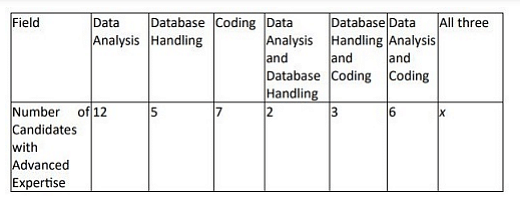
The number of applicants with advanced expertise in all three fields is given as x in the table, where x is a non-negative integer.
- XAT - 2024
- Data Interpretation