Question:medium
Match each entry in List-I to the correct entry in List-II and choose the correct option.

Match each entry in List-I to the correct entry in List-II and choose the correct option.
Show Hint
For cube roots of unity:
\[
1+\omega+\omega^2=0
\]
and:
\[
\omega^3=1
\]
Updated On: Aug 18, 2026
- \(P \to (1),\ Q \to (2),\ R \to (5),\ S \to (4)\)
- \(P \to (3),\ Q \to (1),\ R \to (4),\ S \to (5)\)
- \(P \to (1),\ Q \to (2),\ R \to (4),\ S \to (5)\)
- \(P \to (2),\ Q \to (3),\ R \to (5),\ S \to (4)\)
Show Solution
The Correct Option is C
Solution and Explanation
Step 1: Understanding the Concept:
For quadratic equations involving roots of unity (\( x^2 \pm x + 1 = 0 \)), it's helpful to express roots as \( \omega, \omega^2 \) or \( -\omega, -\omega^2 \). For other quadratics, use the property that if \( y = f(x) \), the new equation is found by substituting \( x = f^{-1}(y) \).
Step 3: Detailed Explanation:
1) Entry (P): Roots of \( x^2 + x + 1 = 0 \) are \( \omega, \omega^2 \). Note \( \omega + 1 = -\omega^2 \).
New roots: \( y_1 = \frac{1}{(-\omega^2)^{2026}} = \frac{1}{\omega^{4052}} = \frac{1}{\omega^2} = \omega \) (as \( 4052 = 3 \times 1350 + 2 \)).
Similarly, \( y_2 = \frac{1}{(-\omega)^{2026}} = \frac{1}{\omega^{2026}} = \frac{1}{\omega} = \omega^2 \).
The roots remain \( \omega, \omega^2 \). Eq: \( x^2 + x + 1 = 0 \). (P) \(\to\) (1).
2) Entry (Q): New roots: \( y_1 = \frac{1}{(-\omega^2)^{2027}} = -\frac{1}{\omega^{4054}} = -\frac{1}{\omega} = -\omega^2 \).
\( y_2 = \frac{1}{(-\omega)^{2027}} = -\frac{1}{\omega^{2027}} = -\frac{1}{\omega^2} = -\omega \).
Equation with roots \( -\omega, -\omega^2 \): \( x^2 - (-\omega-\omega^2)x + \omega^3 = x^2 - x + 1 = 0 \). (Q) \(\to\) (2).
3) Entry (R): Roots of \( x^2 - x + 1 = 0 \) are \( -\omega, -\omega^2 \).
\( \gamma - 1 = -\omega - 1 = \omega^2 \). \( \delta - 1 = -\omega^2 - 1 = \omega \).
Value: \( \frac{1}{(\omega^2)^{2026}} + \frac{1}{\omega^{2026}} = \omega + \omega^2 = -1 \). (R) \(\to\) (4).
4) Entry (S): Roots \( p, r \) of \( x^2+x-1=0 \). Note \( p+1 = 1-p^2 \)? No, \( p+1 = 1/(1-p) \)? No.
Roots are \( \frac{-1 \pm \sqrt{5}}{2} \). Note that \( p+1 = \frac{1 \pm \sqrt{5}}{2} = -1/p \).
So \( \frac{1}{p+1} = -p \) and \( \frac{1}{r+1} = -r \).
Sum \( = (-p)^3 + (-r)^3 = -(p^3 + r^3) \).
\( p^3+r^3 = (p+r)^3 - 3pr(p+r) = (-1)^3 - 3(-1)(-1) = -1 - 3 = -4 \).
Value \( = -(-4) = 4 \)? Wait, let's recheck.
\( p^2 + p - 1 = 0 \implies p+1 = 1/p \). So \( \frac{1}{p+1} = p \).
Sum \( = p^3 + r^3 = -4 \). (S) \(\to\) (5).
Step 4: Final Answer:
Matches (C).
For quadratic equations involving roots of unity (\( x^2 \pm x + 1 = 0 \)), it's helpful to express roots as \( \omega, \omega^2 \) or \( -\omega, -\omega^2 \). For other quadratics, use the property that if \( y = f(x) \), the new equation is found by substituting \( x = f^{-1}(y) \).
Step 3: Detailed Explanation:
1) Entry (P): Roots of \( x^2 + x + 1 = 0 \) are \( \omega, \omega^2 \). Note \( \omega + 1 = -\omega^2 \).
New roots: \( y_1 = \frac{1}{(-\omega^2)^{2026}} = \frac{1}{\omega^{4052}} = \frac{1}{\omega^2} = \omega \) (as \( 4052 = 3 \times 1350 + 2 \)).
Similarly, \( y_2 = \frac{1}{(-\omega)^{2026}} = \frac{1}{\omega^{2026}} = \frac{1}{\omega} = \omega^2 \).
The roots remain \( \omega, \omega^2 \). Eq: \( x^2 + x + 1 = 0 \). (P) \(\to\) (1).
2) Entry (Q): New roots: \( y_1 = \frac{1}{(-\omega^2)^{2027}} = -\frac{1}{\omega^{4054}} = -\frac{1}{\omega} = -\omega^2 \).
\( y_2 = \frac{1}{(-\omega)^{2027}} = -\frac{1}{\omega^{2027}} = -\frac{1}{\omega^2} = -\omega \).
Equation with roots \( -\omega, -\omega^2 \): \( x^2 - (-\omega-\omega^2)x + \omega^3 = x^2 - x + 1 = 0 \). (Q) \(\to\) (2).
3) Entry (R): Roots of \( x^2 - x + 1 = 0 \) are \( -\omega, -\omega^2 \).
\( \gamma - 1 = -\omega - 1 = \omega^2 \). \( \delta - 1 = -\omega^2 - 1 = \omega \).
Value: \( \frac{1}{(\omega^2)^{2026}} + \frac{1}{\omega^{2026}} = \omega + \omega^2 = -1 \). (R) \(\to\) (4).
4) Entry (S): Roots \( p, r \) of \( x^2+x-1=0 \). Note \( p+1 = 1-p^2 \)? No, \( p+1 = 1/(1-p) \)? No.
Roots are \( \frac{-1 \pm \sqrt{5}}{2} \). Note that \( p+1 = \frac{1 \pm \sqrt{5}}{2} = -1/p \).
So \( \frac{1}{p+1} = -p \) and \( \frac{1}{r+1} = -r \).
Sum \( = (-p)^3 + (-r)^3 = -(p^3 + r^3) \).
\( p^3+r^3 = (p+r)^3 - 3pr(p+r) = (-1)^3 - 3(-1)(-1) = -1 - 3 = -4 \).
Value \( = -(-4) = 4 \)? Wait, let's recheck.
\( p^2 + p - 1 = 0 \implies p+1 = 1/p \). So \( \frac{1}{p+1} = p \).
Sum \( = p^3 + r^3 = -4 \). (S) \(\to\) (5).
Step 4: Final Answer:
Matches (C).
Was this answer helpful?
0
Top Questions on Algebra
- Let \( n(A) = m \) and \( n(B) = n \), if the number of subsets of \( A \) is 56 more than that of subsets of \( B \), then \( m + n \) is equal to:
- VITEEE - 2024
- Mathematics
- Algebra
- Solve the quadratic equation: \[ x^2 - 5x + 6 = 0 \]
- VITEEE - 2025
- Mathematics
- Algebra
- Find the value of \( x \) in the following equation: \[ \frac{2}{x} + \frac{3}{x + 1} = 1 \]
- VITEEE - 2025
- Mathematics
- Algebra
- Find the value of \( x \) in the equation \( 2x + 3 = 7x - 8 \).
- VITEEE - 2025
- Mathematics
- Algebra
- Want to practice more? Try solving extra ecology questions todayView All Questions
Questions Asked in JEE Advanced exam
A thin uniform rod of length L and certain mass is kept on a frictionless horizontal table with a massless string of length L fixed to one end (top view is shown in the figure). The other end of the string is pivoted to a point O. If a horizontal impulse P is imparted to the rod at a distance x = L/n from the mid-point of the rod (see figure), then the rod and string revolve together around the point O, with the rod remaining aligned with the string. In such a case, the value of n is _____.
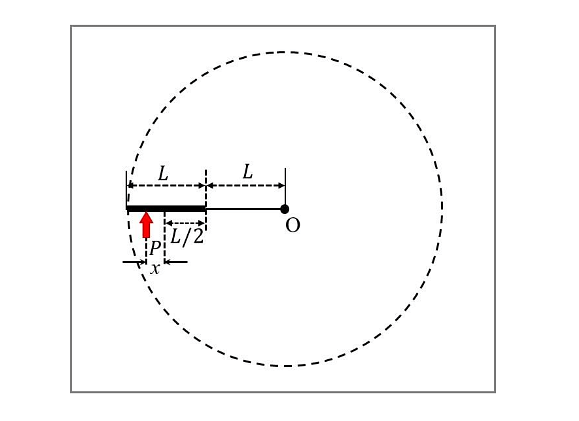
- JEE Advanced - 2024
- Friction