Question:medium
Let $y = f(x)$ be the real valued function defined on the interval $(0, \infty)$, satisfying $f(1) = 0$ and the differential equation
\[ x \frac{dy}{dx} = y - x^3. \]
Then which of the following statements is (are) TRUE?
Let $y = f(x)$ be the real valued function defined on the interval $(0, \infty)$, satisfying $f(1) = 0$ and the differential equation
\[ x \frac{dy}{dx} = y - x^3. \]
Then which of the following statements is (are) TRUE?
Show Hint
Solve the linear equation to get f(x) = (x - x^3)/2. Then f' changes sign from + to - at x = 1/sqrt3, and f = g reduces to a quadratic with two positive roots.
Updated On: Nov 19, 2026
- The function $f$ has a local minimum at $x = \frac{1}{\sqrt{3}}$
- The function $f$ has a local maximum at $x = \frac{1}{\sqrt{3}}$
- The function $f$ is increasing in the interval $(1, 2)$
- If $g(x) = 4x^3 - 5x^2 + \frac{3}{2}x$ for $x > 0$, then the number of elements in the set $\{ x \in (0, \infty) : f(x) = g(x) \}$ is 2
Show Solution
The Correct Option is B, D
Solution and Explanation
Step 1: Use the substitution y = xv:
Let $y = xv$, so $\dfrac{dy}{dx} = v + x\dfrac{dv}{dx}$. The equation $x\dfrac{dy}{dx} = y - x^3$ becomes
\[ xv + x^2\frac{dv}{dx} = xv - x^3 \;\Rightarrow\; x^2\frac{dv}{dx} = -x^3 \;\Rightarrow\; \frac{dv}{dx} = -x \]
So $v = -\tfrac{x^2}{2} + C$ and $y = -\tfrac{x^3}{2} + Cx$.
Step 2: Apply the condition:
$y(1) = 0$ gives $-\tfrac12 + C = 0$, so $C = \tfrac12$.
\[ f(x) = \frac{x}{2} - \frac{x^3}{2} \]
Step 3: Critical points:
$f'(x) = \tfrac12 - \tfrac32x^2$. Setting it to zero gives $x^2 = \tfrac13$, so $x = \tfrac{1}{\sqrt3}$.
The graph of $f$ is a cubic with a negative leading coefficient. It rises first, then falls, so the turning point at $x = \tfrac{1}{\sqrt3}$ is a maximum.
Step 4: Verdict on (A), (B), (C):
(A) is incorrect because the turning point is a maximum.
(B) is correct for the same reason.
(C) is incorrect. For $x > \tfrac{1}{\sqrt3}$ the function decreases, and $(1, 2)$ lies there, since $f(1) = 0$ and $f(2) = -3$.
Step 5: Option (D) by counting roots:
Set $f(x) - g(x) = 0$. We get $\dfrac{x - x^3}{2} - 4x^3 + 5x^2 - \dfrac32x = -\dfrac92x^3 + 5x^2 - x = 0$.
Factor: $-x\left(\dfrac92x^2 - 5x + 1\right) = 0$. The quadratic has product of roots $\dfrac{2}{9} > 0$ and sum $\dfrac{10}{9} > 0$, and discriminant $25 - 18 = 7 > 0$.
So it has two distinct positive roots. Together with $x = 0$ (outside $(0, \infty)$), the set has exactly 2 elements. (D) is correct.
Final Answer:
Options (B) and (D) are correct. \[ \boxed{\text{(B), (D)}} \]
Was this answer helpful?
0
Top Questions on types of differential equations
- Let the system of equations \(x+2y+3z = 5\), \(2x+3y+z = 9\), \(4x+3y+λz = μ\) have an infinite number of solutions. Then \(λ + 2μ\) is equal to
- JEE Main - 2024
- Mathematics
- types of differential equations
- If \(∫^{0.15}_{-0.15 }|100x^2-1|dx=\frac{k}{3000,}\) then k is equal to____.
- JEE Main - 2023
- Mathematics
- types of differential equations
- Let the digits a, b, c be in A.P. Nine-digit numbers are to be formed using each of these three digits thrice such that three consecutive digits are in A.P. at least once. How many such numbers can be formed?
- JEE Main - 2023
- Mathematics
- types of differential equations
- let Dk=\(\begin{vmatrix} 1 & 2k& 2k-1\\ n & n^2+n+2 & n^2\\ n & n^2+n & n^2+n+2 \end{vmatrix}\) if \(∑^n_{ k=1}\) Dk=96, Then n is equal to
- JEE Main - 2023
- Mathematics
- types of differential equations
- Want to practice more? Try solving extra ecology questions todayView All Questions
Questions Asked in JEE Advanced exam
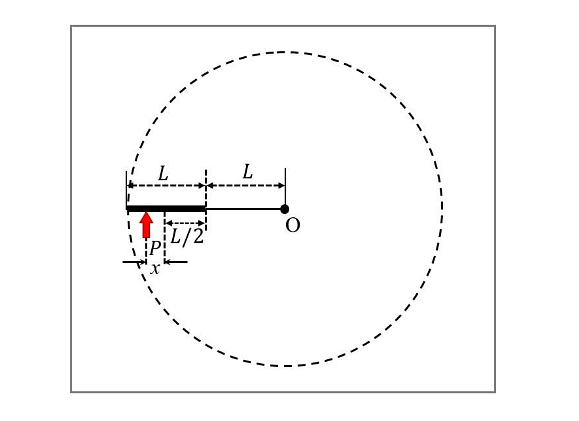
A thin uniform rod of length L and certain mass is kept on a frictionless horizontal table with a massless string of length L fixed to one end (top view is shown in the figure). The other end of the string is pivoted to a point O. If a horizontal impulse P is imparted to the rod at a distance x = L/n from the mid-point of the rod (see figure), then the rod and string revolve together around the point O, with the rod remaining aligned with the string. In such a case, the value of n is _____.
- JEE Advanced - 2024
- Friction