Question:hard
Let X be a four digit number with exactly three consecutive digits being the same, and X is a multiple of 9. How many such X's are possible?
Let X be a four digit number with exactly three consecutive digits being the same, and X is a multiple of 9. How many such X's are possible?
Show Hint
Split the count into the two shapes AAAB and ABBB, and use the fact that a number is a multiple of 9 only when its digit sum is a multiple of 9.
Updated On: Jul 10, 2026
- 12
- 16
- 19
- None of the above.
Show Solution
The Correct Option is D
Solution and Explanation
Step 1: Understanding the Concept:
A 4-digit number has a digit sum between $1$ (for $1000$) and $36$ (for $9999$), so the only sums that are multiples of $9$ worth checking are $9$, $18$ and $27$. The sum $36$ needs all four digits to be $9$, which has all four digits equal, not exactly three, so it is not counted.
Step 2: Key Formula or Approach:
For the pattern $aaab$ (repeated digit $a$ from $1$-$9$ in the first three places, different digit $b$ from $0$-$9$ last), the digit sum is $3a+b$. For the pattern $cbbb$ (different digit $c$ from $1$-$9$ first, repeated digit $a$ from $0$-$9$ in the last three places), the digit sum is $c+3a$. In both cases we look for the value that has to be added to $3a$ to reach the nearest multiple of $9$.
Step 3: Detailed Explanation:
For $aaab$: taking $3a$ for $a=1$ to $9$ gives $3,6,9,12,15,18,21,24,27$. The amount needed to reach the next multiple of $9$ (this is the required $b$) is $6,3,0,6,3,0,6,3,0$ in order. When this gap is $0$, both $b=0$ and $b=9$ work, unless one of them equals $a$; this removes one option only at $a=9$, since $b=9$ would then repeat $a$. Adding up the valid $b$ values for each $a$ gives $1+1+2+1+1+2+1+1+1=11$.
For $cbbb$: taking $3a$ for $a=0$ to $9$ gives $0,3,6,9,12,15,18,21,24,27$, and the same gap logic gives the required $c$, except $c$ must be from $1$ to $9$ and never $0$. This removes the case $a=9$, where the only fitting $c$ would be $9$ itself, equal to $a$, and so not allowed. This leaves $9$ working numbers.
Step 4: Final Answer:
Total $= 11+9 = 20$, which is not one of $12$, $16$, $19$ or $21$, so the answer is option E, "none of the above".
A 4-digit number has a digit sum between $1$ (for $1000$) and $36$ (for $9999$), so the only sums that are multiples of $9$ worth checking are $9$, $18$ and $27$. The sum $36$ needs all four digits to be $9$, which has all four digits equal, not exactly three, so it is not counted.
Step 2: Key Formula or Approach:
For the pattern $aaab$ (repeated digit $a$ from $1$-$9$ in the first three places, different digit $b$ from $0$-$9$ last), the digit sum is $3a+b$. For the pattern $cbbb$ (different digit $c$ from $1$-$9$ first, repeated digit $a$ from $0$-$9$ in the last three places), the digit sum is $c+3a$. In both cases we look for the value that has to be added to $3a$ to reach the nearest multiple of $9$.
Step 3: Detailed Explanation:
For $aaab$: taking $3a$ for $a=1$ to $9$ gives $3,6,9,12,15,18,21,24,27$. The amount needed to reach the next multiple of $9$ (this is the required $b$) is $6,3,0,6,3,0,6,3,0$ in order. When this gap is $0$, both $b=0$ and $b=9$ work, unless one of them equals $a$; this removes one option only at $a=9$, since $b=9$ would then repeat $a$. Adding up the valid $b$ values for each $a$ gives $1+1+2+1+1+2+1+1+1=11$.
For $cbbb$: taking $3a$ for $a=0$ to $9$ gives $0,3,6,9,12,15,18,21,24,27$, and the same gap logic gives the required $c$, except $c$ must be from $1$ to $9$ and never $0$. This removes the case $a=9$, where the only fitting $c$ would be $9$ itself, equal to $a$, and so not allowed. This leaves $9$ working numbers.
Step 4: Final Answer:
Total $= 11+9 = 20$, which is not one of $12$, $16$, $19$ or $21$, so the answer is option E, "none of the above".
Was this answer helpful?
0
Top Questions on Divisibility Rules
- The expression \( 2^{4n} - 15n - 1 \), where \( n \in \mathbb{N} \) (the set of natural numbers), is divisible by:
- WBJEE - 2025
- Mathematics
- Divisibility Rules
- The number 311311311311311311311 is
- SNAP - 2007
- Quantitative Aptitude
- Divisibility Rules
- Want to practice more? Try solving extra ecology questions todayView All Questions
Questions Asked in XAT exam
Applicants have been shortlisted for interviews for some data analyst positions. Some of the applicants have advanced expertise in one or more fields among the following: data analysis, database handling and coding. The numbers of applicants with different advanced expertise are given in the 2 × 8 table below.
The number of applicants with advanced expertise in all three fields is given as x in the table, where x is a non-negative integer.
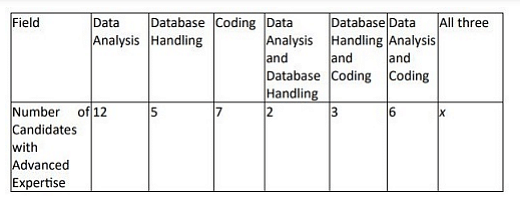
The number of applicants with advanced expertise in all three fields is given as x in the table, where x is a non-negative integer.
- XAT - 2024
- Data Interpretation