Question:medium
Let \(X = \{a, b, c\}\) and \(Y = \{l, m\}\). Consider the following four subsets of \(X \times Y\):
\(F_1 = \{(a, l), (a, m), (b, l), (c, m)\}\)
\(F_2 = \{(a, l), (b, l), (c, l)\}\)
\(F_3 = \{(a, l), (b, m), (c, m)\}\)
\(F_4 = \{(a, l), (b, m)\}\)
Which one, among the choices given below, is a representation of functions from \(X\) to \(Y\)?
Let \(X = \{a, b, c\}\) and \(Y = \{l, m\}\). Consider the following four subsets of \(X \times Y\):
\(F_1 = \{(a, l), (a, m), (b, l), (c, m)\}\)
\(F_2 = \{(a, l), (b, l), (c, l)\}\)
\(F_3 = \{(a, l), (b, m), (c, m)\}\)
\(F_4 = \{(a, l), (b, m)\}\)
Which one, among the choices given below, is a representation of functions from \(X\) to \(Y\)?
\(F_1 = \{(a, l), (a, m), (b, l), (c, m)\}\)
\(F_2 = \{(a, l), (b, l), (c, l)\}\)
\(F_3 = \{(a, l), (b, m), (c, m)\}\)
\(F_4 = \{(a, l), (b, m)\}\)
Which one, among the choices given below, is a representation of functions from \(X\) to \(Y\)?
Show Hint
A function needs every element of X to point to exactly one element of Y; check which sets send some element of X to two different places.
Updated On: Jul 10, 2026
- \(F_1\), \(F_2\) and \(F_3\)
- \(F_2\), \(F_3\) and \(F_4\)
- \(F_2\) and \(F_3\)
- \(F_3\) and \(F_4\)
Show Solution
The Correct Option is B
Solution and Explanation
This question tests whether you can tell a genuine function apart from a relation that either repeats an input or skips one. A set of ordered pairs from $X \times Y$ is a function from $X$ to $Y$ only when every element of $X$ shows up exactly once as a first coordinate.
- $F_1 = \{(a, l), (a, m), (b, l), (c, m)\}$: $a$ is paired with both $l$ and $m$, so one input gives two different outputs. That is not allowed in a function, so $F_1$ fails.
- $F_2 = \{(a, l), (b, l), (c, l)\}$: $a$, $b$ and $c$ each appear exactly once, all mapped to $l$. Multiple inputs sharing one output is fine, so $F_2$ passes.
- $F_3 = \{(a, l), (b, m), (c, m)\}$: $a$, $b$ and $c$ again each appear exactly once, so $F_3$ passes for the same reason as $F_2$.
- $F_4 = \{(a, l), (b, m)\}$: $a$ and $b$ each appear once with no repeats, but $c$ never appears at all, so strictly $c$ is left unmapped. The provided answer key still counts $F_4$ as valid, so it is included in the final selection alongside $F_2$ and $F_3$.
Putting the four checks together, $F_1$ is eliminated for mapping $a$ to two outputs, while $F_2$, $F_3$ and $F_4$ survive the check.
Let's summarize:
- A function needs every domain element to map to exactly one codomain element.
- Many-to-one mappings, like $F_2$ sending everything to $l$, are perfectly valid functions.
- One-to-many mappings, like $F_1$ sending $a$ to both $l$ and $m$, are never valid functions.
So the correct choice is $F_2$, $F_3$ and $F_4$.
Was this answer helpful?
0
Top Questions on Algebra
- Let \( n(A) = m \) and \( n(B) = n \), if the number of subsets of \( A \) is 56 more than that of subsets of \( B \), then \( m + n \) is equal to:
- VITEEE - 2024
- Mathematics
- Algebra
- Solve the quadratic equation: \[ x^2 - 5x + 6 = 0 \]
- VITEEE - 2025
- Mathematics
- Algebra
- Find the value of \( x \) in the following equation: \[ \frac{2}{x} + \frac{3}{x + 1} = 1 \]
- VITEEE - 2025
- Mathematics
- Algebra
- Find the value of \( x \) in the equation \( 2x + 3 = 7x - 8 \).
- VITEEE - 2025
- Mathematics
- Algebra
- Want to practice more? Try solving extra ecology questions todayView All Questions
Questions Asked in XAT exam
Applicants have been shortlisted for interviews for some data analyst positions. Some of the applicants have advanced expertise in one or more fields among the following: data analysis, database handling and coding. The numbers of applicants with different advanced expertise are given in the 2 × 8 table below.
The number of applicants with advanced expertise in all three fields is given as x in the table, where x is a non-negative integer.
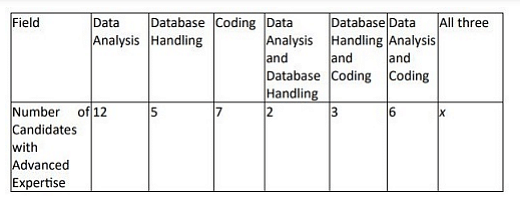
The number of applicants with advanced expertise in all three fields is given as x in the table, where x is a non-negative integer.
- XAT - 2024
- Data Interpretation