Let \(S\) be the set of rational numbers with the following properties:
(i) \(\dfrac{1}{2} \in S\);
(ii) If \(x \in S\), then both \(\dfrac{1}{x+1} \in S\) and \(\dfrac{x}{x+1} \in S\).
Which of the following is true?
(i) \(\dfrac{1}{2} \in S\);
(ii) If \(x \in S\), then both \(\dfrac{1}{x+1} \in S\) and \(\dfrac{x}{x+1} \in S\).
Which of the following is true?
Show Hint
- S contains all rational numbers in the interval \(0 < x < 1\)
- S contains all rational numbers in the interval \(-1 < x < 1\)
- S contains all rational numbers in the interval \(-1 < x < 0\)
- S contains all rational numbers in the interval \(1 < x < \alpha\)
The Correct Option is A
Solution and Explanation
The two rules given, \(x \to \frac{1}{x+1}\) and \(x \to \frac{x}{x+1}\), build up a tree of fractions starting from \(\frac12\). Let's grow a few levels of this tree and see the pattern before checking the options.
Starting value: \(\frac12\).
From \(\frac12\): \(\frac{1}{\frac12+1}=\frac{1}{3/2}=\frac23\), and \(\frac{\frac12}{\frac12+1}=\frac{1/2}{3/2}=\frac13\).
From \(\frac13\): we get \(\frac34\) and \(\frac14\). From \(\frac23\): we get \(\frac35\) and \(\frac25\).
Every fraction produced so far, \(\frac12,\frac13,\frac23,\frac14,\frac34,\frac25,\frac35\), and so on, is a rational number strictly between 0 and 1. This is not a coincidence: if \(0<x<1\) then \(1<x+1<2\), so \(\frac{1}{x+1}\) lands between \(\frac12\) and \(1\), and \(\frac{x}{x+1}=1-\frac{1}{x+1}\) lands between \(0\) and \(\frac12\). Both children of any fraction in \((0,1)\) stay inside \((0,1)\), so nothing ever escapes this interval.
- Option 2, \(-1<x<1\): wrong, because no negative number is ever produced (every fraction generated is positive, as shown above).
- Option 3, \(-1<x<0\): wrong for the same reason: S never contains a negative number.
- Option 4, \(1<x<\alpha\): wrong, since every generated fraction is less than 1, never equal to or above it.
What remains is option 1: every rational strictly between 0 and 1 is eventually produced this way. This matches the pattern in the tree above: after 2 levels we already got \(\frac13,\frac14,\frac25,\frac35,\frac34,\frac23\), which are exactly the fractions with denominator up to 5 that lie between 0 and 1 in lowest terms, and going deeper into the tree keeps filling in every remaining rational in \((0,1)\) with larger denominators.
Let's summarize:
- Both moves keep any number strictly between 0 and 1, so nothing outside this range is ever in S.
- Working backwards from any target fraction, undoing whichever move was last applied based on whether it is above or below 1/2, always reduces its denominator, eventually reaching 1/2, so every rational in (0,1) is reachable.
So S is exactly the set of rational numbers in the interval \(0<x<1\), which is option 1.
Questions Asked in XAT exam
The number of applicants with advanced expertise in all three fields is given as x in the table, where x is a non-negative integer.
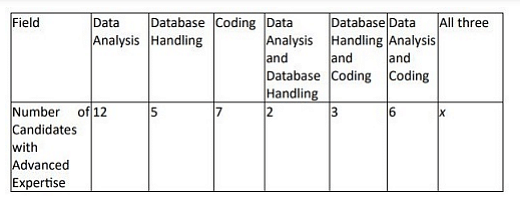
- XAT - 2024
- Data Interpretation