Question:medium
Let
\[
S=\{1,2,3,\ldots,10\}.
\]
Consider the set
\[
X=\{R : R \text{ is an equivalence relation on } S \text{ such that } R \text{ has exactly } 42 \text{ elements}\}.
\]
Then the number of elements in \(X\) is __________.
Let
\[
S=\{1,2,3,\ldots,10\}.
\]
Consider the set
\[
X=\{R : R \text{ is an equivalence relation on } S \text{ such that } R \text{ has exactly } 42 \text{ elements}\}.
\]
Then the number of elements in \(X\) is __________.
Show Hint
If equivalence classes have sizes:
\[
n_1,n_2,\ldots,n_k
\]
then total elements in the relation are:
\[
n_1^2+n_2^2+\cdots+n_k^2
\]
Updated On: Jun 4, 2026
Show Solution
Correct Answer: 1260
Solution and Explanation
Step 1: Understanding the Concept:
An equivalence relation \( R \) on a set \( S \) of size \( n \) is completely defined by a partition of \( S \) into disjoint subsets (equivalence classes) \( S_1, S_2, \dots, S_k \). The number of elements in the relation \( R \) is given by the sum of the squares of the sizes of these classes: \( |R| = \sum_{i=1}^k |S_i|^2 \).
Step 2: Key Formula or Approach:
We need to find a partition of 10 into integers \( n_1, n_2, \dots, n_k \) such that:
1) \( n_1 + n_2 + \dots + n_k = 10 \)
2) \( n_1^2 + n_2^2 + \dots + n_k^2 = 42 \)
Step 3: Detailed Explanation:
Trying possible partitions:
- Let the largest class be \( n_1 = 6 \). Then \( n_1^2 = 36 \). Sum of remaining squares = \( 42 - 36 = 6 \). Remaining elements = \( 10 - 6 = 4 \). Sum of 4 positive integer squares can at most be \( 1^2+1^2+1^2+1^2 = 4 \). No solution.
- Let \( n_1 = 5 \). Then \( n_1^2 = 25 \). Sum of remaining squares = \( 42 - 25 = 17 \). Remaining elements = \( 10 - 5 = 5 \).
If \( n_2 = 4 \), then \( n_2^2 = 16 \). Sum of remaining squares = \( 17 - 16 = 1 \). Remaining elements = \( 5 - 4 = 1 \). This works with \( n_3 = 1 \).
So the partition is \( \{5, 4, 1\} \).
Check: \( 5+4+1 = 10 \) and \( 5^2+4^2+1^2 = 25+16+1 = 42 \).
- Are there other partitions?
If \( n_1 = 4 \), \( n_1^2 = 16 \). Remainder sum of squares = 26, Remainder elements = 6.
If \( n_2 = 4 \), Remainder square sum = 10, Remainder elements = 2. Max square sum is \( 1^2+1^2=2 \). No.
If \( n_2 = 3 \), Remainder square sum = 17, Remainder elements = 3. Max square sum is \( 1^2+1^2+1^2=3 \). No.
So the only partition is \( \{5, 4, 1\} \).
Now we calculate the number of ways to form such classes from 10 distinct elements:
Number of ways = \( \frac{10!}{5! \cdot 4! \cdot 1!} \)
Calculation: \( \frac{10 \cdot 9 \cdot 8 \cdot 7 \cdot 6}{4 \cdot 3 \cdot 2 \cdot 1} = 10 \cdot 9 \cdot 2 \cdot 7 = 1260 \).
Step 4: Final Answer:
The number of such relations is 1260.
An equivalence relation \( R \) on a set \( S \) of size \( n \) is completely defined by a partition of \( S \) into disjoint subsets (equivalence classes) \( S_1, S_2, \dots, S_k \). The number of elements in the relation \( R \) is given by the sum of the squares of the sizes of these classes: \( |R| = \sum_{i=1}^k |S_i|^2 \).
Step 2: Key Formula or Approach:
We need to find a partition of 10 into integers \( n_1, n_2, \dots, n_k \) such that:
1) \( n_1 + n_2 + \dots + n_k = 10 \)
2) \( n_1^2 + n_2^2 + \dots + n_k^2 = 42 \)
Step 3: Detailed Explanation:
Trying possible partitions:
- Let the largest class be \( n_1 = 6 \). Then \( n_1^2 = 36 \). Sum of remaining squares = \( 42 - 36 = 6 \). Remaining elements = \( 10 - 6 = 4 \). Sum of 4 positive integer squares can at most be \( 1^2+1^2+1^2+1^2 = 4 \). No solution.
- Let \( n_1 = 5 \). Then \( n_1^2 = 25 \). Sum of remaining squares = \( 42 - 25 = 17 \). Remaining elements = \( 10 - 5 = 5 \).
If \( n_2 = 4 \), then \( n_2^2 = 16 \). Sum of remaining squares = \( 17 - 16 = 1 \). Remaining elements = \( 5 - 4 = 1 \). This works with \( n_3 = 1 \).
So the partition is \( \{5, 4, 1\} \).
Check: \( 5+4+1 = 10 \) and \( 5^2+4^2+1^2 = 25+16+1 = 42 \).
- Are there other partitions?
If \( n_1 = 4 \), \( n_1^2 = 16 \). Remainder sum of squares = 26, Remainder elements = 6.
If \( n_2 = 4 \), Remainder square sum = 10, Remainder elements = 2. Max square sum is \( 1^2+1^2=2 \). No.
If \( n_2 = 3 \), Remainder square sum = 17, Remainder elements = 3. Max square sum is \( 1^2+1^2+1^2=3 \). No.
So the only partition is \( \{5, 4, 1\} \).
Now we calculate the number of ways to form such classes from 10 distinct elements:
Number of ways = \( \frac{10!}{5! \cdot 4! \cdot 1!} \)
Calculation: \( \frac{10 \cdot 9 \cdot 8 \cdot 7 \cdot 6}{4 \cdot 3 \cdot 2 \cdot 1} = 10 \cdot 9 \cdot 2 \cdot 7 = 1260 \).
Step 4: Final Answer:
The number of such relations is 1260.
Was this answer helpful?
0
Top Questions on permutations and combinations
- There are 6 boys and 4 girls. Arrange their seating arrangement on a round table such that 2 boys and 1 girl can't sit together.
- MHT CET - 2025
- Mathematics
- permutations and combinations
- How many different 4-letter words can be formed from the letters of the word "BINARY" without repetition?
- BITSAT - 2025
- Mathematics
- permutations and combinations
- A local restaurant has 16 vegetarian items and 9 non-vegetarian items in their menu. Some items contain gluten, while the rest are gluten-free.
One evening, Rohit and his friends went to the restaurant. They planned to choose two different vegetarian items and three different non-vegetarian items from the entire menu. Later, Bela and her friends also went to the same restaurant: they planned to choose two different vegetarian items and one non-vegetarian item only from the gluten-free options. The number of item combinations that Rohit and his friends could choose from, given their plan, was 12 times the number of item combinations that Bela and her friends could choose from, given their plan.
How many menu items contain gluten?- XAT - 2024
- Quantitative Ability and Data Interpretation
- permutations and combinations
- Five people are distributed in four identical rooms. A room can also contain zero people. Find the number of ways to distribute them.
- JEE Main - 2024
- Mathematics
- permutations and combinations
- Want to practice more? Try solving extra ecology questions todayView All Questions
Questions Asked in JEE Advanced exam
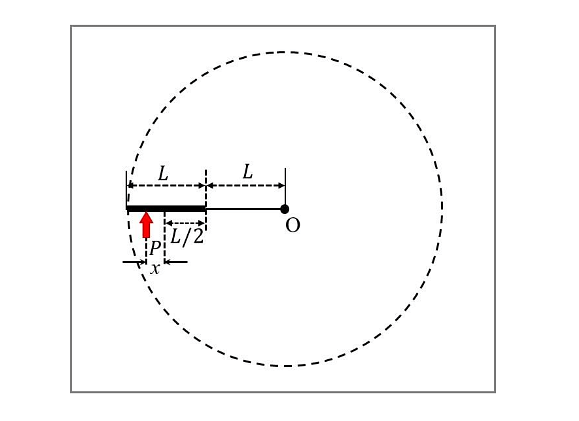
A thin uniform rod of length L and certain mass is kept on a frictionless horizontal table with a massless string of length L fixed to one end (top view is shown in the figure). The other end of the string is pivoted to a point O. If a horizontal impulse P is imparted to the rod at a distance x = L/n from the mid-point of the rod (see figure), then the rod and string revolve together around the point O, with the rod remaining aligned with the string. In such a case, the value of n is _____.
- JEE Advanced - 2024
- Friction