Question:medium
Let \(P\) be the plane such that it contains the straight line
\[
\frac{x-1}{2}=\frac{y-3}{3}=\frac{z+2}{1}
\]
and is perpendicular to the plane
\[
x+2y+3z=4
\]
Let \(P_1\) be the plane which passes through the point \((4,2,2)\) and is parallel to \(P\).
Then which of the following statements is (are) TRUE?
Show Hint
The normal of P is the cross product of the line direction (2,3,1) and (1,2,3), which gives (7,-5,1). Then check each statement.
Updated On: Nov 19, 2026
- The equation of the plane \(P\) is 7x-5y+z=-10
- The distance between the planes \(P\) and \(P_1\) is \(30\)
- The distance of the plane \(P\) from the origin is \(2\sqrt3\)
- The acute angle between the plane \(P\) and the plane 2x+2y+z=3 is \[\cos^{-1}\left(\frac1{3\sqrt3}\right)\]
Show Solution
The Correct Option is A, D
Solution and Explanation
Step 1: Find P by solving for the normal:
Let $P$ be $ax+by+cz=d$. The line lies in $P$, so its direction $(2,3,1)$ is perpendicular to $(a,b,c)$: $2a+3b+c=0$.
$P$ is perpendicular to $x+2y+3z=4$, so the normals are perpendicular: $a+2b+3c=0$.
Take $c=1$. Then $2a+3b=-1$ and $a+2b=-3$. Multiply the second by $2$ and subtract: $b=-5$. Then $a=7$.
So the normal is $(7,-5,1)$. The point $(1,3,-2)$ gives $d=7-15-2=-10$. Plane: $7x-5y+z=-10$.
Step 2: Use the distance formula for B and C:
The length of the normal is $\sqrt{49+25+1}=\sqrt{75}=5\sqrt3$.
For $P_1$ through $(4,2,2)$: the value of $7x-5y+z$ there is $20$. The gap between the two plane constants is $20-(-10)=30$.
Distance between the planes $=\dfrac{30}{5\sqrt3}=2\sqrt3$. The number $30$ is only the numerator, so (B) is FALSE.
Distance of $P$ from the origin is $\dfrac{|-10|}{5\sqrt3}=\dfrac{2}{\sqrt3}$, which is not $2\sqrt3$. So (C) is FALSE.
Step 3: Use the angle formula for D:
The angle between two planes is the angle between their normals. Use $\cos\theta=\dfrac{|n_1\cdot n_2|}{|n_1||n_2|}$.
\[ \cos\theta=\frac{|14-10+1|}{5\sqrt3\times3}=\frac{5}{15\sqrt3}=\frac1{3\sqrt3} \]
So (D) is TRUE. Also (A) is TRUE because it is the plane we found.
Final Answer:
Only A and D are true. \[ \boxed{\text{A, D}} \]
Was this answer helpful?
0
Top Questions on 3D Geometry
- The lines \( \frac{1 - x}{2} = \frac{y - 1}{3} = \frac{z}{1} \) and \( \frac{2x - 3}{2p} = \frac{y}{-1} = \frac{z - 4}{7} \) are perpendicular to each other for \( p \) equal to:
- CBSE Class XII - 2024
- Mathematics
- 3D Geometry
- Find the distance between the line \( \frac{x}{2} = \frac{2y - 6}{4} = \frac{1 - z}{-1} \) and another line parallel to it passing through the point \( (4, 0, -5) \).
- CBSE Class XII - 2024
- Mathematics
- 3D Geometry
- If the lines \( \frac{x - 1}{-3} = \frac{y - 2}{2k} = \frac{z - 3}{2} \) and \( \frac{x - 1}{3k} = \frac{y - 1}{1} = \frac{z - 6}{-7} \) are perpendicular to each other, find the value of \( k \) and hence write the vector equation of a line perpendicular to these two lines passing through the point \( (3, -4, 7) \).
- CBSE Class XII - 2024
- Mathematics
- 3D Geometry
- If \( d_1 \) is the shortest distance between the lines \(\frac{x+1}{2} = \frac{y-1}{-12} = \frac{z-1}{-7} \quad \text{and} \quad \frac{x-1}{7} = \frac{y+8}{2} = \frac{z-4}{5},\) and \( d_2 \) is the shortest distance between the lines \(\frac{x-1}{2} = \frac{y-2}{1} = \frac{z-6}{-3} \quad \text{and} \quad \frac{x+2}{1} = \frac{y+2}{2} = \frac{z-1}{6},\) then the value of \( \frac{32\sqrt{3}d_1}{d_2} \) is:
- JEE Main - 2024
- Mathematics
- 3D Geometry
- Want to practice more? Try solving extra ecology questions todayView All Questions
Questions Asked in JEE Advanced exam
A thin uniform rod of length L and certain mass is kept on a frictionless horizontal table with a massless string of length L fixed to one end (top view is shown in the figure). The other end of the string is pivoted to a point O. If a horizontal impulse P is imparted to the rod at a distance x = L/n from the mid-point of the rod (see figure), then the rod and string revolve together around the point O, with the rod remaining aligned with the string. In such a case, the value of n is _____.
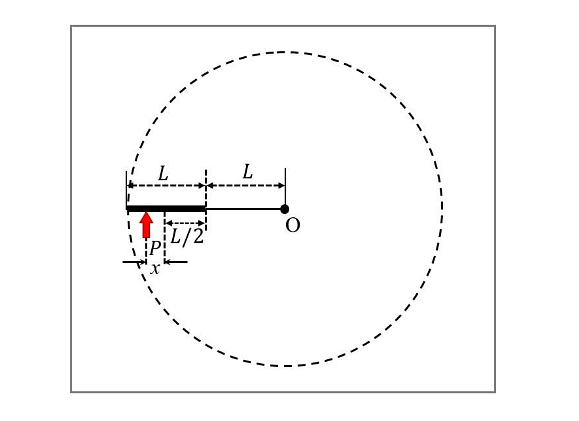
- JEE Advanced - 2024
- Friction