Question:medium
Let \(P\) be the plane such that it contains the straight line
\[
\frac{x-1}{2}=\frac{y-3}{3}=\frac{z+2}{1}
\]
and is perpendicular to the plane
\[
x+2y+3z=4
\]
Let \(P_1\) be the plane which passes through the point \((4,2,2)\) and is parallel to \(P\).
Then which of the following statements is (are) TRUE?
Let \(P\) be the plane such that it contains the straight line
\[
\frac{x-1}{2}=\frac{y-3}{3}=\frac{z+2}{1}
\]
and is perpendicular to the plane
\[
x+2y+3z=4
\]
Let \(P_1\) be the plane which passes through the point \((4,2,2)\) and is parallel to \(P\).
Then which of the following statements is (are) TRUE?
Show Hint
Write the given line as the intersection of two simple coordinate planes, then use the family of planes through that line, $P_1+\lambda P_2=0$, to represent every plane containing it. Fix the unknown constant by setting the dot product of the normal vector of this family with the normal of the given plane to zero, since perpendicular planes have perpendicular normals. Once you have the equation of plane $P$, apply the standard formulas for distance between parallel planes, distance from a point, and angle between planes to test each option.
Updated On: Aug 17, 2026
- The equation of the plane \(P\) is 7x-5y+z=-10
- The distance between the planes \(P\) and \(P_1\) is \(30\)
- The distance of the plane \(P\) from the origin is \(2\sqrt3\)
- The acute angle between the plane \(P\) and the plane 2x+2y+z=3 is \[\cos^{-1}\left(\frac1{3\sqrt3}\right)\]
Show Solution
The Correct Option is A
Solution and Explanation
To solve the problem, let's first break down the given pieces of information and solve it step by step:
- \(P\) is a plane that contains the line \(\frac{x-1}{2}=\frac{y-3}{3}=\frac{z+2}{1}\) and is perpendicular to the plane \(x+2y+3z=4\).
- The given line can be written in the vector form as: \(\textbf{r} = \begin{bmatrix} 1 \\ 3 \\ -2 \end{bmatrix} + \lambda \begin{bmatrix} 2 \\ 3 \\ 1 \end{bmatrix}\), where \(\lambda\) is a parameter.
- Thus, the direction ratios of the line are \((2, 3, 1)\).
- The plane \(P\) is perpendicular to the plane \(x + 2y + 3z = 4\).
- This implies that the normal vector to plane \(P\) is a linear combination of the direction ratios of the line and the normal vector of the given plane. Thus, the normal vector of plane \(P\) can be calculated using the cross product of the two direction vectors.
- The normal vector of the given plane is \((1, 2, 3)\).
- The cross product of \((2, 3, 1)\) and \((1, 2, 3)\) is calculated as follows: \(\begin{vmatrix} \mathbf{i} & \mathbf{j} & \mathbf{k} \\ 2 & 3 & 1 \\ 1 & 2 & 3 \end{vmatrix} = \mathbf{i}(9 - 2) - \mathbf{j}(6 - 1) + \mathbf{k}(4 - 3) = 7\mathbf{i} - 5\mathbf{j} + \mathbf{k}.\)
- Therefore, the equation of the plane \(P\) can be written as: \(7x - 5y + z = d\).
- Since the plane \(P\) contains the point \((1, 3, -2)\): \(\Rightarrow 7(1) - 5(3) + (-2) = d \\ \Rightarrow 7 - 15 - 2 = d \\ \Rightarrow d = -10.\)
- Thus, the equation of the plane \(P\) is: \(7x - 5y + z = -10\).
Was this answer helpful?
0
Top Questions on 3D Geometry
- The lines \( \frac{1 - x}{2} = \frac{y - 1}{3} = \frac{z}{1} \) and \( \frac{2x - 3}{2p} = \frac{y}{-1} = \frac{z - 4}{7} \) are perpendicular to each other for \( p \) equal to:
- CBSE Class XII - 2024
- Mathematics
- 3D Geometry
- Find the distance between the line \( \frac{x}{2} = \frac{2y - 6}{4} = \frac{1 - z}{-1} \) and another line parallel to it passing through the point \( (4, 0, -5) \).
- CBSE Class XII - 2024
- Mathematics
- 3D Geometry
- If the lines \( \frac{x - 1}{-3} = \frac{y - 2}{2k} = \frac{z - 3}{2} \) and \( \frac{x - 1}{3k} = \frac{y - 1}{1} = \frac{z - 6}{-7} \) are perpendicular to each other, find the value of \( k \) and hence write the vector equation of a line perpendicular to these two lines passing through the point \( (3, -4, 7) \).
- CBSE Class XII - 2024
- Mathematics
- 3D Geometry
- If \( d_1 \) is the shortest distance between the lines \(\frac{x+1}{2} = \frac{y-1}{-12} = \frac{z-1}{-7} \quad \text{and} \quad \frac{x-1}{7} = \frac{y+8}{2} = \frac{z-4}{5},\) and \( d_2 \) is the shortest distance between the lines \(\frac{x-1}{2} = \frac{y-2}{1} = \frac{z-6}{-3} \quad \text{and} \quad \frac{x+2}{1} = \frac{y+2}{2} = \frac{z-1}{6},\) then the value of \( \frac{32\sqrt{3}d_1}{d_2} \) is:
- JEE Main - 2024
- Mathematics
- 3D Geometry
- Want to practice more? Try solving extra ecology questions todayView All Questions
Questions Asked in JEE Advanced exam
A thin uniform rod of length L and certain mass is kept on a frictionless horizontal table with a massless string of length L fixed to one end (top view is shown in the figure). The other end of the string is pivoted to a point O. If a horizontal impulse P is imparted to the rod at a distance x = L/n from the mid-point of the rod (see figure), then the rod and string revolve together around the point O, with the rod remaining aligned with the string. In such a case, the value of n is _____.
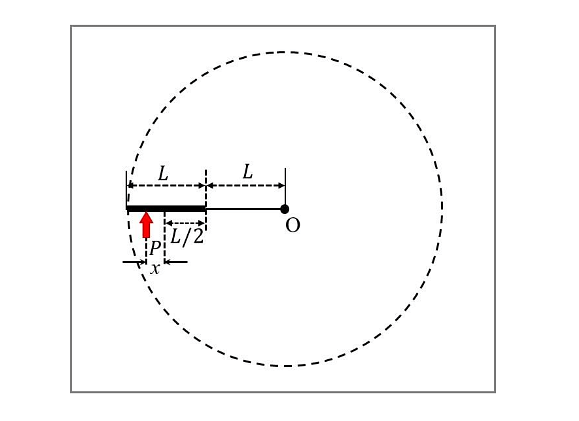
- JEE Advanced - 2024
- Friction