Question:hard
Let \(p\) be any positive integer, and let
\[ 2x + p = 2y, \quad p + y = x, \quad x + y = z \]
For what value of \(p\) would \(x + y + z\) attain its maximum value?
Let \(p\) be any positive integer, and let
\[ 2x + p = 2y, \quad p + y = x, \quad x + y = z \]
For what value of \(p\) would \(x + y + z\) attain its maximum value?
\[ 2x + p = 2y, \quad p + y = x, \quad x + y = z \]
For what value of \(p\) would \(x + y + z\) attain its maximum value?
Show Hint
Substitute p + y = x into 2x + p = 2y and see what value of p keeps the system from contradicting itself.
Updated On: Jul 13, 2026
- 0
- 1
- 2
- 3
Show Solution
The Correct Option is A
Solution and Explanation
Step 1: Isolate p from each equation separately.
From \(2x+p=2y\): \(p = 2y - 2x\).
From \(p+y=x\): \(p = x - y\).
Step 2: Since both expressions equal the same p, set them equal.
\[ 2y - 2x = x - y \]
\[ 2y + y = x + 2x \]
\[ 3y = 3x \]
\[ y = x \]
Step 3: Substitute back to find p.
Using \(p = x - y\) and \(y=x\):
\[ p = x - x = 0 \]
So whatever \(x\) and \(y\) turn out to be, they must be equal, and this in turn forces \(p\) to be exactly \(0\). There is no freedom to pick \(p=1,2\) or \(3\) and still satisfy both starting equations.
Step 4: Build x + y + z and compare options.
With \(y=x\) and \(z=x+y=2x\), the sum \(x+y+z = 4x\) can be found for \(p=0\), but for any positive \(p\), the equation \(3p=0\) derived the same way is violated, so there is no valid \(x,y,z\) at all, and the sum cannot even be written down.
Between the given choices, only \(p=0\) actually allows the sum to exist, so it is the value that lets \(x+y+z\) attain its value.
Step 5: Double-check by plugging p = 0 back into all three original equations.
With \(p=0\), pick any number for \(x\), say \(x=5\). Then \(y=x=5\) (from Step 2), and \(z=x+y=10\).
Check equation 1: \(2x+p=2(5)+0=10\), and \(2y=2(5)=10\). They match.
Check equation 2: \(p+y=0+5=5\), and \(x=5\). They match.
Check equation 3: \(x+y=5+5=10=z\). This matches too, so all three equations hold together only when \(p=0\), confirming that no other listed value of \(p\) can ever work.
\[ \boxed{p = 0} \]
From \(2x+p=2y\): \(p = 2y - 2x\).
From \(p+y=x\): \(p = x - y\).
Step 2: Since both expressions equal the same p, set them equal.
\[ 2y - 2x = x - y \]
\[ 2y + y = x + 2x \]
\[ 3y = 3x \]
\[ y = x \]
Step 3: Substitute back to find p.
Using \(p = x - y\) and \(y=x\):
\[ p = x - x = 0 \]
So whatever \(x\) and \(y\) turn out to be, they must be equal, and this in turn forces \(p\) to be exactly \(0\). There is no freedom to pick \(p=1,2\) or \(3\) and still satisfy both starting equations.
Step 4: Build x + y + z and compare options.
With \(y=x\) and \(z=x+y=2x\), the sum \(x+y+z = 4x\) can be found for \(p=0\), but for any positive \(p\), the equation \(3p=0\) derived the same way is violated, so there is no valid \(x,y,z\) at all, and the sum cannot even be written down.
Between the given choices, only \(p=0\) actually allows the sum to exist, so it is the value that lets \(x+y+z\) attain its value.
Step 5: Double-check by plugging p = 0 back into all three original equations.
With \(p=0\), pick any number for \(x\), say \(x=5\). Then \(y=x=5\) (from Step 2), and \(z=x+y=10\).
Check equation 1: \(2x+p=2(5)+0=10\), and \(2y=2(5)=10\). They match.
Check equation 2: \(p+y=0+5=5\), and \(x=5\). They match.
Check equation 3: \(x+y=5+5=10=z\). This matches too, so all three equations hold together only when \(p=0\), confirming that no other listed value of \(p\) can ever work.
\[ \boxed{p = 0} \]
Was this answer helpful?
0
Top Questions on Algebra
- Let \( n(A) = m \) and \( n(B) = n \), if the number of subsets of \( A \) is 56 more than that of subsets of \( B \), then \( m + n \) is equal to:
- VITEEE - 2024
- Mathematics
- Algebra
- Solve the quadratic equation: \[ x^2 - 5x + 6 = 0 \]
- VITEEE - 2025
- Mathematics
- Algebra
- Find the value of \( x \) in the following equation: \[ \frac{2}{x} + \frac{3}{x + 1} = 1 \]
- VITEEE - 2025
- Mathematics
- Algebra
- Find the value of \( x \) in the equation \( 2x + 3 = 7x - 8 \).
- VITEEE - 2025
- Mathematics
- Algebra
- Want to practice more? Try solving extra ecology questions todayView All Questions
Questions Asked in XAT exam
Applicants have been shortlisted for interviews for some data analyst positions. Some of the applicants have advanced expertise in one or more fields among the following: data analysis, database handling and coding. The numbers of applicants with different advanced expertise are given in the 2 × 8 table below.
The number of applicants with advanced expertise in all three fields is given as x in the table, where x is a non-negative integer.
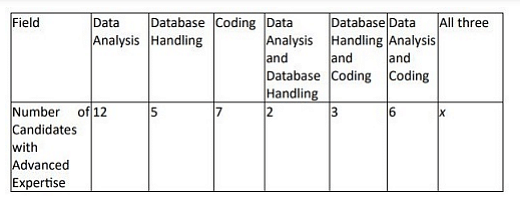
The number of applicants with advanced expertise in all three fields is given as x in the table, where x is a non-negative integer.
- XAT - 2024
- Data Interpretation