Let \(\{A_n\}\) be a unique sequence of positive integers satisfying the following properties: \(A_1 = 1,\ A_2 = 2,\ A_4 = 12\), and \(A_{n+1}\cdot A_{n-1} = A_n^2 \pm 1\) for \(n = 2, 3, 4, \dots\)
Then, \(A_7\) is:
Then, \(A_7\) is:
Show Hint
- 60
- 120
- 149
- 169
The Correct Option is D
Solution and Explanation
There's a faster route here once we spot the pattern in the numbers: $1, 2, 5, 12, 29, 70, 169$ are the well-known "half companion Pell" numbers, and they satisfy the simple two-term recursion $A_{n+1} = 2A_n + A_{n-1}$.
Let's check that this simple rule actually agrees with the given $A_{n+1}A_{n-1}=A_n^2\pm1$ rule and the two known values $A_1=1,\ A_2=2$.
Using $A_{n+1}=2A_n+A_{n-1}$ starting from $A_1=1,\ A_2=2$:
$$A_3 = 2(2)+1 = 5$$$$A_4 = 2(5)+2 = 12$$This already matches the given $A_4=12$ exactly, which is a strong check that this is the right sequence.
Continuing the same simple doubling-and-adding rule:
$$A_5 = 2(12)+5 = 29$$$$A_6 = 2(29)+12 = 70$$$$A_7 = 2(70)+29 = 169$$We can also verify this two-term rule is consistent with the original $\pm1$ identity by checking one instance directly: $A_4 A_2 = 12\times2=24$ and $A_3^2-1 = 25-1=24$, which matches using the minus sign, and $A_5A_3 = 29\times5=145$ and $A_4^2+1=144+1=145$, matching with the plus sign. So the sign genuinely alternates step by step, and the simpler $2A_n+A_{n-1}$ rule produces exactly the same numbers without needing to hunt for the sign at every step.
Let's summarize:
- The values $1, 2, 5, 12$ already match the pattern $A_{n+1}=2A_n+A_{n-1}$, confirmed by $A_4=12$ matching the given value.
- Extending this same rule two more steps gives $A_5=29$, $A_6=70$, $A_7=169$.
So $A_7 = 169$.
Top Questions on Sequence and Series
- Series Expansion $ n^6 + \frac{1}{2} n^4 + \frac{1}{3} n^2 + \cdots + \frac{1}{n} C_n + 1 \quad n \to \infty $
- MHT CET - 2025
- Mathematics
- Sequence and Series
- Krishna has certain number of coins numbered with a series of consecutive natural numbers starting with 1. He found that the sum of squares of all the numbers on the coins is 1753 times the sum of numbers on coins. How many coins does he have?
- IBSAT
- Quantitative Aptitude
- Sequence and Series
- A group of 630 children is arranged in rows for a photograph session. Each row contains three children lesser than the row in front of it. Which of the below mentioned number of rows is not possible?
- IBSAT
- Quantitative Aptitude
- Sequence and Series
- In each of the following questions a number series is given with one missing (?) term. The term is given as one of the alternatives among the five numbers given in the answer choic Find the term.
1, 27, 125, ? , 729, 1331- IBSAT
- Quantitative Aptitude
- Sequence and Series
- Want to practice more? Try solving extra ecology questions todayView All Questions
Questions Asked in XAT exam
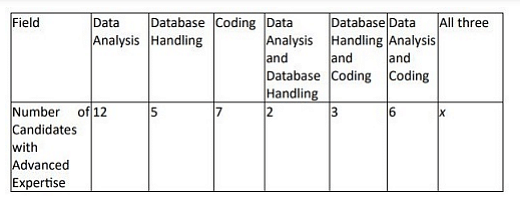
The number of applicants with advanced expertise in all three fields is given as x in the table, where x is a non-negative integer.
- XAT - 2024
- Data Interpretation