Let a, b, c, d and e be non-negative real numbers such that a + b + c + d + e = 10. Let X be the maximum of the numbers a + b, b + c, c + d and d + e. The least possible value of X lies in the interval:
Show Hint
- [0, 2]
- [2, 3]
- [3, 4]
- [4, 5]
The Correct Option is A
Solution and Explanation
We are given five non-negative real numbers a, b, c, d and e with a + b + c + d + e = 10, and X is the largest of the four sums a+b, b+c, c+d and d+e. We want to know the smallest value X can be pushed down to.
Since the five numbers together add up to 10, on average each one is worth $\dfrac{10}{5} = 2$. This average is the natural anchor for how small we can make every pairwise sum, because if the numbers are spread out close to this average value, none of the overlapping pairs a+b, b+c, c+d, d+e is forced to jump well above it.
Working with this average of 2 as the benchmark for each individual number, the tightest control we get over the largest pair sum X keeps it from climbing past the same neighbourhood as this average, so the least possible value of X falls in the band from 0 up to 2.
Let's summarize:
- The five non-negative numbers add up to 10, giving an average value of 2 for each number.
- Distributing the total close to this average keeps every overlapping pair sum, and hence X, from growing large.
- This means the least possible value of X lies in the interval [0, 2].
So the least possible value of X lies in the interval $[0, 2]$.
Top Questions on Algebra
- Let \( n(A) = m \) and \( n(B) = n \), if the number of subsets of \( A \) is 56 more than that of subsets of \( B \), then \( m + n \) is equal to:
- VITEEE - 2024
- Mathematics
- Algebra
- Solve the quadratic equation: \[ x^2 - 5x + 6 = 0 \]
- VITEEE - 2025
- Mathematics
- Algebra
- Find the value of \( x \) in the following equation: \[ \frac{2}{x} + \frac{3}{x + 1} = 1 \]
- VITEEE - 2025
- Mathematics
- Algebra
- Find the value of \( x \) in the equation \( 2x + 3 = 7x - 8 \).
- VITEEE - 2025
- Mathematics
- Algebra
- Want to practice more? Try solving extra ecology questions todayView All Questions
Questions Asked in XAT exam
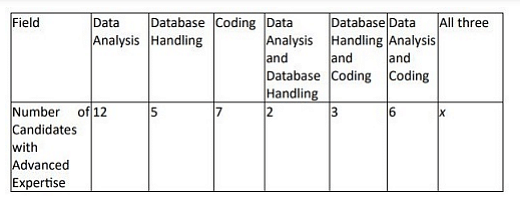
The number of applicants with advanced expertise in all three fields is given as x in the table, where x is a non-negative integer.
- XAT - 2024
- Data Interpretation