KindCare hospital, located in the small industrial town of Chinar, is one of the largest hospitals within 50 kilometers radius. It is well-regarded among the locals for emergency services.
However, for critical surgeries, they prefer to travel to the nearest city Shamili, which is 100 kilometers away. When KindCare was established 50 years ago, the town was still in its early stages of development.
Consequently, the hospital needed to incorporate several facilities within its premises, including a 24-hour cafeteria, to accommodate needs of the patients and their relatives who would come from nearby places. Another facility that KindCare built and takes pride in is its state-of-the-art testing lab. It is the most sought after testing lab in Chinar even today when many independent labs have come up around KindCare. Moreover, many other facilities have also come up in the surrounding area of the hospital such as pharmacies, food joints, hotels etc. Further, a standalone pharmacy chain has gained a strong foothold in Chinar as they expand their reach into Tier-3 cities.
When it comes to KindCare, a signi cant proportion of its patients are outpatients with a substantial number seeking emergency services. As the sole 600-bed hospital in the region, KindCare plays a crucial role in medical services, and receives generous funding from two major corporations operating locally, further enabling KindCare to cater to the growing medical needs of the community.
During the COVID-19 pandemic, KindCare made signi cant investment in enhancing internet connectivity, enabling many doctors, and the majority of administrative staff, to seamlessly work remotely. This investment also allowed KindCare to bring in doctors from other cities through remote care.
Further, COVID-19 was a wakeup call for KindCare to enhance their infrastructure. Though KindCare made signi cant improvements, they kept the major renovations on hold due to the constant ow of patients. KindCare believes that if the held renovations are not taken up on an urgent basis now, the operations at the hospital will get obstructed
KindCare feels that it needs to be better prepared before a similar situation like COVID-19 chances upon the city again. The hospital decides to invest immediately in improving their infrastructure. However, this would mean that, temporarily, it should either reduce, or shut down the operations of a few departments.
It is considering the following options:
A) Reduce their outpatient capacity to half
B) Shut down the cafeteria for the period of renovation
C) Ask their administrative staff to work remotely
D) Strip the pharmacy operations down to emergency and critical medications
E) Shut down the medical lab, and arrange medical tests from a local lab
Which of the following combinations will LEAST affect the functioning of the hospital?
B) Shut down the cafeteria for the period of renovation
C) Ask their administrative staff to work remotely
D) Strip the pharmacy operations down to emergency and critical medications
E) Shut down the medical lab, and arrange medical tests from a local lab
Which of the following combinations will LEAST affect the functioning of the hospital?
Show Hint
- ACD
- BCD
- BCE
- ABE
- ABC
The Correct Option is C
Solution and Explanation
KindCare, a 600-bed facility, is the region's sole hospital, handling a high volume of emergency and outpatient services. Key departments include the pharmacy, cafeteria, medical lab, and administration. Remote work for administrators was successfully implemented during COVID-19. The community also has numerous independent laboratories and pharmacies.
Phase 2: Assess Each Option.
- Option A (Reduce outpatient capacity by 50%): This would significantly impact patient volume and community service, as outpatient care is a core function.
- Option B (Close cafeteria): Primarily serving visitors and staff, a temporary cafeteria closure would not directly impede medical services.
- Option C (Admin staff work remotely): This practice was already established during COVID-19, posing minimal to no operational disruption.
- Option D (Pharmacy for critical medications only): Limiting pharmacy services might inconvenience patients and create significant issues for long-term and routine treatments.
- Option E (Close medical lab, outsource tests): Local availability of independent labs makes outsourcing feasible without substantially disrupting patient care.
Phase 3: Select the Least Disruptive Combination.
- Combinations including Option A (outpatient reduction) severely compromise hospital functionality and are therefore unsuitable.
- Combinations including Option D (pharmacy restriction) endanger essential hospital services and are also risky.
- Option BCE (closing the cafeteria, remote administration, and outsourcing lab tests) represents a manageable set of changes that do not significantly impede hospital operations.
Conclusion: \[\boxed{\text{C (BCE)}}\]
KindCare needs to maintain a large inventory of medicines and other auxiliary supplies in their storage unit. The storage unit ensures adequate and timely supply to Intensive Care Unit and the emergency services, and always runs to capacity.
The renovation team suggests that the storage unit be shut down for seven days for urgent renovation. However, the hospital building being old, in the past, renovation work had stretched beyond estimated time.
Which of the following actions BEST ensures KindCare operates efficiently during the renovation of the storage unit?
Show Hint
- Rent a large space, about one hour away from the hospital, for seven days.
- Shut down the hospital until further notice, except for the emergency ward, which can run on outside supplies.
- Renovate the storage unit part by part while halving the capacity of the emergency services until the renovation completes.
- Start building a new storage facility, as their capacity is already stretched.
- Shut down the cafeteria until further notice and relocate the storage unit.
The Correct Option is
Solution and Explanation
The storage unit is essential for emergency and ICU operations. Disruptions directly threaten patient survival. Therefore, ensuring medicine supply is the highest priority.
Step 2: Evaluate the options.
- Option A: Renting off-site space one hour away impedes emergency medicine access. It is unreliable. - Option B: Halting all hospital operations except for emergencies is extreme and unviable. - Option C: Reducing emergency services by half diminishes hospital capacity, posing a risk in a region where KindCare is the only 600-bed facility. - Option D: Constructing a new facility is a long-term project, unsuitable for immediate renovation needs. - Option E: Moving the storage to the hospital cafeteria ensures continued access to medicines by temporarily repurposing a non-critical area. This approach is practical and maintains service continuity.
Step 3: Best solution.
Option E effectively addresses the immediate renovation requirement while guaranteeing continuous access to vital medical supplies.
Final Answer: \[\boxed{\text{E}}\]
KindCare Hospital has to renovate its storage unit, given the complexity of the medicines and the need to store other critical supplies. The renovation is supposed to take seven days. However, as the work starts, the team entrusted with the work realizes that the work will take more than 15 days. KindCare feels that even this revised estimate is modest. Already the outpatient services are affected, and people visiting the hospital are being turned away. Stretching it further will attract a strong public resentment.
Which of the following actions offers the MOST sustainable solution for KindCare to reduce the number of patients being turned away?
Show Hint
- Arrange with a larger hospital, in Shamili, to take over their critical patients.
- Stop the renovation work immediately, and resume normal operations.
- Resume some operations from rented spaces, scattered around the region.
- Start reduced operations gradually, and hire a team of experts to find ways to expedite the renovation.
- Bring in a reputed renovation team at triple the cost, which guarantees to finish this work in three days.
The Correct Option is D
Solution and Explanation
The hospital faces a dual challenge: ongoing renovations and patient discontent. Extending renovations will provoke public outcry, while halting them compromises past investment and leaves the hospital vulnerable to future emergencies.
Step 2: Options Assessment.
- Option A: Relocating patients to Shamili (100 km distant) is unsuitable for urgent cases and inconvenient for patients. - Option B: Ceasing renovations allows immediate service restoration but leaves KindCare unprepared, mirroring previous errors. This approach lacks long-term viability. - Option C: Securing dispersed locations fragments operations, leading to coordination and patient care deficiencies. - Option D: Phased reopening permits continued patient service, with expert involvement expediting renovation completion. This method reconciles immediate demands with future readiness. - Option E: Employing an expensive new team might accelerate completion, but the "triple cost" is financially unsupportable and offers no guarantee of sustained improvements.
Step 3: Optimal Sustainable Solution.
Option D presents the most balanced approach: sustaining partial patient services while ensuring efficient renovation completion.
Final Determination: \[\boxed{\text{D}}\]
Top Questions on Grouping and Selections
- Five people joined different engineering colleges. Their first names were Sarah (Ms.), Swati (Ms.), Jackie, Mohan and Priya (Ms.). The surnames were Reddy, Gupta, Sanyal, Kumar and Chatterjee. Except for one college which was rated as 3 star, all other colleges were rated either 4 star or 5 star.
The 'Techno Institute' had a higher rating than the college where Priya studied. The three-star college was not 'Deccan College.' Mohan's last name was Gupta but he didn't study at 'Barla College.' Sarah, whose last name wasn't Sanyal, joined 'Techno Institute.' Ms. Kumar and Jackie both studied at four-star colleges. Ms. Reddy studied at the 'Anipal Institute,' which wasn't a five-star college. The 'Barla College' was a five-star college. Swati's last name wasn't Chatterjee. The 'Chemical College' was rated with one star less than the college where Sanyal studied. Only one college was rated five star.
In which college did Priya study?- XAT - 2009
- Decision Making
- Grouping and Selections
- Five people joined different engineering colleges. Their first names were Sarah (Ms.), Swati (Ms.), Jackie, Mohan and Priya (Ms.). The surnames were Reddy, Gupta, Sanyal, Kumar and Chatterjee. Except for one college which was rated as 3 star, all other colleges were rated either 4 star or 5 star.
The 'Techno Institute' had a higher rating than the college where Priya studied. The three-star college was not 'Deccan College.' Mohan's last name was Gupta but he didn't study at 'Barla College.' Sarah, whose last name wasn't Sanyal, joined 'Techno Institute.' Ms. Kumar and Jackie both studied at four-star colleges. Ms. Reddy studied at the 'Anipal Institute,' which wasn't a five-star college. The 'Barla College' was a five-star college. Swati's last name wasn't Chatterjee. The 'Chemical College' was rated with one star less than the college where Sanyal studied. Only one college was rated five star.
The person with surname Sanyal was:- XAT - 2009
- Decision Making
- Grouping and Selections
Directions: Each group of questions in this section is based on a set of conditions. In answering some of the questions, it may help to draw a rough diagram. Choose the response that most accurately and completely answers each question.
Questions 91 to 96: Seven film buffs, Gangadhar, Indra, Lalatakshaya, Maheshwar, Rudra, Vyomkesha, and Yogi, attend a showing of classic films. Three films are shown, one each directed by Guru Dutt, Satyajit Ray, and Ritwik Ghatak. Each film buff sees exactly one of the three films. The films are shown only once, one film at a time. The following restrictions apply:
- Exactly twice as many of the film buffs see the Satyajit Ray film as see the Guru Dutt film.
- Gangadhar and Rudra do not see the same film as each other.
- Indra and Maheshwar do not see the same film as each other.
- Vyomkesha and Yogi see the same film as each other.
- Lalatakshaya sees the Satyajit Ray film.
- Gangadhar sees either the Guru Dutt film or the Ritwik Ghatak film.
91. Which one of the following could be an accurate matching of film buffs to films?
- XAT - 2007
- Decision Making
- Grouping and Selections
Directions: Each group of questions in this section is based on a set of conditions. In answering some of the questions, it may help to draw a rough diagram. Choose the response that most accurately and completely answers each question.
Questions 91 to 96: Seven film buffs, Gangadhar, Indra, Lalatakshaya, Maheshwar, Rudra, Vyomkesha, and Yogi, attend a showing of classic films. Three films are shown, one each directed by Guru Dutt, Satyajit Ray, and Ritwik Ghatak. Each film buff sees exactly one of the three films. The films are shown only once, one film at a time. The following restrictions apply:
- Exactly twice as many of the film buffs see the Satyajit Ray film as see the Guru Dutt film.
- Gangadhar and Rudra do not see the same film as each other.
- Indra and Maheshwar do not see the same film as each other.
- Vyomkesha and Yogi see the same film as each other.
- Lalatakshaya sees the Satyajit Ray film.
- Gangadhar sees either the Guru Dutt film or the Ritwik Ghatak film.
92. Each of the following must be false EXCEPT:
- XAT - 2007
- Decision Making
- Grouping and Selections
- Want to practice more? Try solving extra ecology questions todayView All Questions
Questions Asked in XAT exam
The number of applicants with advanced expertise in all three fields is given as x in the table, where x is a non-negative integer.
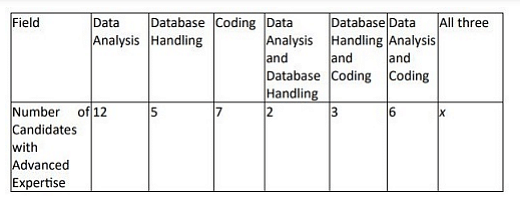
- XAT - 2024
- Data Interpretation