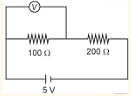
In given circuit, reading of voltmeter is 1 V, then resistance of
- 100 Ω
- 200 Ω
- 200√5 Ω
- 50 Ω
The Correct Option is A
Solution and Explanation
This problem requires determining the internal resistance of a voltmeter. The scenario involves a series circuit with a 5 V source, a 200 Ω resistor, and a 100 Ω resistor. A voltmeter is connected in parallel with the 100 Ω resistor, and its reading is provided.
Underlying Principles:
The solution is based on fundamental electric circuit principles:
1. Ohm's Law: \( V = IR \), where \( V \) is voltage, \( I \) is current, and \( R \) is resistance.
2. Series Circuits: In a series circuit, the total voltage is the sum of individual voltage drops, and the current is uniform throughout.
3. Parallel Circuits: For two resistors \( R_a \) and \( R_b \) in parallel, the equivalent resistance \( R_p \) is calculated as:
\[\frac{1}{R_p} = \frac{1}{R_a} + \frac{1}{R_b} \quad \text{or} \quad R_p = \frac{R_a R_b}{R_a + R_b}\]A voltmeter, characterized by its internal resistance, is always connected in parallel to measure voltage across a component.
Solution Steps:
Step 1: Define Given Circuit Parameters.
Source voltage, \( V_s = 5 \, \text{V} \).
Resistor 1, \( R_1 = 100 \, \Omega \).
Resistor 2, \( R_2 = 200 \, \Omega \).
Voltmeter reading across \( R_1 \), \( V_m = 1 \, \text{V} \).
Let the voltmeter's resistance be \( R_V \).
Step 2: Calculate Voltage Across the 200 Ω Resistor.
The parallel combination of the voltmeter and the 100 Ω resistor is in series with the 200 Ω resistor. The sum of voltages across these series elements equals the source voltage.
\[V_s = V_m + V_{200}\]Substituting known values:
\[5 \, \text{V} = 1 \, \text{V} + V_{200}\]Therefore:
\[V_{200} = 4 \, \text{V}\]Step 3: Determine the Total Circuit Current.
This total current \( I \) flows through the 200 Ω resistor. Applying Ohm's Law:
\[I = \frac{V_{200}}{R_2} = \frac{4 \, \text{V}}{200 \, \Omega} = 0.02 \, \text{A}\]Step 4: Compute the Equivalent Resistance of the Parallel Combination.
The voltmeter reading \( V_m = 1 \, \text{V} \) is the voltage across the parallel arrangement of \( R_1 \) and \( R_V \). Let this equivalent resistance be \( R_p \). Using Ohm's Law for this parallel section:
\[V_m = I \times R_p\]Substituting values:
\[1 \, \text{V} = (0.02 \, \text{A}) \times R_p\]Solving for \( R_p \):
\[R_p = 50 \, \Omega\]Step 5: Calculate the Voltmeter's Resistance \( R_V \).
The equivalent parallel resistance \( R_p \) is derived from \( R_1 \) and \( R_V \) in parallel:
\[R_p = \frac{R_1 \times R_V}{R_1 + R_V}\]Substitute the known values:
\[50 = \frac{100 \times R_V}{100 + R_V}\]Final Calculation and Outcome:
Solving the equation for \( R_V \):
\[50(100 + R_V) = 100 R_V\]\[5000 + 50 R_V = 100 R_V\]\[5000 = 50 R_V\]\[R_V = 100 \, \Omega\]The resistance of the voltmeter is determined to be 100 Ω.
Top Questions on Heat Transfer
- Sphere of color black, red, white, and yellow are heated to the same temperature. The decreasing order of cooling is:
- MHT CET - 2024
- Physics
- Heat Transfer
- What is heat transfer?
- CBSE Class X - 2024
- Food Production
- Heat Transfer
- Heat transferred through the movement of molecules in air or liquid is:
- CBSE Class X - 2024
- Food Production
- Heat Transfer
- How conduction helps in heat transference?
- CBSE Class X - 2024
- Food Production
- Heat Transfer
- Want to practice more? Try solving extra ecology questions todayView All Questions
