Question:hard
In a game, a "word" is any combination of at least five letters of the English alphabet (the word does not have to have a meaning). A "sentence" in this game consists of exactly six such words, and it must satisfy all of the following rules:
1. The six words are written from left to right on a single line, in strictly increasing alphabetical order.
2. The sentence may start with any word. Each successive word is obtained from the word right before it by applying exactly ONE of three operations: deleting one letter, adding one letter, or replacing one letter with another letter.
3. At most three of the six words can begin with the same letter.
4. Apart from the first word, every word must be formed using an operation different from the one used to form the word immediately before it (so the same operation can never be used twice in a row).
If "clean" is the first word in a sentence and "learn" is another word in the sentence, then which one of the following is a complete and accurate list of the positions "learn" could occupy?
In a game, a "word" is any combination of at least five letters of the English alphabet (the word does not have to have a meaning). A "sentence" in this game consists of exactly six such words, and it must satisfy all of the following rules:
1. The six words are written from left to right on a single line, in strictly increasing alphabetical order.
2. The sentence may start with any word. Each successive word is obtained from the word right before it by applying exactly ONE of three operations: deleting one letter, adding one letter, or replacing one letter with another letter.
3. At most three of the six words can begin with the same letter.
4. Apart from the first word, every word must be formed using an operation different from the one used to form the word immediately before it (so the same operation can never be used twice in a row).
If "clean" is the first word in a sentence and "learn" is another word in the sentence, then which one of the following is a complete and accurate list of the positions "learn" could occupy?
1. The six words are written from left to right on a single line, in strictly increasing alphabetical order.
2. The sentence may start with any word. Each successive word is obtained from the word right before it by applying exactly ONE of three operations: deleting one letter, adding one letter, or replacing one letter with another letter.
3. At most three of the six words can begin with the same letter.
4. Apart from the first word, every word must be formed using an operation different from the one used to form the word immediately before it (so the same operation can never be used twice in a row).
If "clean" is the first word in a sentence and "learn" is another word in the sentence, then which one of the following is a complete and accurate list of the positions "learn" could occupy?
Show Hint
First find the fewest moves needed to turn "clean" into "learn" - that fixes the earliest possible position; later positions come from inserting extra detour words.
Updated On: Jul 10, 2026
- Third
- Second, third, fourth
- Third, fourth
- Third, fourth, fifth, sixth
Show Solution
The Correct Option is D
Solution and Explanation
A faster way to see this is to first fix the SHORTEST possible distance between "clean" and "learn", then argue that any LONGER distance is also achievable simply by inserting extra detour words in between, since the game never limits how many extra words can sit between two words as long as the total sentence stays six words long and the rules keep holding.
- Minimum distance: "clean" (c-l-e-a-n) needs its leading "c" deleted to give "lean" (l-e-a-n), and then an "r" added before the last letter to give "learn" (l-e-a-r-n). That is two moves, so "learn" cannot be reached in just one move. It can never be the second word right after "clean"; the earliest it can appear is the third word.
- Can we always insert one extra detour word and still land on "learn"?: yes. Between "clean" and "lean" we can slip in an extra word by using a different first move (for example replacing a letter instead of deleting) and then completing the same delete-then-add journey with one more step folded in, while keeping every neighbouring pair of operations different and every word alphabetically ahead of the last.
- How far can this stretch?: since the full sentence has only six words total, and "clean" occupies the first slot, there are at most five slots left for "learn" to land in (positions two through six). Position two is already ruled out. That leaves positions three, four, five, and six as candidates, and a genuine word chain can be built for every one of them.
- Why not just "third" or "third, fourth"?: those under-count the answer, because once a valid detour chain exists for one later position, a similar detour pushes "learn" further out too, all the way to the last available slot, position six.
Let's summarize:
- "Learn" is always at least two moves from "clean", so positions one and two are impossible.
- Extra detour words, each using a fresh operation type, can delay "learn" to any later slot.
- With six words total, the only slots left after ruling out one and two are third, fourth, fifth, and sixth, and all four are genuinely reachable.
So the complete and accurate list of positions "learn" can occupy is third, fourth, fifth, and sixth.
Was this answer helpful?
0
Top Questions on Verbal Reasoning
- If 'WATER' is coded as 'YCVGT', how will 'FIRE' be coded in that language?
- Karnataka PGCET - 2026
- Logical Reasoning
- Verbal Reasoning
- It is desirable to be able to distinguish between strong arguments and weak arguments. Strong arguments are those which are both important and directly related to the question. Weak arguments are those which are of minor importance and also may not be directly related to the question or may be related to trivial aspects of the question. The Statement below is followed by two arguments numbered I and II. You have to decide which of the arguments is a strong argument and which is a weak argument.
Statement: Should larger the sample size minimize the experimental error?
Arguments: I. Yes, this is one of the ways to improve the efficiency of the estimator. II. No, sample size is not at all a matter.- Karnataka PGCET - 2026
- Logical Reasoning
- Verbal Reasoning
- Which is NOT an advantage of writing Business letter?
- Karnataka PGCET - 2026
- General Aptitude
- Verbal Reasoning
- In a game, a "word" is any combination of at least five letters of the English alphabet (the word does not have to have a meaning). A "sentence" in this game consists of exactly six such words, and it must satisfy all of the following rules:
1. The six words are written from left to right on a single line, in strictly increasing alphabetical order.
2. The sentence may start with any word. Each successive word is obtained from the word right before it by applying exactly ONE of three operations: deleting one letter, adding one letter, or replacing one letter with another letter.
3. At most three of the six words can begin with the same letter.
4. Apart from the first word, every word must be formed using an operation different from the one used to form the word immediately before it (so the same operation can never be used twice in a row).
Which one of the following could be a sentence in the word game?- XAT - 2008
- Decision Making
- Verbal Reasoning
- Want to practice more? Try solving extra ecology questions todayView All Questions
Questions Asked in XAT exam
Applicants have been shortlisted for interviews for some data analyst positions. Some of the applicants have advanced expertise in one or more fields among the following: data analysis, database handling and coding. The numbers of applicants with different advanced expertise are given in the 2 × 8 table below.
The number of applicants with advanced expertise in all three fields is given as x in the table, where x is a non-negative integer.
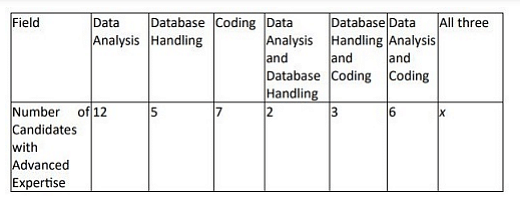
The number of applicants with advanced expertise in all three fields is given as x in the table, where x is a non-negative integer.
- XAT - 2024
- Data Interpretation